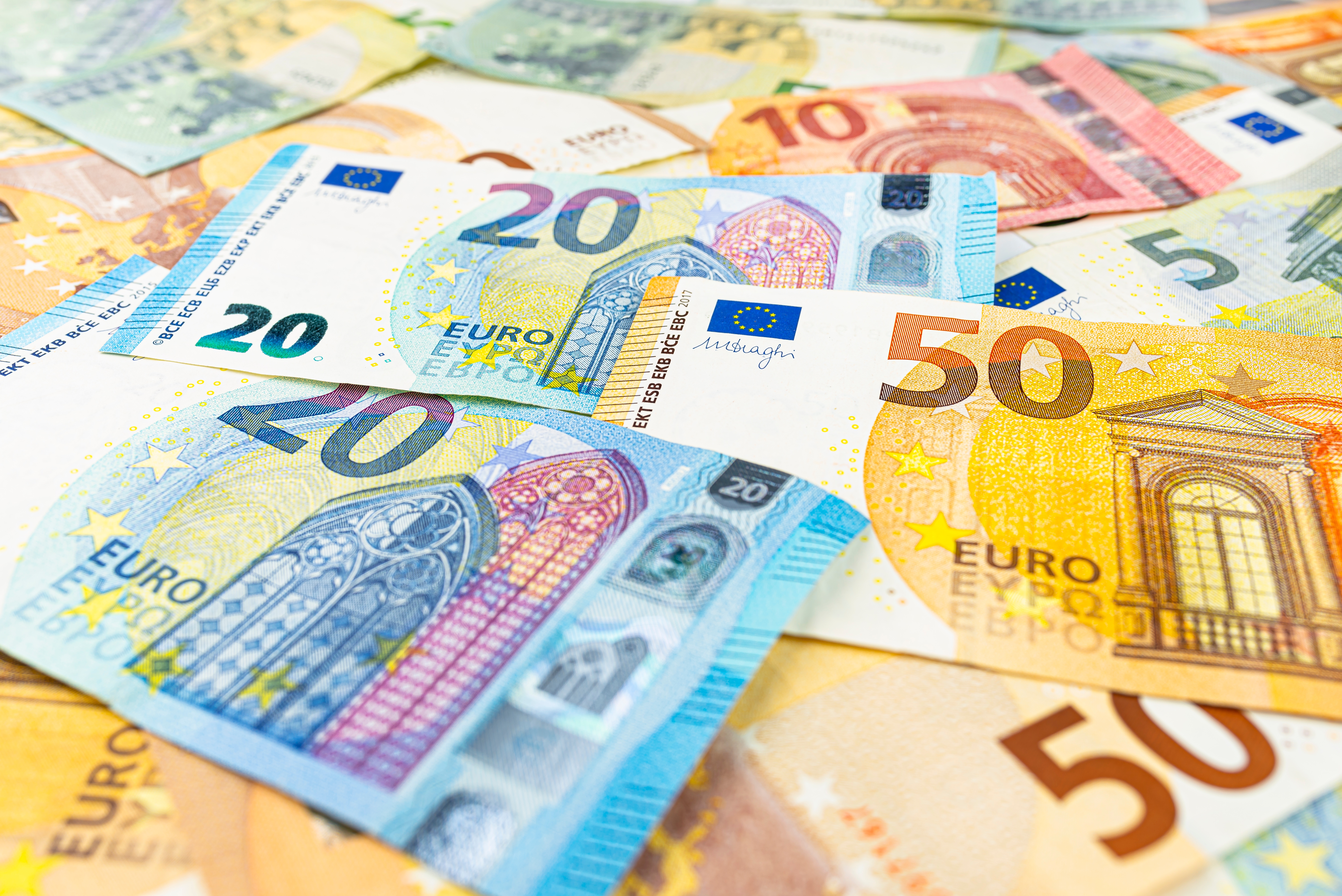
Europe uses over a dozen different currencies — from the euro shared by 21 countries to the British pound, Swiss franc and a handful of Scandinavian crowns. Whether you are sending money to family in the UK, planning a trip across the continent or simply curious about the currencies in your neighbourhood, here is the complete guide to every European currency — with the fun facts that make each one worth knowing. This guide also includes a comprehensive European currencies list.
The Euro — Europe’s shared currency
🇪🇺 Eurozone — Euro (EUR) €
Symbol: € | Code: EUR | Subdivisions: 1 euro = 100 cents
The euro is the world’s second most traded currency — used by 21 countries and approximately 350 million people across the European Union. It is managed by the European Central Bank (ECB) in Frankfurt.
Eurozone members (21 countries as of 2026): Austria, Belgium, Bulgaria (joined 1 January 2026), Croatia, Cyprus, Estonia, Finland, France, Germany, Greece, Ireland, Italy, Latvia, Lithuania, Luxembourg, Malta, Netherlands, Portugal, Slovakia, Slovenia, Spain.
Fun facts:
- The € symbol was designed by a team at the European Commission — it was inspired by the Greek letter epsilon (ε), with two horizontal lines representing stability. Thirteen design proposals were submitted; the Commission chose the design but has never officially credited any individual designer
- Euro banknotes feature bridges and archways on them — but the bridges are fictional, not depicting any real European bridge. This was deliberate — using real landmarks would have implied favouritism toward particular countries. In 2016, the Dutch artist Robin Stam revealed that he had built real versions of the fictional bridges in the Netherlands, and they quickly became tourist attractions
- <cite index=”59-1″>Bulgaria adopted the euro on 1 January 2026, becoming the 21st Eurozone member — its former currency, the lev, means “lion” in old Bulgarian; the lev had been pegged to the euro for years before the switch</cite>
- Euro coins are the same on one side across all countries (showing the denomination) but each country designs its own reverse — meaning a €1 coin from Germany looks different from a €1 coin from Ireland, but both are valid across the entire Eurozone
- The euro is not used in all EU countries — Denmark, Sweden, Poland, Czech Republic, Hungary and Romania are EU members that have not (yet) adopted the euro
Non-EU countries that officially use the euro: Monaco, San Marino, Vatican City (by treaty) and Andorra (by agreement) — none of these are EU members but all use the euro legally.
Countries that use the euro without formal agreement: Kosovo and Montenegro use the euro as their de facto currency without any formal treaty — one of the quirks of post-Yugoslav monetary history.
Western Europe
🇬🇧 United Kingdom — British Pound Sterling (GBP) £
Symbol: £ | Code: GBP | Subdivisions: 1 pound = 100 pence
Fun facts:
- The pound sterling is the world’s oldest currency still in use — it has been in continuous circulation since approximately 775 CE, over 1,200 years; the word “sterling” derives from the Old English steorling, meaning “little star” — a reference to the small star design on early Norman coins
- Before decimalisation on 15 February 1971 (“Decimal Day”), the British pound was divided into 20 shillings, each of 12 pence — a system so complex that children were taught it as a mathematics subject; the old system had 240 pence per pound (12 × 20)
- Scotland, Northern Ireland and the Channel Islands each issue their own pound banknotes — Scottish banknotes are legal currency but not technically legal tender in England; this causes occasional confusion at English shops
- The £1 coin introduced in 2017 has 12 sides — described by the Royal Mint as “the most secure coin in the world” at launch; it replaced the round £1 coin, approximately 1 in 30 of which were counterfeit
- After Brexit, the Bank of England began redesigning banknotes to feature King Charles III — the first UK monarch change on currency since 1952
- The pound is the fifth most traded currency in the world and one of the world’s primary reserve currencies
🇨🇭 Switzerland — Swiss Franc (CHF) Fr
Symbol: Fr (or CHF) | Code: CHF | Subdivisions: 1 franc = 100 centimes/Rappen/centesimi/rap
Fun facts:
- Switzerland has four official languages — German, French, Italian and Romansh — and the Swiss franc has four names for its subdivision: Rappen (German), centime (French), centesimo (Italian) and rap (Romansh)
- The Swiss franc is the only currency in the world whose ISO code begins with the country’s name in none of its official languages — Switzerland’s Latin name is Confoederatio Helvetica, which is why its ISO code is CHF (not SWF or SCF)
- Switzerland is not in the European Union — and decisively voted to keep the Swiss franc rather than adopt the euro. In a 2023 referendum, over 70% of Swiss voters rejected euro adoption
- In January 2015, the Swiss National Bank shocked global markets by unexpectedly abandoning its peg to the euro — the franc surged 20-30% in minutes, causing one of the most violent currency moves in modern history
- Swiss banknotes are printed vertically — one of very few currencies in the world printed portrait (vertical) rather than landscape (horizontal)
- The Swiss franc is considered the world’s premier “safe haven” currency — in times of global uncertainty, investors buy CHF
🇳🇴 Norway — Norwegian Krone (NOK) kr
Symbol: kr | Code: NOK | Subdivisions: 1 krone = 100 øre (øre coins discontinued 2012)
Fun facts:
- Krone means “crown” in Norwegian — the same meaning as the Swedish krona, Danish krone, Czech koruna and Icelandic króna; all descended from the same Scandinavian monetary union of the 19th century
- Norway is not in the European Union — it rejected EU membership in referendums in 1972 and 1994 — yet participates in the European Economic Area; the krone has remained Norway’s currency throughout
- Norway’s krone is backed by one of the world’s largest sovereign wealth funds — the Government Pension Fund Global (also called the Oil Fund), worth over USD $1.7 trillion; this makes the NOK one of the most resource-backed currencies in the world
- The 1 and 2 øre coins were discontinued in 2012 — all cash prices are now rounded to the nearest krone; the øre lives on only in electronic transactions
🇸🇪 Sweden — Swedish Krona (SEK) kr
Symbol: kr | Code: SEK | Subdivisions: 1 krona = 100 öre (öre not in physical circulation)
Fun facts:
- Sweden is one of the most cashless societies in the world — by 2023, fewer than 10% of retail transactions used physical cash; the Riksbank (Sweden’s central bank) has responded by investigating a digital e-krona to ensure citizens always have access to a central bank currency
- Sweden was the first country in Europe to introduce banknotes — in 1661, Johan Palmstruch of the Stockholm Banco issued Europe’s first paper banknotes; they proved so popular that the bank overprinted them and went bankrupt in 1664
- Sweden is an EU member but has not adopted the euro — in a 2003 referendum, 56% of Swedes voted against joining the Eurozone; unlike Denmark, Sweden has no opt-out treaty and is technically obliged to join eventually, but continues to delay
🇩🇰 Denmark — Danish Krone (DKK) kr
Symbol: kr | Code: DKK | Subdivisions: 1 krone = 100 øre
Fun facts:
- Denmark has a formal opt-out from adopting the euro — negotiated in 1992 after Danish voters rejected the Maastricht Treaty in a referendum; Denmark is the only EU country with a permanent legal exemption from the single currency
- The Danish krone is pegged to the euro at approximately 7.46 DKK per 1 EUR — within a very narrow band of ±2.25%; in practice, Denmark effectively follows ECB monetary policy without being in the Eurozone
- The Faroe Islands and Greenland (both Danish territories) use the Danish krone — though the Faroe Islands also issue their own Faroese króna banknotes at 1:1 parity with the DKK
🇮🇸 Iceland — Icelandic Króna (ISK) kr
Symbol: kr | Code: ISK | Subdivisions: 1 króna = 100 aurar (not in use)
Fun facts:
- Iceland’s króna collapsed spectacularly during the 2008 global financial crisis — the country’s three largest banks failed simultaneously, and the króna lost approximately 50% of its value; Iceland famously let its banks fail rather than bailing them out and recovered faster than most economists expected
- Iceland is not in the European Union — it applied for membership in 2009 but withdrew its application in 2015; the króna remains its currency
- The króna (the Icelandic word for crown) shares its name with the Norwegian, Swedish, Danish and Czech currencies — all from the same Scandinavian monetary tradition
Central and Eastern Europe
🇵🇱 Poland — Polish Złoty (PLN) zł
Symbol: zł | Code: PLN | Subdivisions: 1 złoty = 100 groszy
Fun facts:
- Złoty means “golden” in Polish — from the gold coins that circulated in medieval Poland; the modern Polish złoty was reintroduced in 1995 after hyperinflation, replacing the old złoty at 10,000 old złoty = 1 new złoty
- Poland is an EU member but one of the largest economies in Europe to have not adopted the euro — there is no official target date for Poland to join the Eurozone
- The 1 grosz coin — the smallest denomination — costs more to produce than it is worth; Poland periodically debates abolishing it, but it remains in circulation
- Poland’s economy is one of the strongest in Central Europe, and the złoty has been one of the more stable currencies in the region
🇨🇿 Czech Republic — Czech Koruna (CZK) Kč
Symbol: Kč | Code: CZK | Subdivisions: 1 koruna = 100 haléřů
Fun facts:
- Koruna means “crown” in Czech — the same meaning as the Norwegian krone, Swedish krona and Danish krone
- The Czech Republic is an EU member but has repeatedly delayed adopting the euro; there is strong public resistance to giving up the koruna
- In 2013, the Czech National Bank launched an unprecedented currency intervention — it sold massive amounts of koruna to weaken the currency and combat deflation; the intervention lasted nearly four years, one of the longest sustained currency interventions in European history
🇭🇺 Hungary — Hungarian Forint (HUF) Ft
Symbol: Ft | Code: HUF | Subdivisions: 1 forint = 100 fillér (not in use)
Fun facts:
- The forint was introduced in 1946 after one of the worst hyperinflations in world history — post-war Hungary’s pengő currency inflated so rapidly that prices doubled every 15 hours; the exchange rate reached 400 octillion (4 × 10²⁹) pengő per 1 US dollar at its peak; the forint was introduced at 400 octillion pengő per 1 forint — the largest redenomination in history
- Forint derives from the city of Florence (Fiorino) — the medieval gold coin of Florence that was used across Europe for centuries
- Hungary is an EU member but has not adopted the euro; the government has stated no target date for euro adoption
🇷🇴 Romania — Romanian Leu (RON) lei
Symbol: lei | Code: RON | Subdivisions: 1 leu = 100 bani
Fun facts:
- Leu means “lion” in Romanian — the same meaning as the Bulgarian lev (now replaced by the euro) and the Moldovan leu; all three currencies share a name reflecting the lion imagery on the old Ottoman coins that circulated in the region
- Romania redenominated its currency in 2005 — 1 new leu replaced 10,000 old lei; the old lei had been severely devalued by decades of communist-era inflation
- Romania is an EU member and is expected to adopt the euro eventually — it has met some but not all of the economic criteria
🇲🇩 Moldova — Moldovan Leu (MDL) lei
Symbol: lei | Code: MDL | Subdivisions: 1 leu = 100 bani
Fun facts:
- Moldova’s leu shares the same name — and the same “lion” etymology — as the Romanian leu; Moldova uses MDL to distinguish it from Romania’s RON
- Moldova is the poorest country in Europe by GDP per capita — and one of the most remittance-dependent; remittances from Moldovans working in EU countries account for over 15% of GDP
🇷🇸 Serbia — Serbian Dinar (RSD) din
Symbol: din | Code: RSD | Subdivisions: 1 dinar = 100 para
Fun facts:
- The dinar is one of the oldest monetary names in the world — derived from the Roman denarius coin; the name has been used across the Balkans for over 700 years
- The dinar symbol shares its name with currencies in several other countries — Algeria, Bahrain, Iraq, Jordan, Kuwait, Libya and Tunisia all call their currency the dinar; the Serbian dinar (RSD) is distinguished by its ISO code
🇧🇦 Bosnia and Herzegovina — Convertible Mark (BAM) KM
Symbol: KM | Code: BAM | Subdivisions: 1 mark = 100 feninga
Fun facts:
- The convertible mark has been pegged to the euro at exactly 1.95583 BAM per 1 EUR since 1997 — the same rate as the old German mark to euro conversion; the BAM is essentially a currency board currency backed by euro reserves
- Bosnia’s currency authority is unusual — the Central Bank of Bosnia and Herzegovina cannot lend money to the government or conduct open market operations; it functions purely as a currency board, maintaining the peg
🇦🇱 Albania — Albanian Lek (ALL) L
Symbol: L | Code: ALL | Subdivisions: 1 lek = 100 qindarka
Fun facts:
- The lek is named after Alexander the Great (Aleksandër in Albanian) — whose image appeared on early lek coins
- Albania was one of the most isolated economies in the world under communist rule (1944-1990); the lek was a completely non-convertible currency for decades
🇲🇰 North Macedonia — Macedonian Denar (MKD) ден
Symbol: ден | Code: MKD | Subdivisions: 1 denar = 100 deni
Fun facts:
- Like Serbia’s dinar, the denar’s name comes from the ancient Roman denarius
- North Macedonia’s denar has been pegged to the euro since 2002 — maintaining monetary stability while the country pursues EU membership
Scandinavia and Nordic Countries
🇫🇮 Finland — Euro (EUR) €
Finland was one of the first wave of Eurozone members — it adopted the euro on 1 January 1999 for transactions and introduced euro coins and banknotes on 1 January 2002. Finland’s old currency was the Finnish markka (FIM).
Fun fact: Finland’s last markka coin — a 1 markka piece — featured a flying whooper swan, Finland’s national bird; numismatists consider it one of the most beautifully designed coins of the 20th century.
British Isles
🇮🇪 Ireland — Euro (EUR) €
Ireland adopted the euro in 2002, replacing the Irish pound (punt).
Fun fact: The Irish pound featured a woodcock on its reverse — one of several animals on Irish coins that reflected the country’s Celtic relationship with nature. The harp on Irish euro coins is the only national symbol that carried over from the punt to the euro.
🇨🇭 Liechtenstein — Swiss Franc (CHF) Fr
Liechtenstein uses the Swiss franc — it has a customs and monetary union with Switzerland.
Fun fact: Liechtenstein is one of only two doubly landlocked countries in the world (surrounded entirely by landlocked countries) — and has no central bank of its own; its monetary policy is entirely determined by Switzerland.
Microstates
🇻🇦 Vatican City — Euro (EUR) €
Vatican City issues its own euro coins — featuring the Pope’s portrait — which are highly sought by collectors. A Vatican €2 coin can sell for hundreds of euros on the secondary market.
🇸🇲 San Marino — Euro (EUR) €
San Marino also issues its own euro coins with unique designs — also collector favourites.
🇲🇨 Monaco — Euro (EUR) €
Monaco’s euro coins feature the Grimaldi royal family and are among the rarest in circulation.
🇦🇩 Andorra — Euro (EUR) €
Andorra adopted the euro formally in 2014 after years of informal use. Its coins feature the Andorran coat of arms.
Currencies of the former Soviet Union in Europe
🇷🇺 Russia — Russian Ruble (RUB) ₽
Symbol: ₽ | Code: RUB | Subdivisions: 1 ruble = 100 kopeks
Fun facts:
- The ruble is one of the world’s oldest currencies — it has existed in some form since the 13th century; ruble derives from the Russian verb rubit (to chop) — a reference to chopping off pieces of silver ingot for payment
- The ruble symbol ₽ was only officially adopted in 2013 — before that, the ruble had no unique symbol and was written as “руб” or “р”
- Russia’s ruble has been under severe pressure since international sanctions were imposed following the 2022 invasion of Ukraine — the ruble lost significant value in 2022 before recovering partially due to capital controls; it remains heavily managed by the Central Bank of Russia
🇺🇦 Ukraine — Ukrainian Hryvnia (UAH) ₴
Symbol: ₴ | Code: UAH | Subdivisions: 1 hryvnia = 100 kopiyok
Fun facts:
- The hryvnia was introduced in 1996 — replacing the interim karbovanets currency that had itself replaced the Soviet ruble after independence in 1991
- The hryvnia symbol ₴ was designed to evoke the Cyrillic letter Г (heh) with a double strikethrough — representing the currency’s Ukrainian identity
- The hryvnia is named after a medieval monetary unit — the hryvnya was a weight of silver used in Kyivan Rus’ trading from the 11th century; it is one of the oldest monetary concepts in Eastern Europe
- Ukraine’s hryvnia came under significant pressure following Russia’s full-scale invasion in 2022 — the National Bank of Ukraine has maintained a managed exchange rate with significant international support
🇧🇾 Belarus — Belarusian Ruble (BYN) Br
Symbol: Br | Code: BYN | Subdivisions: 1 ruble = 100 kopecks
Fun facts:
- Belarus redenominated its ruble in 2016 — 1 new ruble = 10,000 old rubles; the old 100,000 ruble note became a 10 ruble note overnight
- The Belarusian ruble shares its name with the Russian ruble but is a completely separate currency
🇬🇪 Georgia — Georgian Lari (GEL) ₾
Symbol: ₾ | Code: GEL | Subdivisions: 1 lari = 100 tetri
Fun facts:
- The lari symbol ₾ was designed by artist Malkhaz Shvelidze — it evokes the Georgian script letter las (ლ) with a horizontal strikethrough, making it one of the few currency symbols explicitly designed to reflect a non-Latin alphabet
- Lari is an archaic Georgian word for hoard or property — reflecting the currency’s deep cultural roots
🇦🇲 Armenia — Armenian Dram (AMD) ֏
Symbol: ֏ | Code: AMD | Subdivisions: 1 dram = 100 luma
Fun facts:
- The Armenian dram symbol ֏ is unique — derived from the Armenian script letter dram (Դ) combined with a horizontal bar; it is one of the few currency symbols derived entirely from a non-Latin, non-Greek script
- Dram is the Armenian word for a historical silver coin — from the ancient Greek drachma
🇦🇿 Azerbaijan — Azerbaijani Manat (AZN) ₼
Symbol: ₼ | Code: AZN | Subdivisions: 1 manat = 100 qəpik
Fun facts:
- Azerbaijan redenominated in 2006 — 1 new manat = 5,000 old manat; the new manat was introduced to signal economic stability from oil revenues
- The manat symbol ₼ resembles the letter M with a horizontal bar — a simple, elegant design adopted when the new manat was introduced
Notable European currency facts
Oldest currency in continuous use: The British pound sterling — over 1,200 years.
Most widely used: The euro — 21 countries, approximately 350 million people.
Worst hyperinflation in history: Hungary’s pengő (1945-1946) — prices doubled every 15 hours; the forint replaced it at 400 octillion pengő per 1 forint.
Most dramatic single-day move: The Swiss franc on 15 January 2015 — surged 20-30% in minutes when the SNB abandoned its euro peg.
Most cashless: Sweden — fewer than 10% of retail transactions use physical cash.
Newest Eurozone member: Bulgaria — joined 1 January 2026.
Currencies that share a name meaning “crown”: Norwegian krone, Swedish krona, Danish krone, Czech koruna, Icelandic króna — all from the same Scandinavian monetary union tradition.
Currencies that share a name meaning “lion”: Romanian leu, (former) Bulgarian lev — from Ottoman-era coin imagery.
FAQs (frequently asked questions)
How many countries use the euro in 2026?
21 countries — Bulgaria joined on 1 January 2026, becoming the newest Eurozone member.
Which EU countries do not use the euro?
Denmark, Sweden, Poland, Czech Republic, Hungary and Romania are EU members that have not adopted the euro. Denmark has a permanent opt-out; the others are expected to join eventually.
What is the world’s oldest currency still in use?
The British pound sterling — in continuous use since approximately 775 CE, over 1,200 years.
Which European currency suffered the worst hyperinflation?
Hungary’s pengő (1945-1946) — the worst hyperinflation in recorded history. Prices doubled every 15 hours at peak. The forint replaced it at 400 octillion pengő per forint.
Why does Switzerland use CHF and not SWF?
Switzerland’s official Latin name is Confoederatio Helvetica — giving rise to CH as the country code and CHF as the currency code. The same Latin name gives us the “CH” on Swiss number plates.
Are Scottish banknotes legal tender in England?
No — Scottish banknotes are legal currency (and must be accepted by law in Scotland) but are not technically legal tender in England. In practice, many English businesses accept them, but they are not legally obliged to.
What it means for your transfers
Sending money to family in the UK, Europe or anywhere across the OrbitRemit network is fast, affordable and transparent — with the rate locked at confirmation and no hidden margins.
GBP transfers from Australia and New Zealand are fee-free with OrbitRemit.
Currency information is for general reference. Exchange rates fluctuate. Last updated August 2026.
Sources: wechselkurse-vergleich.de — European Currencies 2026 (May 3, 2026) | geofungames.com — Currencies of Europe 2026 | Wikipedia — List of currencies in Europe | eurochange.co.uk — World currency symbols 2026 (November 2025) | GeoFunGames — European currencies (confirmed Bulgaria euro adoption 1 January 2026)


