When is Tihar in 2026?
Tihar 2026 runs from Saturday 7 November to Wednesday 11 November 2026.
| Day | Festival | Date |
|---|---|---|
| Day 1 | Kaag Tihar (crow worship) | Saturday 7 November 2026 |
| Day 2 | Kukur Tihar and Laxmi Puja (dog worship and Goddess Lakshmi) | Sunday 8 November 2026 |
| Day 3 | Gai Tihar (cow worship) | Monday 9 November 2026 |
| Day 4 | Govardhan Puja / Mha Puja / Goru Tihar | Tuesday 10 November 2026 |
| Day 5 | Bhai Tika (brothers and sisters) | Wednesday 11 November 2026 |
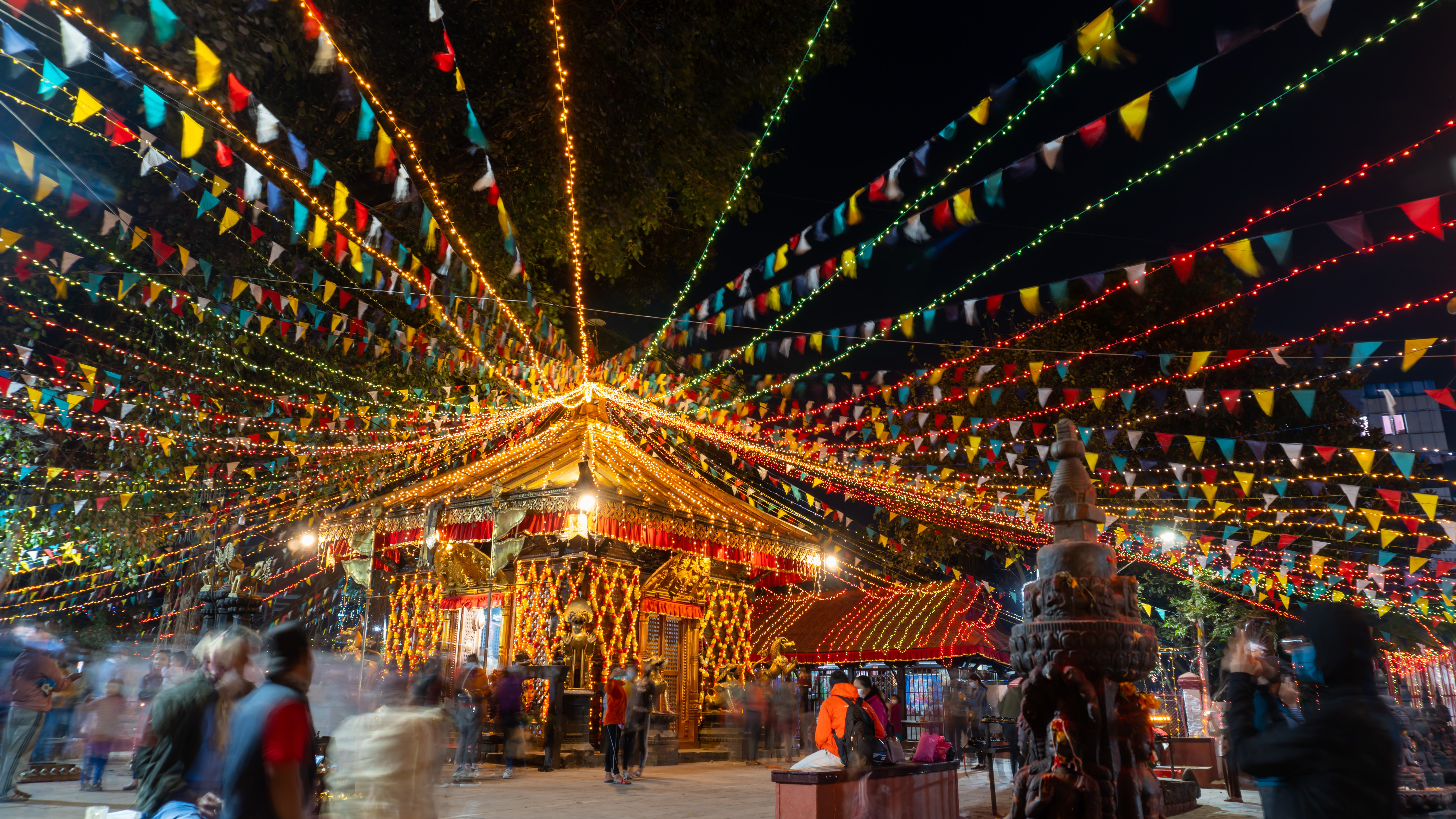
The main night of lights – Laxmi Puja – falls on Sunday 8 November 2026, when homes and streets are lit with diyo (oil lamps), candles and string lights to welcome Goddess Laxmi.
What is Tihar?
Tihar is Nepal’s five-day Festival of Lights and the second most celebrated festival in Nepal after Dashain. It is also known as Deepawali or Yama Panchak, and is the Nepali equivalent of Diwali – sharing the same main night of Laxmi Puja and the same central themes of light over darkness and good over evil, but with distinctly Nepali traditions, including the worship of crows, dogs, cows and oxen across the first four days.
What makes Tihar unique among all Hindu festivals is its honouring of animals as sacred beings deserving worship, gratitude and respect. Each of the first four days is dedicated to a different creature or entity before the festival concludes with Bhai Tika, a celebration of the bond between siblings.
Tihar is also known as Swanti in the Newar community of the Kathmandu Valley, where the festival incorporates additional rituals specific to Newar culture, including Mha Puja – a ritual of self-worship and self-affirmation – on the fourth day.
The five days of Tihar explained
Day 1 – Kaag Tihar (Saturday 7 November 2026)
The festival opens with Kaag Tihar – the day of the crow. Crows are considered the messengers of Yama, the Hindu god of death, and are believed to bring news from the afterlife. On this day, food offerings (typically rice, sweets and milk) are placed on rooftops before sunrise for crows to eat. Hearing a crow call near the home is considered auspicious; a crow cawing before sunrise on Kaag Tihar is believed to signal good news for the household.
Day 2 – Kukur Tihar and Laxmi Puja (Sunday 8 November 2026)
The second day is one of the most beloved of Tihar – Kukur Tihar, the day of the dog. Dogs are honoured as guardians, loyal companions and, in Hindu tradition, the sacred vehicle of Bhairava and the gatekeepers of the afterlife. On Kukur Tihar, dogs are garlanded with marigolds, given a tikka (red mark) on their foreheads, fed special food and celebrated throughout the day. Working dogs, street dogs and family pets are all honoured equally.
The evening of Day 2 is also when Laxmi Puja is performed – the most important ritual of Tihar. As darkness falls, families light diyo (small clay oil lamps), candles and electric string lights throughout and around the home to invite Goddess Laxmi, the deity of wealth and prosperity. Rangoli patterns are drawn at the entrance to guide Laxmi into the home. Puja (prayer) is offered with flowers, incense and sweets, and fireworks light the sky across Nepal.
This is the night equivalent to the main Diwali night celebrated in India and by Indian communities worldwide.
Day 3 – Gai Tihar (Monday 9 November 2026)
The third day honours the cow – considered in Hinduism as a symbol of prosperity, nourishment and spiritual guidance. Cows are given garlands of marigolds, a tikka and offerings of special food. The cow is also the national animal of Nepal, giving Gai Tihar an additional layer of national significance. In the evenings, the tradition of Deusi Bhailo begins – groups of young people go from house to house singing traditional Tihar songs and performing dances, receiving sweets, money and blessings in return. Deusi (sung by boys) and Bhailo (sung by girls) are two of the most distinctive sounds of the Tihar season.
Day 4 – Govardhan Puja / Mha Puja / Goru Tihar (Tuesday 10 November 2026)
The fourth day is the most varied, with different communities celebrating different aspects:
Govardhan Puja: Commemorates Lord Krishna lifting the Govardhan Hill to shelter people and cattle from Indra’s storm. Celebrated across Hindu communities.
Mha Puja (Newari tradition): Unique to the Newar community of the Kathmandu Valley. Mha Puja is a ritual of self-worship – a celebration of one’s own life, body and existence. Participants create a mandala representing themselves and offer prayers to their own life force. It is also celebrated as the Newari New Year (Nepal Sambat).
Goru Tihar: The worship of oxen, which are honoured for their role in agriculture and their service to farming families.
Day 5 – Bhai Tika (Wednesday 11 November 2026)
The final and most emotionally resonant day of Tihar is Bhai Tika – the celebration of the bond between brothers and sisters. Sisters apply a special multi-coloured tikka (made from oil, yoghurt and a mixture of coloured powders) to their brothers’ foreheads, place a garland of marigolds and makhamali (a velvety flower used only for Bhai Tika) around their necks, and pray for their long life, health and success. Brothers give gifts to their sisters in return.
The ritual of Bhai Tika is connected to the story of Yama, the god of death, visiting his sister Yamuna on this day. Yamuna performed the tikka ritual for her brother, and Yama was so moved that he granted her the wish that any brother whose sister performs Bhai Tika would be protected from untimely death. Bhai Tika is therefore considered one of the most auspicious and protective rituals in the Nepali calendar.
Tihar traditions
Diyo and lights: The defining visual of Tihar is the diyo – a small clay oil lamp filled with mustard oil or ghee and lit with a cotton wick. Rows of diyo line windowsills, doorsteps, courtyards and rooftops. Combined with electric string lights and candles, Tihar transforms Nepali neighbourhoods into seas of light.
Rangoli: Intricate patterns drawn at the entrance of homes using coloured powder, rice flour, flower petals or chalk. Rangoli for Tihar traditionally incorporates the footprints of Laxmi, believed to guide the goddess into the home.
Deusi Bhailo: Traditional Tihar songs and performances where groups go house to house during the evenings of Days 3, 4 and 5. The tradition has a community fundraising element – many Deusi Bhailo groups collect donations for local causes.
Marigold garlands: Marigolds (sayapatri) are the flower of Tihar, used extensively for garlands, offerings and decorations. The makhamali flower is specifically used for Bhai Tika garlands on Day 5.
Sel roti: A traditional Nepali rice flour doughnut – crispy on the outside, soft inside – made in large quantities during Tihar and shared with neighbours, friends and family.
Tihar in Australia and New Zealand
Nepal is among the fastest-growing migrant communities in both Australia and New Zealand, with significant Nepali populations in Auckland, Wellington, Christchurch, Sydney, Melbourne, Brisbane and Perth. Tihar is celebrated across both countries through community events, temple gatherings and family celebrations.
Nepali community associations in Auckland, Sydney and Melbourne typically organise Tihar events featuring cultural performances, Deusi Bhailo, traditional food and Laxmi Puja. Many families also celebrate privately at home with diyo, Rangoli and the full five-day ritual calendar.
Sending money home for Tihar
Tihar is one of the most important gifting and celebration periods in the Nepali calendar. Families in Nepal prepare for the festival with new clothes, decorations, sel roti and sweets, and the Bhai Tika gifts exchanged between siblings are a significant part of the celebration. Many Nepali-Australians and Nepali-New Zealanders send money home to help family prepare for the festival.
Timing: Send before 7 November to ensure family has funds before Kaag Tihar begins. Bhai Tika gifts are exchanged on 11 November – allow 1-2 business days for delivery from the time of sending.
OrbitRemit – NZD to NPR:
- No flat transfer fee from Australia (AUD to NPR)
- NZD $4 flat fee from New Zealand (NZD to NPR)
- Delivery: typically 1-2 business days to Nepali bank accounts
- Exchange rate locked at the time of confirmation
FAQs (frequently asked questions)
When is Tihar in 2026?
Tihar 2026 runs from Saturday 7 November to Wednesday 11 November 2026. The main Laxmi Puja night falls on Sunday 8 November 2026.
What is the difference between Tihar and Diwali?
Tihar is Nepal’s version of Diwali – they share the same main night (Laxmi Puja on 8 November 2026), the same themes of light over darkness and the same five-day structure. Tihar is distinctive for its worship of crows, dogs, cows and oxen across the first four days, and for the Bhai Tika ritual on the final day. In the Newar community, Day 4 is celebrated as Mha Puja (self-worship) and Newari New Year.
What is Kukur Tihar?
The second day of Tihar, dedicated to the worship of dogs. Dogs are garlanded with marigolds, given a tikka on their forehead and offered special food. It is one of the most widely shared aspects of Tihar on social media worldwide.
What is Bhai Tika?
The fifth and final day of Tihar, celebrating the bond between siblings. Sisters apply a multi-coloured tikka to their brothers’ foreheads, garland them with marigolds and makhamali flowers, and pray for their long life. Brothers give gifts to their sisters.
What is Deusi Bhailo?
Traditional Tihar songs performed by groups going house to house during the evenings of Days 3-5. Deusi is sung by boys, Bhailo by girls. Groups receive sweets, money and blessings in return. It is one of the most distinctive community traditions of Tihar.
How do I send money to Nepal for Tihar?
OrbitRemit transfers AUD to NPR with no flat transfer fee from Australia, and NZD to NPR with a flat NZD $4 fee from New Zealand. Send before 7 November to ensure family has funds before the festival begins.
Nepal festival dates 2026
| Festival | Date |
|---|---|
| Dashain (Tika day) | 21 October 2026 |
| Tihar begins (Kaag Tihar) | 7 November 2026 |
| Laxmi Puja (main Tihar night) | Sunday 8 November 2026 |
| Bhai Tika (Tihar ends) | 11 November 2026 |
Related guides
Festival dates follow the Hindu lunar calendar (Bikram Sambat) and may vary by one day depending on local panchang calculations. Always confirm exact dates and timings with your local Nepali community association. Last updated October 2026.
Sources: nepalhikingteam.com – Tihar 2026: Dates and Celebration of Nepal’s Festival of Lights | Wikipedia – Tihar (festival) | everesttrekkingroutes.com – Tihar Festival in Nepal: Inside the Five Nights of Light (August 21, 2026) | bestheritagetour.com – Tihar Festival 2026 (April 27, 2026) | hindutone.com – Tihar 2026: Diwali in Nepal, the Festival of Animals | hopnepal.com – Tihar Festival Nepal 2026


