Summary
Australian and New Zealand passport holders do not need a visa to visit Singapore — entry is visa-free for tourism and business visits, with a stay of up to 30 days granted at the port of entry — no advance application, no fee, no pre-registration; simply arrive with a valid passport (6 months validity beyond your stay), a confirmed return or onward ticket and evidence of sufficient funds if asked; both the Singapore High Commission in Canberra and the Singapore High Commission in Wellington confirm this visa exemption officially; the grant of stay is at the discretion of Immigration and Checkpoints Authority (ICA) officers on arrival
Singapore is one of the most efficient and rewarding short-break destinations available to Australians and New Zealanders — a city-state of 730 square kilometres that somehow contains a UNESCO World Heritage-listed rainforest, a 40-metre indoor waterfall at Jewel Changi Airport, Michelin-starred hawker stalls selling chicken rice for SGD 6, the world’s most recognisable infinity pool and some of Southeast Asia’s finest museums; the MRT covers virtually every attraction in under 35 minutes from the city centre, and a significant proportion of Singapore’s best experiences are completely free
Three to four days covers Singapore’s core highlights comfortably — Marina Bay, Gardens by the Bay, a cultural neighbourhood day and Sentosa — hawker centre meals cost SGD 3-6, MRT fares start from SGD 0.83, and free nightly light shows (Garden Rhapsody at Gardens by the Bay at 7:45pm and 8:45pm; Spectra at Marina Bay at 8pm and 9pm) mean Singapore can be done on almost any budget; mid-range travellers typically spend SGD 150-250 per day
Singapore is the easiest possible introduction to Southeast Asia for Australians and New Zealanders — English is widely spoken, the MRT is intuitive, the food is extraordinary, the streets are clean and safe, and the distance from the east coast of Australia is just under 8 hours. It works equally well as a standalone destination of 3-5 days or as a stopover base for connecting onward to Europe, the UK or the rest of Asia.
Visa and entry requirements
Visa-free — no application required
Both Australian and New Zealand passport holders enter Singapore without a visa for tourism, social visits, business meetings and conferences.
Confirmed by:
- Singapore High Commission Canberra (official): “Australian passport holders do not require a visa to enter Singapore for business or for social visit purposes.”
- Singapore High Commission Wellington (official): “New Zealand passport holders do not require a visa to enter Singapore for business or for social visit purposes.”
- Smartraveller (official Australian Government): “Australian passport holders do not require a visa to enter Singapore.”
Entry details:
| Visa required | No |
| Maximum stay | 30 days (granted at the port of entry by ICA officers) |
| Passport validity | At least 6 months beyond your intended departure from Singapore |
| Return or onward ticket | Required — have it ready to show at check-in and on arrival |
| Proof of funds | May be requested — a travel card or credit card is generally sufficient |
| Currency | Singapore Dollar (SGD) |
Note: The period of stay is determined by ICA officers on arrival — possession of a valid passport and onward ticket is the key. Extended stays beyond 30 days require a Long-Term Visit Pass applied for before arrival.
Work and study: Australians and New Zealanders intending to work in Singapore require an Employment Pass or Work Permit applied for before arrival. Singapore is strict about this — working on a tourist entry has serious consequences.
Laws to be aware of: Singapore has strict laws on matters that may be treated more leniently in Australia and New Zealand. Unauthorised public demonstrations are illegal; demonstrations are only permitted at Speakers Corner in Hong Lim Park. Drug trafficking carries the death penalty. Chewing gum cannot be imported for personal use (medical gum is an exception). Jaywalking, littering and smoking in non-designated areas carry fines. Smartraveller advises Exercise Normal Safety Precautions for Singapore.
Best time to visit
Singapore sits just 1.3 degrees north of the equator — the climate is warm and humid year-round (26-32°C) with no true dry or wet season. Rain falls throughout the year, typically as short intense afternoon showers rather than all-day rain.
February to April — driest overall Slightly lower rainfall than the rest of the year; comfortable for walking between attractions; Chinese New Year falls in this period (dates vary — January or February) and brings extraordinary street decorations and cultural events to Chinatown.
June to August — school holiday peak Busier and more expensive; the Singapore Grand Prix (Formula 1, night race) falls in September; if visiting around the race, book accommodation well in advance.
November to January — northeast monsoon Wetter months; heavier rainfall particularly in November and December; the Christmas decorations along Orchard Road are spectacular; year-end hotel prices rise for the festive period.
The honest answer: Singapore is worth visiting any time of year. The rain rarely lasts long. Every indoor attraction — and there are many — is air-conditioned. The food is always excellent.
Getting there
From Australia
Multiple airlines fly direct between Australian cities and Singapore Changi Airport (SIN).
| City | Airlines | Approx flight time |
|---|---|---|
| Sydney to Singapore | Qantas, Singapore Airlines, Jetstar | ~8 hours |
| Melbourne to Singapore | Qantas, Singapore Airlines, Jetstar | ~8 hours |
| Brisbane to Singapore | Qantas, Singapore Airlines, Jetstar | ~7.5 hours |
| Perth to Singapore | Qantas, Singapore Airlines | ~5 hours |
Cost: Return flights from Australia to Singapore typically range from AUD $400-$900 booked ahead — some of the most competitive airfares from Australia to any overseas destination.
From New Zealand
All routes connect via Australian cities or direct.
| City | Route | Approx flight time |
|---|---|---|
| Auckland to Singapore | Singapore Airlines, Air New Zealand (direct or via Australia) | ~10 hours |
Cost: Return flights from Auckland to Singapore typically range from NZD $600-$1,200.
Getting around Singapore
The MRT — the best urban rail system in Asia
Singapore’s Mass Rapid Transit (MRT) network is one of the finest urban rail systems in the world — clean, punctual, air-conditioned and covering virtually every attraction on a first-time itinerary. Fares start from SGD 0.83 and rarely exceed SGD 2.50 for any journey within the island.
Pay with: Contactless Visa or Mastercard tapped directly on the card reader at MRT gates — no need to buy a separate transit card. Alternatively, buy an EZ-Link card at any MRT station for convenience.
Key stations for tourists:
- Bayfront — Marina Bay Sands, Gardens by the Bay, ArtScience Museum
- Chinatown — Chinatown Heritage Centre, Maxwell Food Centre, temples
- Little India — Mustafa Centre, Sri Veeramakaliamman Temple, Tekka Market
- Bugis — Kampong Glam, Sultan Mosque, Arab Street
- Orchard — shopping malls, Somerset, Dhoby Ghaut
- HarbourFront — Sentosa Island, VivoCity mall
Taxis and rideshares
Grab (Southeast Asia’s equivalent of Uber) is the standard rideshare app — fast, metered, bookable from anywhere. Download and set up before arrival. Taxis are also widely available; all are metered.
Walking
Singapore’s city centre is flat, walkable and connected by covered walkways and air-conditioned shopping mall corridors between many major attractions — the link between Bayfront MRT and Marina Bay Sands, and the underground and overhead connections between Orchard Road malls, make walking in the heat more manageable than it appears.
Top destinations
Marina Bay — the iconic waterfront
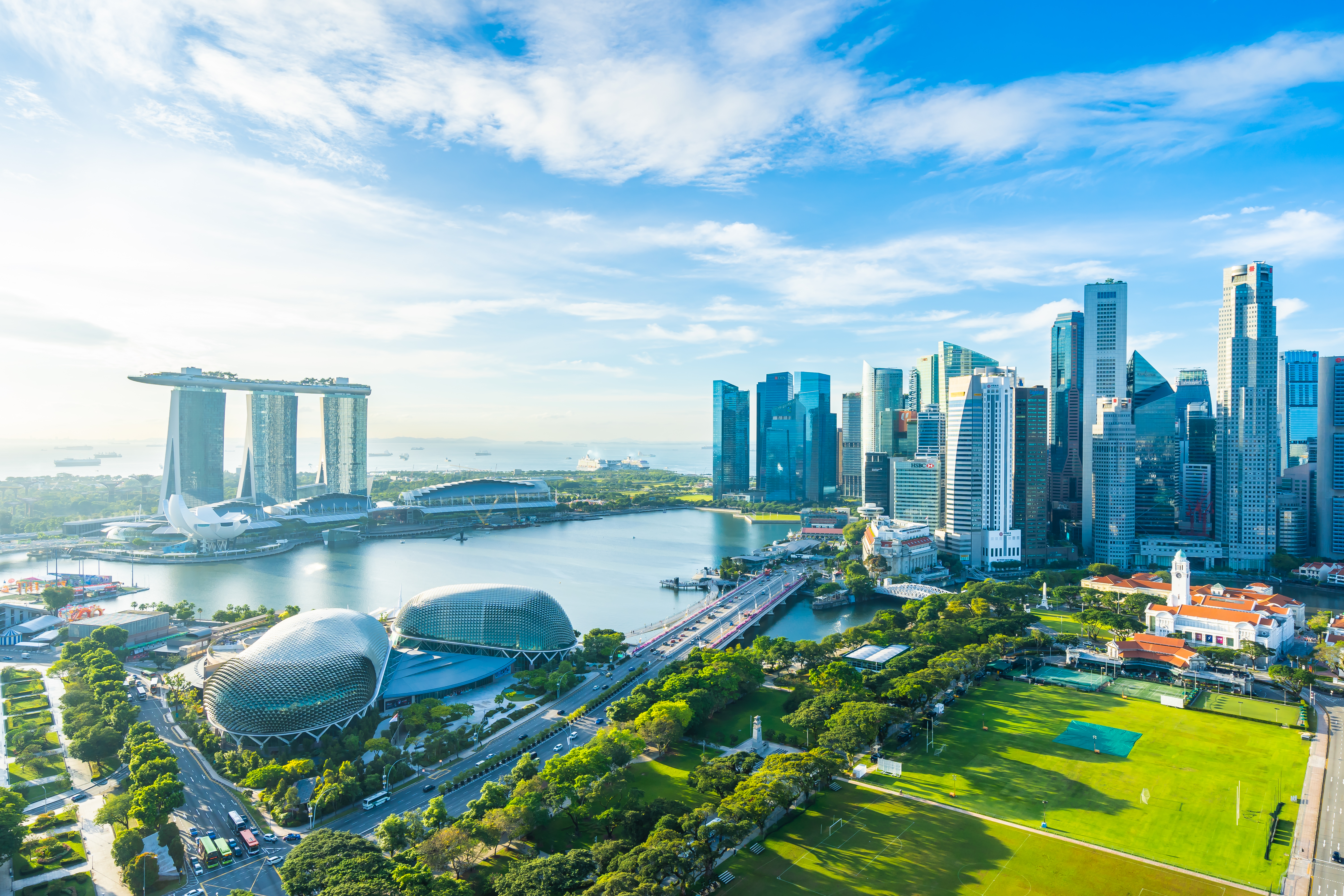
Marina Bay is Singapore’s most recognisable precinct — a curved waterfront framed by the Marina Bay Sands integrated resort, the lotus-shaped ArtScience Museum, the Esplanade “durian” performing arts centre and a constant loop of free light shows after dark.

Marina Bay Sands: The three-tower integrated resort connected at the top by the cantilevered SkyPark — one of the most recognisable buildings on earth. The SkyPark Observation Deck (SGD 32) offers 360-degree views over Singapore, the Strait of Malacca and the islands of Indonesia on clear days. The infinity pool at the top of the SkyPark is available to hotel guests only — it does not appear in any other context. The ground-level mall, canal, and waterfront promenade are free to access.


ArtScience Museum: Shaped like a lotus flower opening at the water’s edge — one of Singapore’s finest museum spaces, hosting major international exhibitions alongside permanent digital art installations.

Merlion Park: The Merlion — half-lion, half-fish, spouting water into the bay — is Singapore’s national icon; the statue at the mouth of the Singapore River facing Marina Bay is the most photographed spot in the country; free, and best photographed at night with the illuminated Marina Bay Sands behind it.

The Helix Bridge: A pedestrian bridge connecting Marina Bay Sands to the Esplanade precinct — designed in the shape of a double helix DNA strand; illuminated at night; one of the finest free walking experiences in Singapore.


Spectra — free nightly light show: A water, laser and light projection show on the Event Plaza in front of Marina Bay Sands — nightly at 8pm and 9pm, with an additional 10pm show on Fridays and Saturdays. Free. Arrive 10-15 minutes early for the best viewing spot.
Gardens by the Bay
Directly behind Marina Bay Sands — one of the finest horticultural attractions in the world, combining extraordinary engineering with genuine botanical ambition. The Supertrees (vertical garden structures up to 50 metres tall) are free to walk around at ground level; the OCBC Skyway bridge between the Supertrees costs SGD 14 and gives elevated views; the Flower Dome and Cloud Forest conservatories together cost SGD 28.


Garden Rhapsody — free nightly light show: Every night at 7:45pm and 8:45pm, the Supertrees light up in synchronised colour to a music program — one of Singapore’s finest free experiences; plan your evening at Gardens by the Bay to end at one of these two shows.

Cloud Forest Conservatory: A 35-metre man-made mountain inside a temperature-controlled dome — covered in tropical highland plants, orchids and ferns; a spectacular engineered environment; cooler than outside (around 23-25°C); particularly welcome on a hot day.

Flower Dome Conservatory: The world’s largest glass greenhouse at the time of its opening — an air-conditioned Mediterranean-climate biome housing olive trees, baobabs and flower displays that change with the seasons.

Cultural neighbourhoods
Singapore’s heritage neighbourhoods are the best way to understand the city as something more than a skyline.
Chinatown: Singapore’s historic Chinese quarter — shophouses painted in candy colours, the Sri Mariamman Temple (Singapore’s oldest Hindu temple, incongruously in the heart of Chinatown), the Buddha Tooth Relic Temple (housing a relic of the Buddha brought from Myanmar), the Chinatown Heritage Centre and some of the best hawker eating in the city at Maxwell Food Centre and Chinatown Complex Food Centre.

Little India: The Serangoon Road district — a dense, colourful, sensory neighbourhood of garland sellers, spice shops, gold jewellers, Tamil restaurants, the Sri Veeramakaliamman Temple and the Tekka Market (fresh produce, textiles and cooked food). The 24-hour Mustafa Centre — a vast department store covering everything from electronics to saris to groceries — is a Singapore institution.
Kampong Glam: Singapore’s historic Malay and Arab quarter — the Sultan Mosque (1932, Singapore’s largest mosque, its golden dome visible across the district), Haji Lane (a narrow street of independent boutiques, street art and cafés) and Arab Street (textiles, carpets, rattan goods and the fragrance shops of Bussorah Street). One of the finest streetscape experiences in Singapore.
Joo Chiat and Katong: The Peranakan (Straits-born Chinese) neighbourhood in the east — pastel-coloured shophouses, Peranakan restaurants serving nyonya laksa and chicken buah keluak, and a quieter, more authentic pace than the tourist-facing neighbourhoods of the city centre.
Sentosa Island
Singapore’s resort island — connected to the mainland by a causeway, a cable car and the Sentosa Express monorail. Beaches, theme parks, hotels, golf courses and a casino all share the 5-kilometre island.

Universal Studios Singapore: Southeast Asia’s only Universal Studios theme park — from SGD 83 per adult; rides themed around Transformers, Battlestar Galactica, Shrek and the iconic Jurassic Park river adventure; a full day attraction.
Adventure Cove Waterpark: A water park with wave pools, river rapids and a snorkelling trail through a 14,000-fish reef — good for families and for those who want Sentosa without the theme park crowds.
Sentosa beaches: Palawan Beach, Siloso Beach and Tanjong Beach — free to access; the water is calm and warm; Tanjong Beach Club is the most relaxed and scenically situated beach bar on the island.

Jewel Changi Airport
Even if you are not flying — Jewel Changi Airport is a destination in itself. The interconnected complex between Terminals 1, 2 and 3 houses the world’s tallest indoor waterfall (HSBC Rain Vortex, 40 metres), surrounded by a five-storey indoor forest; approximately 280 shops and restaurants; the Canopy Park (hedge mazes, walking nets, mirror mazes — ticketed, from SGD 5); and food courts representing every major Singaporean cuisine. If your flight goes through Changi, allow extra time.


Hawker centres and Singapore food
Singapore’s hawker centres are UNESCO Intangible Cultural Heritage — open-air or covered food courts where independent stalls serve dishes at prices that make the quality almost implausible. A plate of Hainanese chicken rice at a Michelin-listed stall costs SGD 5-6.

Essential dishes:
- Hainanese chicken rice — poached chicken over fragrant rice cooked in chicken fat; the national dish; Tian Tian Chicken Rice at Maxwell Food Centre is Michelin Bib Gourmand listed
- Laksa — spicy coconut curry noodle soup; Katong laksa (with short noodles eaten with a spoon) is the Singapore variation
- Char kway teow — wok-fried flat rice noodles with egg, beansprouts, Chinese sausage and cockles; a dish that depends entirely on the breath of the wok (wok hei)
- Satay — grilled meat skewers over charcoal; best at Lau Pa Sat on Robinson Road
- Chilli crab — Singapore’s signature seafood dish; whole mud crab in a semi-thick tomato and chilli sauce; eaten with fried mantou buns to mop up the sauce; expensive but worth it for a special occasion
- Kaya toast — thick toast spread with kaya (a coconut and egg jam) and cold butter; eaten with soft-boiled eggs and kopi (Singapore coffee); the definitive Singapore breakfast


Best hawker centres:
- Maxwell Food Centre (Chinatown) — Tian Tian Chicken Rice, wonton noodles, fruit juice
- Newton Food Centre (Newton MRT) — touristy but reliable; satay, oyster omelette, fresh seafood
- Lau Pa Sat (Raffles Place MRT) — Victorian cast-iron market building; satay street comes alive after dark
- Tekka Market (Little India) — freshest roti prata and South Indian food in Singapore
- Old Airport Road Food Centre (Mountbatten MRT) — local favourite; some of Singapore’s oldest stalls
Money and costs
Currency: Singapore Dollar (SGD). As of September 2026, approximately AUD $1 = SGD 0.88; NZD $1 = SGD 0.77.
Daily budgets:
| Budget level | Daily spend (SGD) | AU equivalent | What you get |
|---|---|---|---|
| Budget | SGD 60-80 | ~AUD 68-90 | Hostel, hawker meals, MRT, free attractions |
| Mid-range | SGD 150-250 | ~AUD 170-285 | Hotel, restaurants, paid attractions |
| Luxury | SGD 400+ | ~AUD 455+ | Marina Bay Sands or similar, fine dining |
Free attractions and experiences:
- Supertree Grove, Gardens by the Bay (ground level)
- Garden Rhapsody nightly (7:45pm and 8:45pm)
- Spectra nightly (8pm and 9pm)
- Merlion Park
- Helix Bridge
- Singapore Botanic Gardens (UNESCO World Heritage Site)
- East Coast Park beach
- Chinatown, Little India, Kampong Glam walking
Paid attractions 2026:
- MBS SkyPark Observation Deck: SGD 32
- Gardens by the Bay conservatories: SGD 28
- Universal Studios Singapore: from SGD 83
- Singapore Flyer: SGD 40
- S.E.A. Aquarium: from SGD 45
What it means for your transfers
Singapore is home to a significant Singaporean-Australian and Singaporean-New Zealand community, as well as a large community of Australians and New Zealanders living and working in Singapore. Singapore’s position as Southeast Asia’s financial and logistics hub makes it an important OrbitRemit destination.
AUD to SGD and NZD to SGD transfers with OrbitRemit — check current fees and rates at orbitremit.com.
FAQs (frequently asked questions)
Do Australians need a visa for Singapore?
No — Australian passport holders enter Singapore visa-free for up to 30 days for tourism and business. Passport must be valid for at least 6 months beyond your departure.
Do New Zealanders need a visa for Singapore?
No — same as Australians. Visa-free for tourism and business. Confirmed by Singapore High Commission Wellington official.
How long do I need in Singapore?
Three to four days covers the highlights comfortably — Marina Bay, Gardens by the Bay, a cultural neighbourhood day and Sentosa. Five to six days adds quieter neighbourhoods and day trips to Pulau Ubin or Johor Bahru (Malaysia, 30 minutes by bus).
What are the free things to do in Singapore?
Garden Rhapsody at Gardens by the Bay (7:45pm and 8:45pm nightly), Spectra at Marina Bay (8pm and 9pm nightly), Merlion Park, Singapore Botanic Gardens (UNESCO), Chinatown and Kampong Glam walking, Helix Bridge, East Coast Park beach.
Can I see the Marina Bay Sands infinity pool?
The infinity pool is exclusively for hotel guests staying at Marina Bay Sands. The SkyPark Observation Deck (SGD 32) is open to all visitors and offers similar views.
What is Singapore’s best food experience?
Hawker centres — open-air food courts where independent stalls serve Michelin-quality dishes at SGD 3-6. Maxwell Food Centre (Tian Tian Chicken Rice), Lau Pa Sat (satay) and Newton Food Centre are the best-known. Hainanese chicken rice, laksa, char kway teow and kaya toast are essential.
Is Singapore safe?
Yes — Smartraveller rates Singapore at Exercise Normal Safety Precautions, the lowest advisory level. Singapore is consistently ranked among the safest cities in the world. Be aware of strict local laws — particularly around drugs, public demonstrations and littering.
Related guides
- Malaysia travel guide 2026 →
- Thailand travel guide 2026 →
- Indonesia travel guide 2026 →
- Best travel money cards in Australia 2026 →
- Best travel money cards in New Zealand 2026 →
Visa and entry requirements are subject to change — verify at ica.gov.sg, Smartraveller (smartraveller.gov.au) or Safetravel (safetravel.govt.nz) before travel. Last updated September 2026.
Sources: Singapore High Commission Canberra — Visa information (official, canberra.mfa.gov.sg) | Singapore High Commission Wellington — Visa information (official, wellington.mfa.gov.sg, January 4, 2026) | Smartraveller — Singapore travel advice (smartraveller.gov.au official) | 1cover.com.au — Do Australians Need a Visa for Singapore? | traveloka.com — Entry Guide 2026 (May 21, 2026) | singaporeeast.com — 35 Best Things To Do in Singapore 2026 (July 11, 2026) | tourismattractions.net — Singapore Tourist Attractions 2026 (March 21, 2026) | travjoy.com — Singapore Things To Do 2026 (June 26, 2026) | backpackingislife.com — 17 Best Things To Do In Singapore 2026 (August 1, 2026) | sgeventshub.com — Singapore Events and Attractions 2026 (August 7, 2026)


