Thailand Travel Guide 2026: Essential Tips for Aussies and Kiwis
Australian and New Zealand passport holders can enter Thailand visa-free — but the rules changed on 15 September 2026 — the 60-day visa-free stay that has applied since July 2024 has been cut back to 30 days; the change was published in Thailand’s Royal Gazette on 31 August 2026 and took effect on 15 September; for most short holidays this makes no difference, but travellers planning a longer stay of 30-60 days now need to either extend at a local immigration office (THB 1,900 for a further 30 days) or obtain a tourist visa before departure
The Thailand Digital Arrival Card (TDAC) is now mandatory for all travellers — submit it 24-72 hours before arrival, free of charge — the TDAC replaced the paper TM6 form in May 2025 and must be completed online at tdac.immigration.go.th before boarding; it takes approximately 10 minutes; submitting more than 72 hours ahead will be rejected; keep the QR code on your phone for immigration
Thailand is the most visited country in Southeast Asia by Australians and New Zealanders — warm year-round, affordable, with some of the world’s best street food, extraordinary Buddhist temples, world-class diving and a range of destinations that suits everyone from backpackers to families to luxury travellers; the best time to visit most of Thailand is November to April — the dry season; the islands of the Andaman Sea (Phuket, Krabi, Koh Lanta) have a different wet season to the Gulf islands (Koh Samui, Koh Phangan) — worth understanding before booking
Thailand has a way of making itself feel like home before you fully understand why. The warmth is genuine. The food is extraordinary at every price point. The temples are genuinely beautiful. The islands are exactly what the photographs promise — and in some cases better. Australia and New Zealand send more visitors to Thailand than almost any other non-Asian country, and the relationship is well-established: direct flights, Thai communities in every major Australian and New Zealand city, and decades of backpackers, families and retirees who keep coming back.
This guide covers everything you need for 2026 — including the important visa change that took effect on 15 September.
Visa and entry requirements
Visa-free — but now 30 days from 15 September 2026
Australian and New Zealand passport holders do not need a visa to visit Thailand for tourism. However the rules changed on 15 September 2026.
What changed:
- Before 15 September 2026: 60 days visa-free on arrival
- From 15 September 2026: 30 days visa-free on arrival
The Thai Cabinet approved the reduction on 19 May 2026. It was published in the Royal Gazette on 31 August 2026 and came into effect on 15 September 2026 — 15 days after gazette publication, as required by Thai law.
What you need on arrival:
- Passport valid for at least 6 months beyond your arrival date, with at least one blank page
- Thailand Digital Arrival Card (TDAC) — completed online 24-72 hours before boarding
- Return or onward ticket — immigration officers may ask for it
- Proof of funds: THB 20,000 per person (approximately AUD $820 / NZD $900) in accessible funds
Extending your stay: If you want to stay beyond 30 days, you can extend once at any Thai Immigration Office for THB 1,900 (approximately AUD $78) — giving a maximum total stay of 60 days. Bring your passport, a passport-sized photo and the fee. Extensions are generally straightforward at provincial immigration offices outside of Bangkok.
Overstay warning: Overstaying your permitted period in Thailand carries a fine of THB 500 per day, up to a maximum of THB 20,000 — plus potential detention and a re-entry ban. Check your entry stamp carefully — the date written is the date you must leave, not the date you arrived.
For stays beyond 60 days: Apply for a Tourist Visa (TR) at a Royal Thai Consulate before departure — or consider the Destination Thailand Visa (DTV) for remote workers and longer-stay travellers.
The Thailand Digital Arrival Card (TDAC)
The TDAC is mandatory for all foreign nationals entering Thailand — by air, land or sea — and replaced the paper TM6 arrival card in May 2025.
Submit at: tdac.immigration.go.th (the official portal — free)
When: Between 24 and 72 hours before your flight departs. Earlier than 72 hours will be rejected.
What it covers: Passport details, flight information and accommodation address in Thailand.
Time required: Approximately 10 minutes.
Keep the QR code on your phone or printed — immigration officers scan it at arrival.
Best time to visit
Thailand has two distinct weather patterns depending on which coast you are visiting.
The mainland and Andaman Sea coast (Phuket, Krabi, Koh Lanta, Koh Phi Phi)
Best: November to April — dry season, calm seas, clear skies. Peak season is December to February.
Avoid: May to October — the southwest monsoon brings heavy rain and rough seas to the Andaman coast; Phuket and Krabi can be affected by swells that close some beaches.
The Gulf of Thailand coast (Koh Samui, Koh Phangan, Koh Tao, Pattaya)
Best: December to August — the Gulf coast has its own weather pattern, largely sheltered from the southwest monsoon.
Avoid: September to November — the northeast monsoon brings rain and rough seas to the Gulf islands; Koh Samui in October can be significantly affected.
Bangkok and Chiang Mai
Best: November to February — coolest, driest months. Bangkok in March-April is intensely hot (38°C+). Chiang Mai in March-April suffers from smoke haze from agricultural burning.
Songkran (13-15 April): Thailand’s water festival and New Year — a three-day nationwide water fight; the best celebrations are in Chiang Mai and Bangkok’s Khao San Road. If you embrace it, it is one of the world’s great travel experiences.
Getting there
From Australia
Direct flights:
| City | Airlines | Flight time |
|---|---|---|
| Sydney to Bangkok (BKK/DMK) | Qantas, Thai Airways, AirAsia | ~9 hours |
| Melbourne to Bangkok | Thai Airways, AirAsia, Jetstar | ~9.5 hours |
| Brisbane to Bangkok | Thai Airways, AirAsia | ~9 hours |
| Perth to Bangkok | Thai Airways, Jetstar | ~7 hours |
Cost: Return flights from Australia to Bangkok typically range from AUD $700-$1,200 booked 2-3 months ahead. Budget carriers (AirAsia, Jetstar) can reach AUD $400-600 during sales.
From New Zealand
Via Australia or direct: Auckland to Bangkok direct with Thai Airways (~11 hours) or via Sydney/Melbourne.
Cost: Return flights from Auckland typically range from NZD $900-$1,600 booked ahead.
Getting around Thailand
Domestic flights
Thailand has an excellent and affordable domestic air network. Flights between Bangkok, Chiang Mai, Phuket, Koh Samui and other destinations cost as little as THB 800-1,500 (~AUD $33-62) booked in advance with AirAsia, Thai AirAsia or Nok Air.
Book at least 2-3 weeks ahead for the best fares — same-day or last-minute domestic fares are significantly more expensive.
Trains
The State Railway of Thailand runs overnight sleeper trains connecting Bangkok with Chiang Mai (13 hours), Ayutthaya, Hua Hin and the southern peninsula. The overnight train from Bangkok to Chiang Mai — in a second-class sleeper berth — is one of Southeast Asia’s most enjoyable budget travel experiences. Book at 12go.asia.
Long-distance buses
Comfortable air-conditioned buses connect most Thai cities at very low cost. The Mo Chit (Northern Terminal) in Bangkok is the main hub for northern routes; Sai Tai Mai (Southern Terminal) for southern destinations.
Bangkok transport
BTS Skytrain and MRT: Bangkok’s elevated rail and metro network covers most tourist areas and is fast, air-conditioned and inexpensive (THB 17-59 per journey). Buy a Rabbit Card (BTS) for contactless travel.

Grab: Thailand’s dominant ride-hailing app — available throughout Bangkok and major cities. Always more reliable than trying to negotiate with tuk-tuks for anything beyond a short novelty ride.
Tuk-tuks: The iconic three-wheeled motorised rickshaw — a legitimate and fun way to cover short distances in Bangkok’s old city area; always agree on the price before getting in.

Top destinations
Bangkok — the capital
Bangkok is one of the world’s great cities — a vast, overwhelming, endlessly surprising metropolis of 11 million people where 18th-century Buddhist temples sit beside gleaming glass shopping malls, street food vendors operate under elevated expressways and the Chao Phraya River carries everything from rice barges to tourist ferries. Give Bangkok at least 3 days; most first-time visitors discover they needed more.

The Grand Palace and Wat Phra Kaew (Temple of the Emerald Buddha): The most visited site in Thailand — the former royal palace complex housing the most sacred Buddhist image in Thailand, the Emerald Buddha (carved from a single jade stone; approximately 66cm tall). The complex is extraordinary — gilded spires, mirror-mosaic walls and immaculately maintained grounds. Dress code strictly enforced: shoulders and knees covered; long trousers or skirt; no sleeveless tops. Open daily 8:30am-3:30pm.

Wat Arun (Temple of Dawn): A 70-metre-tall Khmer-style prang (tower) on the west bank of the Chao Phraya, covered in fragments of Chinese porcelain and decorated seashells — one of Bangkok’s most distinctive and beautiful temples. Best viewed from across the river at sunset; climb the steep stairs to the upper terraces for views over the river.

Wat Pho: Bangkok’s largest temple — housing the famous Reclining Buddha (46 metres long, 15 metres high, covered in gold leaf) and the birthplace of traditional Thai massage. The temple complex also contains Thailand’s first public university, established by King Rama III. Thai massage sessions are available on-site — a legitimate and excellent way to experience the tradition in its original setting.
Khao San Road: The legendary backpacker street — hostels, bars, street food, pad thai stalls, souvenir shops, hair braiders and a chaotic energy that has made it an institution since the 1980s. The surrounding neighbourhood (Banglamphu) is far more interesting than the street itself — explore the lanes behind it.

Chatuchak Weekend Market: One of the world’s largest weekend markets — 27 acres, 15,000 stalls, everything from plants to vintage clothing to handmade ceramics to street food. Open Saturday and Sunday. BTS Mo Chit station. Arrive early before the heat.
Rooftop bars: Bangkok’s rooftop bar scene is world-class — the Vertigo at the Banyan Tree, Octave at the Marriott Sukhumvit, Sky Bar at Lebua (featured in The Hangover Part II). Best visited at sunset for views across the city sprawl.

Floating markets: Damnoen Saduak (90 minutes from Bangkok) is the most famous — wooden boats laden with fruit, vegetables and cooked food navigating a network of canals; increasingly touristy but still worth seeing. Amphawa (80 minutes) is smaller, more authentic and operates on weekends only.
Chiang Mai — the northern city
Chiang Mai is everything Bangkok is not — smaller, cooler, slower, green and surrounded by mountains. The old city is enclosed within a moat and ancient walls; outside it, the city sprawls through coffee shops, night markets, cooking schools and temple-lined lanes. Three to four days in Chiang Mai fits naturally into any Thailand itinerary.

Old City temples: Over 300 temples in Chiang Mai — the most important are Wat Phra Singh (housing the revered Phra Singh Buddha image), Wat Chedi Luang (a partially ruined 15th-century chedi rising 60 metres above the city) and Wat Suan Dok (active monastery with free monk-chat sessions on Monday, Wednesday and Friday evenings). Temple-hopping in Chiang Mai is genuinely pleasurable — the architecture is the northern Thai style, distinctly different from Bangkok.

Doi Suthep: A white-and-gold temple on a mountain 13km from the city — reached by a 306-step staircase flanked by naga (serpent) balustrades, or by a funicular. Views over the Chiang Mai valley from the summit terrace. A pilgrimage site of genuine religious significance; go early morning before the tour groups arrive.
Elephant Nature Park: The gold standard for ethical elephant tourism in Thailand — a sanctuary that rescues elephants from logging and tourism industries; visitors can observe, walk alongside and feed the elephants but cannot ride them; the standard that all legitimate sanctuaries should meet. Book weeks ahead.

Doi Inthanon National Park: Thailand’s highest peak at 2,565m — 60km from Chiang Mai; a full-day trip covering the twin pagodas (built to honour the King and Queen), the cloud forest at the summit and several stunning waterfalls. Cool enough for a sweater even in the dry season.
Cooking classes: Chiang Mai is Thailand’s cooking school capital — a half-day or full-day class beginning with a market visit, then cooking 4-6 dishes from scratch, is one of the best value experiences in Southeast Asia. The Chiang Mai Thai Cookery School and Thai Farm Cooking School are consistently well-reviewed.
Night Bazaar and Nimman Road: The Night Bazaar along Chang Khlan Road runs nightly — handicrafts, clothing, street food and live music. Nimman Road (Nimmanhaemin) is Chiang Mai’s trendiest neighbourhood — coffee shops, boutiques and restaurants frequented by the city’s digital nomad and expat community.
Yi Peng and Loy Krathong (November): Chiang Mai’s most magical annual event — on the full moon of November, thousands of paper lanterns (khom loi) are simultaneously released into the night sky over the city, creating one of the world’s most extraordinary visual spectacles. Loy Krathong (floating decorated banana-leaf baskets on rivers and canals) happens on the same night nationwide. Book accommodation months ahead.
Phuket — the island
Phuket is Thailand’s largest island — connected to the mainland by a causeway, with an international airport and a full range of accommodation from budget guesthouses to ultra-luxury villas. It is the most developed beach destination in Thailand and the most expensive — but its best beaches and neighbourhoods are genuinely beautiful.
Patong Beach: The busiest beach in Phuket — long, wide and backed by the famous Bangla Road nightlife strip. Not the most beautiful beach but the most energetic; go for the atmosphere, not the tranquillity.

Kata and Karon Beaches: South of Patong — Kata especially has a quieter, more family-friendly atmosphere with good surf in the monsoon season. Kata Noi (Little Kata) is smaller and more sheltered.

Surin and Bang Tao Beaches: The north-west coast — more upscale, quieter and increasingly popular with the luxury resort crowd. The Catch Beach Club at Bang Tao is one of Phuket’s best beach club experiences.
Phuket Old Town: The historic quarter — Sino-Portuguese shophouse architecture in vivid pastel colours, independent cafés, art galleries and the Sunday Walking Street market. A genuine neighbourhood that repays exploring slowly.
Phi Phi Islands day trip: The twin islands of Koh Phi Phi Don and Koh Phi Phi Leh (home of Maya Bay, made famous by The Beach) are easily reached by speedboat from Phuket (45 minutes) or Krabi (30 minutes). Maya Bay was closed for ecological rehabilitation from 2018 to 2022 and is now open with strict visitor limits and no boats anchoring.

Krabi — limestone and sea
Krabi province on the Andaman coast has some of Thailand’s most dramatic scenery — enormous limestone karst formations rising vertically from turquoise water, white sand beaches and a more relaxed atmosphere than Phuket.

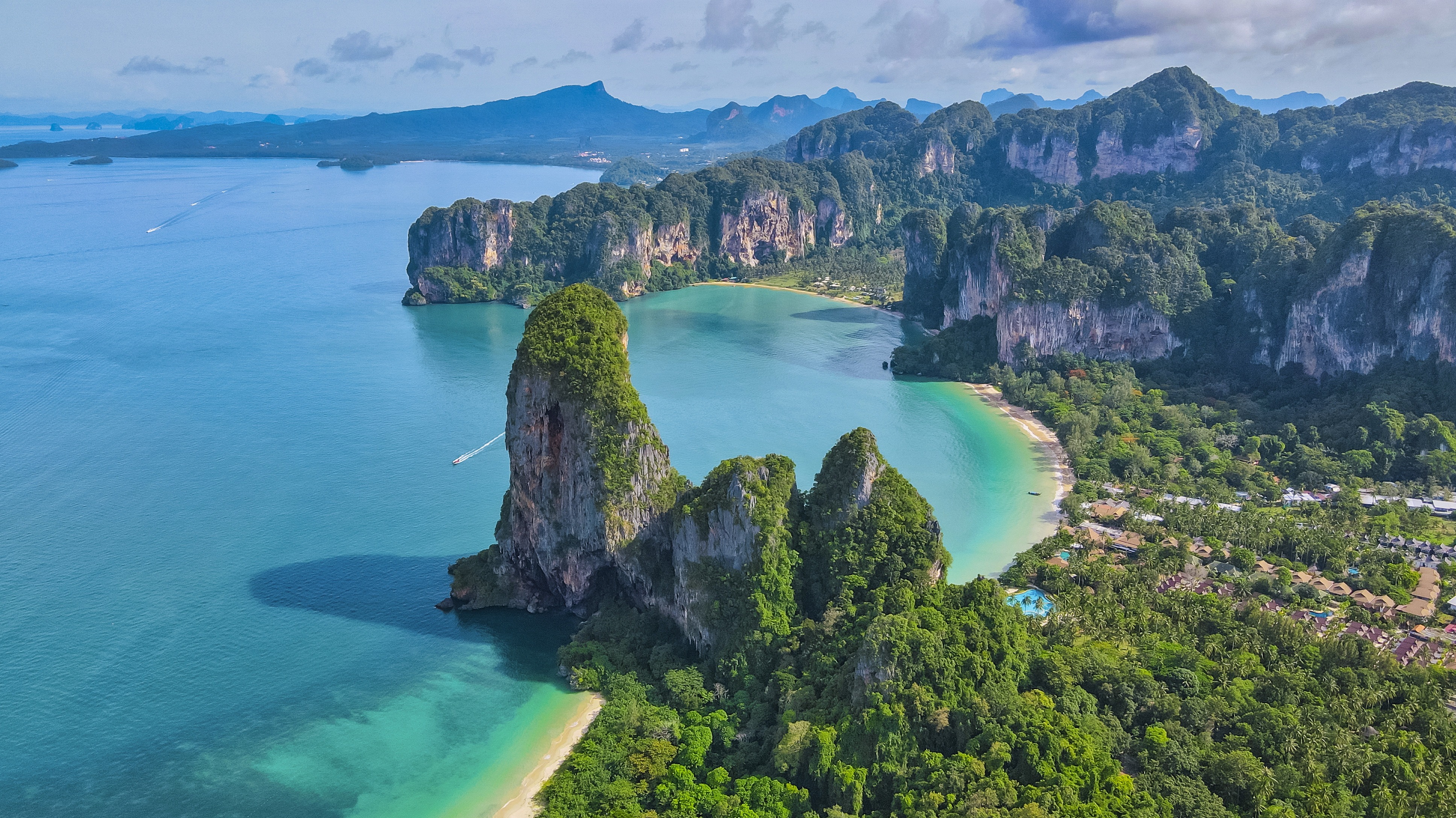
Railay Beach: Accessible only by longtail boat (15 minutes from Ao Nang) — a peninsula completely surrounded by limestone cliffs with no road access; four beaches, excellent rock climbing and a genuinely beautiful setting.
Four Islands tour: A classic longtail or speedboat tour from Ao Nang visiting Koh Poda, Koh Gai (Chicken Island), Tup Island and Koh Mor — snorkelling, white sand beaches and the famous sandbar that appears at low tide.
Emerald Cave (Moray Koh Mook): A sea cave on Koh Mook accessible only by swimming 80 metres through a dark tunnel at low tide — emerging into a hidden lagoon open to the sky above. One of Thailand’s most extraordinary natural experiences.
Koh Samui and the Gulf islands
The Gulf islands operate on a different seasonal calendar from the Andaman coast — drier from December to August, wetter from September to November.
Koh Samui: Thailand’s second-largest island after Phuket — well-developed resorts, good infrastructure, a wide range of restaurants and a livelier atmosphere than most islands. Chaweng Beach is the main tourist strip; Bo Phut (Fisherman’s Village) is quieter and more charming.

Koh Phangan: Known worldwide for the Full Moon Party — a monthly all-night beach party on Haad Rin beach drawing thousands of international visitors every full moon night. Beyond the Full Moon Party, Koh Phangan has quieter beaches on the north and west coasts that are significantly more peaceful.

Koh Tao: The world’s most popular place to learn scuba diving — shallow, clear, warm water with abundant marine life and among the most affordable PADI Open Water courses in the world (approximately THB 9,900-12,000 / AUD $410-495 all-inclusive). An island run almost entirely around the diving industry, with a relaxed backpacker atmosphere.
Kanchanaburi — history and nature
Kanchanaburi is 130km northwest of Bangkok — the site of the infamous Death Railway and Bridge on the River Kwai, built by Allied prisoners of war and Asian labourers under Japanese occupation in World War II. The JEATH War Museum and the Allied War Cemetery at Kanchanaburi are sobering and important sites.

Erawan National Park: Seven-tiered emerald-green waterfalls in a jungle national park — 70km from Kanchanaburi; the turquoise pools at each tier are swimmable and extraordinary. One of Thailand’s most beautiful natural areas.

Thai food — essential eating
Thai cuisine is one of the world’s great food traditions — bold, aromatic, intensely flavoured and available at extraordinary quality at every price point.
Pad Thai: Stir-fried rice noodles with egg, bean sprouts, spring onion, peanuts and your choice of protein — the dish that introduced Thai food to the world; at its best from a wok-and-cart street vendor.

Tom Yum Goong: Hot and sour prawn soup — lemongrass, galangal, kaffir lime leaves, chilli and lime juice in a clear broth; the most internationally recognised Thai soup and genuinely spectacular when made well.

Green Curry (Gaeng Keow Wan): Coconut milk curry with green chilli paste, Thai basil and vegetables — fragrant, slightly sweet and fiery; served with jasmine rice.

Som Tum (Papaya Salad): Shredded green papaya, tomato, green beans, peanuts and dried shrimp pounded in a mortar with lime juice, fish sauce, palm sugar and chilli; the staple of northeastern (Isan) Thai cuisine.

Mango Sticky Rice (Khao Niao Mamuang): Glutinous rice steamed in coconut milk served with fresh ripe mango and a drizzle of salted coconut cream — one of Southeast Asia’s great desserts; available from street vendors and restaurants throughout the country.

Durian (Thurian): Thailand’s most famous and most divisive fruit — the “King of Fruits” in Southeast Asia; a large spiky-shelled fruit with a custard-yellow flesh that produces an extraordinarily pungent smell described variously as onions, turpentine, gym socks and custard, all at once. The taste is a different matter entirely — creamy, rich, complex and unlike anything else; deeply beloved across Thailand and Southeast Asia. Banned from hotels, hospitals, airports and most public transport (look for the “no durian” signs alongside “no smoking”).

Street food: Eating from street stalls and market vendors is not just safe — it is where the best food is. Bangkok’s Chinatown (Yaowarat Road) at night, the Night Markets of Chiang Mai and the beachside vendors of any Thai island are all extraordinary. A full meal from a market stall costs THB 60-100 (approximately AUD $2.50-4).
Money and costs
Currency: Thai Baht (THB). As of September 2026, approximately AUD $1 = THB 24; NZD $1 = THB 21.
Daily budgets:
| Budget level | Daily spend | What you get |
|---|---|---|
| Budget | AUD $50-80 | Guesthouse, street food, local transport, temples |
| Mid-range | AUD $120-200 | Hotel, restaurants, day trips, air-conditioned transport |
| Luxury | AUD $300+ | Resort, fine dining, private tours, spa |
Cash: Thailand remains heavily cash-based — ATMs are available at all airports, banks, 7-Elevens and shopping centres, but many restaurants, markets and local businesses do not accept cards. Carry THB cash. ATM fees typically THB 200 per withdrawal for foreign cards.
Bargaining: Expected at markets; not at restaurants, convenience stores or shopping malls. Always with a smile.
Thai culture — dos and don’ts
The wai: The traditional Thai greeting — palms pressed together, slight bow of the head. Return a wai when offered one; do not wai to children or service staff.
Dress modestly at temples: Cover shoulders and knees at all temples. Many temples provide sarongs at the entrance for a small fee or for free.
The monarchy: Critical comments about the Thai monarchy are illegal under Thailand’s strict lèse-majesté laws — this includes comments about images of the king. Do not discuss the monarchy critically in public.
Remove shoes: At temples, private homes and many traditional restaurants — look for a row of shoes at the entrance.
The head is sacred: Do not touch anyone’s head, including children.
Feet are lowly: Do not point your feet at people, Buddha images or sacred objects.
“Thai smile”: Thai culture values emotional restraint and public harmony. Raising your voice or showing anger in public causes loss of face for both parties. Keep interactions calm and good-humoured — it is almost always more effective.
What it means for your transfers
Thailand has a significant Thai-Australian and Thai-New Zealand diaspora community — and many Australians and New Zealanders with Thai partners or family send money home regularly.
AUD to THB and NZD to THB transfers with OrbitRemit are fast and competitive — check current rates and fees at orbitremit.com.
FAQs (frequently asked questions)
Do Australians need a visa for Thailand?
No — Australian passport holders enter visa-free. From 15 September 2026, the visa-free stay is 30 days (reduced from 60 days). Extendable once by 30 days at an immigration office for THB 1,900.
Do New Zealanders need a visa for Thailand?
No — same as Australians. From 15 September 2026, visa-free for 30 days. Extendable once by 30 days at an immigration office.
What is the TDAC?
The Thailand Digital Arrival Card — a mandatory online entry declaration replacing the paper TM6. Submit at tdac.immigration.go.th between 24 and 72 hours before your flight. Free. Takes approximately 10 minutes.
What is the best time to visit Thailand?
November to February for Bangkok, Chiang Mai and the Andaman coast (Phuket, Krabi). December to August for the Gulf islands (Koh Samui, Koh Phangan, Koh Tao). Avoid March-April in Chiang Mai due to smoke haze.
Is Thailand safe for Australian and New Zealand travellers?
The Australian Government’s Smartraveller advisory is Exercise a High Degree of Caution — noting political instability risks and ongoing issues in the deep south (Pattani, Yala, Narawi, Songkhla provinces). The tourist areas of Bangkok, Chiang Mai, Phuket, Krabi and the main islands are generally safe. Standard urban precautions apply.
How much does it cost to travel Thailand?
Budget travellers can live well on AUD $50-80 per day. Mid-range is AUD $120-200. Thailand is one of the most affordable quality travel destinations in the world.
Related guides
- Indonesia travel guide 2026 →
- Vietnam travel guide 2026 →
- The 5 best eSIMs for international travel from Australia →
- The 5 best eSIMs for international travel from New Zealand →
- The 5 best travel money cards in Australia 2026 →
- The 5 best travel money cards in New Zealand 2026 →
Visa and entry requirements are subject to change — always verify at the Thai Ministry of Foreign Affairs (consular.mfa.go.th) and Smartraveller (smartraveller.gov.au) or Safetravel (safetravel.govt.nz) before travel. Last updated September 2026.
Sources: thailandinsiderguide.com — Thailand Visa & Entry Requirements 2026 (1 week ago) | visamanager.io — Thailand Visa for Australians 2026 (July 5, 2026) | thaiembassy.com — Thailand Entry Requirements 2026 (July 31, 2026) | thethaiger.com — Thailand visa requirements 2026 (June 16, 2026) | evisa-card.com — Thailand Visa for Australian Citizens 2026 (August 5, 2026) | visitthailandtoday.com — Thailand Visa Requirements 2026 (2 weeks ago) | foratravel.com — Definitive Guide Thailand (January 30, 2026) | voyagetips.com — Best Things to Do in Thailand 2026 (July 5, 2026) | wewillnomad.com — Thailand Travel Guide 2026


