Africa is home to over 40 currencies — from some of the continent’s most stable (the South African rand, the Moroccan dirham) to some of the world’s most turbulent monetary histories (Zimbabwe’s extraordinary hyperinflation, the Zimbabwean dollar that lost all meaning). The continent is also home to two of the world’s largest currency unions — the CFA franc zones — where 14 countries share a currency they do not individually control.
Here is the complete guide to every African currency — organised by region, with the fun facts that make each one worth knowing. This guide serves as an African currencies list, providing valuable insights into the continent’s diverse monetary systems.
A note on African currency categories
African currencies broadly fall into four groups:
Independent national currencies: Managed by each country’s own central bank — the South African rand, Nigerian naira, Kenyan shilling, Egyptian pound, Moroccan dirham and Ethiopian birr among them.
The two CFA franc zones: 14 countries share currencies tied to the euro and guaranteed by the French Treasury. The West African CFA franc (XOF) covers 8 countries; the Central African CFA franc (XAF) covers 6. Both trade at exactly the same rate against the euro but are technically different currencies and are not interchangeable.
The Common Monetary Area: South Africa, Lesotho, Eswatini and Namibia — the rand is legal tender in all four; each smaller country also issues its own currency at 1:1 parity with the rand.
Special cases: Zimbabwe — which has gone through its own currency, dollarisation, a basket of currencies, a new Zimbabwe dollar and most recently the Zimbabwe Gold (ZiG) in 2024.
North Africa
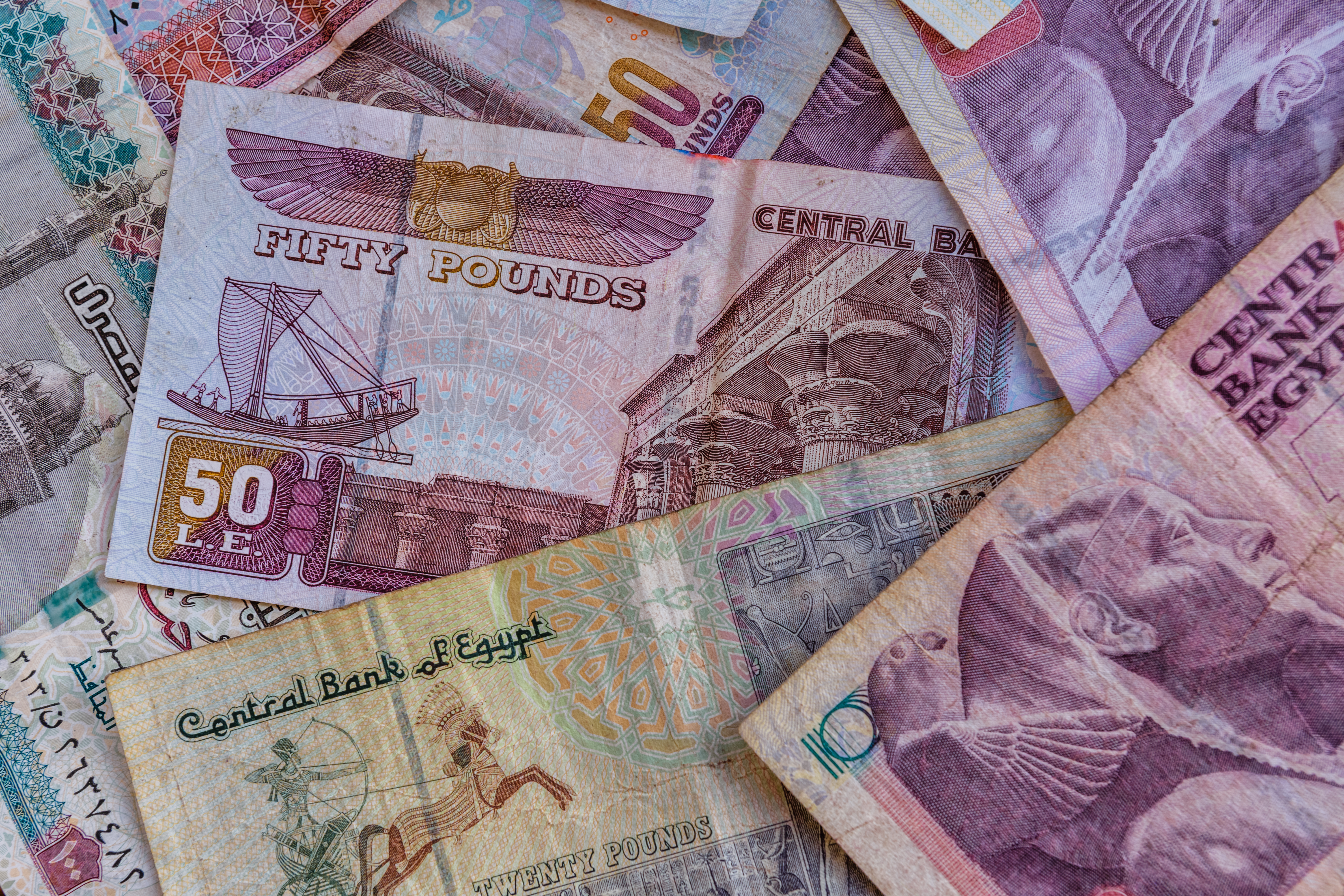
🇪🇬 Egypt — Egyptian Pound (EGP) £
Symbol: £ (E£ to distinguish from GBP) | Code: EGP | Subdivisions: 1 pound = 100 piastres = 1,000 millimes
Fun facts:
- The Egyptian pound is one of the oldest currencies in Africa — it replaced the Egyptian piastre in 1834 during the Ottoman era and has been in continuous use since
- Egypt devalued the pound twice in 2022 and again in March 2024 as part of an IMF agreement — each devaluation caused significant economic pressure but helped stabilise foreign currency reserves
- The pound symbol £ is the same as the British pound — Egypt uses E£ or LE (livres égyptiennes) to distinguish; on street signs and informal contexts, the Arabic symbol ج.م is used
- Egyptian banknotes are bilingual — they display text in both Arabic and English on the same note, reflecting Egypt’s position as a bridge between Arab and international worlds
- The Egyptian pound is the most traded African currency on global forex markets after the South African rand
🇲🇦 Morocco — Moroccan Dirham (MAD) د.م.
Symbol: د.م. | Code: MAD | Subdivisions: 1 dirham = 100 centimes (santimat)
Fun facts:
- The Moroccan dirham is not freely convertible — it cannot be taken out of Morocco in significant quantities and cannot be freely bought or sold on international markets; tourists must exchange money at official rates in Morocco
- Morocco pegs its dirham to a basket of currencies — primarily the euro (60%) and US dollar (40%) — giving it unusual stability relative to most African currencies
- The word dirham comes from the ancient Greek drachma — one of the oldest currency names in the world, tracing a chain of naming from ancient Greece through the Arab world to modern Morocco
- Morocco’s dirham is one of the more stable African currencies — it has maintained its value relatively well due to the basket peg and Morocco’s growing services, tourism and phosphate export economy
🇩🇿 Algeria — Algerian Dinar (DZD) DA
Symbol: DA | Code: DZD | Subdivisions: 1 dinar = 100 centimes
Fun facts:
- Algeria introduced its own dinar in April 1964 — two years after independence from France — replacing the French Algerian franc
- Algeria’s economy is heavily dependent on oil and gas revenues — which means the dinar’s real purchasing power tracks energy prices closely; when oil prices fall, economic pressure on the dinar follows
- The dinar is not freely convertible — Algeria maintains strict currency controls; exchanging on the parallel (“black”) market is common but illegal
🇹🇳 Tunisia — Tunisian Dinar (TND) DT
Symbol: DT | Code: TND | Subdivisions: 1 dinar = 1,000 millimes (the only currency in Africa subdivided into 1,000 units)
Fun facts:
- The Tunisian dinar is the only African currency divided into 1,000 smaller units (millimes) — most currencies use 100 subdivisions; Tunisia’s 1,000-millime system makes it unique on the continent
- The dinar is not freely convertible outside Tunisia — visitors cannot easily buy Tunisian dinars before arriving or sell them after leaving
- Tunisia’s dinar is one of the higher-value African currencies — approximately 0.45 USD per 1 TND — reflecting Tunisia’s relatively diversified economy of tourism, olive oil, phosphates and manufacturing
🇱🇾 Libya — Libyan Dinar (LYD) LD
Symbol: LD | Code: LYD | Subdivisions: 1 dinar = 1,000 dirhams
Fun facts:
- The Libyan dinar is one of the highest-value currencies in Africa — 1 LYD is worth approximately 3 AUD; Libya’s vast oil reserves underpin the dinar’s relatively high face value
- Libya has had two competing central banks since 2014 — one in Tripoli and one in Benghazi, each issuing their own version of the dinar during the country’s civil conflict; the parallel banking system created extraordinary currency chaos
- Like Tunisia, Libya uses 1,000 sub-units (dirhams) per dinar — a system common in the Arab world
West Africa
🇳🇬 Nigeria — Nigerian Naira (NGN) ₦
Symbol: ₦ | Code: NGN | Subdivisions: 1 naira = 100 kobo
Fun facts:
- The naira was introduced on 1 January 1973 — replacing the Nigerian pound at a rate of 2 naira per pound; the name naira is a contraction of “Nigeria”
- Nigeria is Africa’s largest economy by GDP — yet the naira has been one of the continent’s most volatile currencies; it lost approximately 70% of its value against the USD in 2023-2024 following the removal of the official exchange rate peg
- The ₦ symbol was officially gazetted in 1973 — a stylised N with two horizontal bars, echoing the design language of other currency symbols (€, ₤, ¥) with their characteristic double lines
- Nigeria runs a cashless policy initiative — the Central Bank of Nigeria attempted to replace old banknotes with new ones in early 2023, causing a severe cash shortage that paralysed the economy for months; it became one of the most disruptive currency transitions in African history
🇬🇭 Ghana — Ghanaian Cedi (GHS) ₵
Symbol: ₵ | Code: GHS | Subdivisions: 1 cedi = 100 pesewas
Fun facts:
- Cedi comes from the Akan word for cowrie shell — the shells that served as currency in the region for centuries before European contact; Ghana’s modern currency honours this precolonial monetary tradition
- Ghana has redenominated its currency twice — in 1965 and again in 2007 (when 1 new cedi = 10,000 old cedis); each redenomination was prompted by inflation eroding the value of lower denominations
- Ghana experienced a severe debt crisis in 2022-2023 — the cedi lost over 50% of its value and Ghana suspended payments on most of its external debt in December 2022, becoming the fourth African country to default on a Eurobond; an IMF programme of USD $3 billion was agreed in 2023
🇸🇳 Senegal, 🇨🇮 Côte d’Ivoire, 🇲🇱 Mali, 🇧🇫 Burkina Faso, 🇹🇬 Togo, 🇧🇯 Benin, 🇬🇼 Guinea-Bissau, 🇳🇪 Niger — West African CFA Franc (XOF) CFA
Symbol: CFA | Code: XOF | Subdivisions: 1 franc = 100 centimes
Fun facts:
- CFA stands for Communauté Financière Africaine (African Financial Community) — 8 West African countries share this currency, managed by the Central Bank of West African States (BCEAO) in Dakar
- The CFA franc is pegged to the euro at exactly 655.957 XOF per 1 EUR — the same rate it has maintained since the euro replaced the French franc in 1999; before that, the peg was to the French franc at the same ratio
- The French Treasury guarantees convertibility of the CFA franc — meaning France effectively underwrites the currency of 8 sovereign nations; this arrangement is both the source of the franc’s stability and the subject of ongoing political debate about monetary sovereignty
- There are two CFA francs in Africa — the West African (XOF) and the Central African (XAF); they trade at exactly the same rate against the euro but are not interchangeable and cannot be used across zones
- The Eco — a proposed single currency for all 15 ECOWAS member states — has been planned for years but repeatedly delayed; the latest target date is 2031
🇬🇳 Guinea — Guinean Franc (GNF) FG
Symbol: FG | Code: GNF | Subdivisions: 1 franc = 100 centimes (not in practical use)
Fun facts:
- Guinea left the CFA franc zone in 1960 when it chose independence from France — the only former French colony to do so immediately; President Sékou Touré famously said he preferred “poverty in freedom to riches in slavery”
- The Guinean franc has faced persistent inflation — the 20,000 franc note (the largest denomination) is worth approximately AUD $2.70
🇸🇱 Sierra Leone — Sierra Leonean Leone (SLE) Le
Symbol: Le | Code: SLE | Subdivisions: 1 leone = 100 cents
Fun facts:
- Sierra Leone redenominated its currency in 2022 — 1 new leone (SLE) = 1,000 old leones (SLL); the old 50,000 leone note became a 50 leone note overnight
- The leone is named after Sierra Leone itself — which was named by Portuguese explorers who heard the sound of thunderstorms in the mountains and called it Serra Leoa (Lion Mountains)
🇨🇻 Cabo Verde — Cape Verdean Escudo (CVE) $
Symbol: $ | Code: CVE | Subdivisions: 1 escudo = 100 centavos
Fun facts:
- Cabo Verde uses the dollar sign ($) for its escudo — not because it is related to the US dollar, but because the escudo predates the modern dollar symbol convention; confusing to visitors but consistent with the currency’s Portuguese colonial origins
- The Cape Verdean escudo is pegged to the euro — giving this small Atlantic island nation remarkable monetary stability relative to most West African currencies
East Africa
🇰🇪 Kenya — Kenyan Shilling (KES) KSh
Symbol: KSh | Code: KES | Subdivisions: 1 shilling = 100 cents
Fun facts:
- The Kenyan shilling was introduced in 1966 — replacing the East African shilling that had circulated across Kenya, Uganda and Tanzania under British colonial administration; the three countries maintained a currency union until 1967
- Kenya’s shilling is one of East Africa’s most stable currencies — anchored by a diversified economy of tea and coffee exports, horticulture, tourism and increasingly technology (Nairobi is Africa’s leading tech hub, dubbed “Silicon Savannah”)
- The shilling name comes from the old English scilling — a unit of account used since Anglo-Saxon times; British colonial administrators brought the shilling naming convention to their East and Southern African territories
🇹🇿 Tanzania — Tanzanian Shilling (TZS) TSh
Symbol: TSh | Code: TZS | Subdivisions: 1 shilling = 100 senti
Fun facts:
- Tanzania uses senti for cents — from the Swahili adaptation of the English word “cent”; Swahili is Tanzania’s national language and the most widely spoken African language
- Tanzania’s shilling has been relatively stable — Tanzania is one of sub-Saharan Africa’s more consistent growth stories, with gold, coffee, tea and tourism underpinning its economy
- Tanzania and Zanzibar unified in 1964 — and the new country chose “Tanzania” as a portmanteau of Tanganyika and Zanzibar; the shilling unified their currencies in the same year
🇺🇬 Uganda — Ugandan Shilling (UGX) USh
Symbol: USh | Code: UGX | Subdivisions: 1 shilling = 100 cents (cents not in practical use)
Fun facts:
- Uganda’s shilling has had a troubled history — during Idi Amin’s government in the 1970s, the economy experienced severe inflation and monetary instability; the current shilling replaced several devalued predecessors
- The 50,000 Ugandan shilling note (the largest denomination) is worth approximately AUD $18 — the low unit value reflects decades of accumulated inflation
- Uganda was one of the first African countries to adopt mobile money at scale — M-Pesa and local alternatives transformed how Ugandans transact, reducing dependence on physical shillings for everyday payments
🇪🇹 Ethiopia — Ethiopian Birr (ETB) Br
Symbol: Br | Code: ETB | Subdivisions: 1 birr = 100 santim
Fun facts:
- Birr means “silver” in Amharic — a reference to the silver coins that circulated in Ethiopia for centuries; Ethiopia has one of the oldest monetary traditions in Africa, with coins minted by the Aksumite Empire as early as the 3rd century CE — among the earliest coins in sub-Saharan Africa
- Ethiopia is the only African country that uses its own calendar — the Ethiopian calendar has 13 months and runs approximately 7-8 years behind the Gregorian calendar; the birr’s denominations reflect Ethiopian numerals
- Ethiopia unified its currency in 1945 when Haile Selassie replaced the Italian-era currency introduced during the occupation; the current birr has been in continuous use since 1976
🇷🇼 Rwanda — Rwandan Franc (RWF) RF
Symbol: RF | Code: RWF | Subdivisions: 1 franc = 100 centimes (not in practical use)
Fun facts:
- Rwanda’s franc has been one of Africa’s surprising success stories — since the 1994 genocide, Rwanda has rebuilt its economy and the franc has maintained relative stability as Kigali became one of Africa’s most business-friendly cities
- Rwanda is one of the cleanest countries in Africa — plastic bags have been banned since 2008; the franc flows through an economy that has made sustainability a national identity
- The Rwandan franc shares its name with the Burundian franc (BIF) — the two countries use different currencies despite their close geographic and historical ties
🇸🇴 Somalia — Somali Shilling (SOS) Sh.So.
Symbol: Sh.So. | Code: SOS | Subdivisions: 1 shilling = 100 senti
Fun facts:
- For much of the 1990s and 2000s, Somalia had no functioning central bank — yet the Somali shilling continued to circulate, printed by regional authorities and private interests; it is one of the rare examples of a currency surviving without a state to back it
- Somaliland — the self-declared republic in northern Somalia — issues its own Somaliland shilling (SLSH) which is not recognised internationally but functions as a domestic currency; the Somali shilling and Somaliland shilling are completely separate
- Despite Somalia’s instability, mobile money through services like Hormuud Telecom’s EVC Plus has become the primary financial system for millions of Somalis — more stable than the physical shilling
Southern Africa
🇿🇦 South Africa — South African Rand (ZAR) R
Symbol: R | Code: ZAR | Subdivisions: 1 rand = 100 cents
Fun facts:
- The rand is named after the Witwatersrand — the gold-bearing ridge around Johannesburg (Rand is Afrikaans for “ridge”); the discovery of gold on the Rand in 1886 transformed South Africa and ultimately gave its currency its name
- The rand replaced the South African pound on 14 February 1961 — Valentine’s Day — at a rate of 2 rand per pound; South Africa simultaneously became a republic, severing ties with the British Crown
- The rand is the most traded African currency in the world — it is one of the 20 most traded currencies globally and is often used as a proxy for broader emerging market sentiment
- The rand is legal tender in Lesotho, Eswatini and Namibia alongside each country’s own currency — all pegged 1:1 to the rand as part of the Common Monetary Area
- The Big Mac Index — the Economist’s famous measure of purchasing power parity — regularly shows the rand as one of the most undervalued currencies in the world
🇿🇼 Zimbabwe — Zimbabwe Gold (ZiG) ZiG
Symbol: ZiG | Code: ZWG | Subdivisions: 1 ZiG = 100 cents
Fun facts:
- Zimbabwe has had the most extraordinary currency history of any country in the world. Here is a timeline:
- 2008-2009: Hyperinflation — Zimbabwe’s dollar inflated so rapidly that a 100 trillion dollar banknote was issued (100,000,000,000,000 ZWD); at peak, prices doubled every 24 hours; the 100 trillion note is now a collector’s item worth more than its face value ever was
- 2009: Dollarisation — Zimbabwe abandoned its own currency and adopted a basket of foreign currencies (USD, South African rand, Botswana pula, British pound and others) for all transactions
- 2019: New Zimbabwe dollar — Zimbabwe reintroduced its own currency after a decade; it immediately began depreciating
- 2024: Zimbabwe Gold (ZiG) — Zimbabwe replaced the new dollar with the ZiG, a gold-backed currency; 1 ZiG is backed by a defined quantity of gold held in reserve by the Reserve Bank of Zimbabwe; the first gold-backed currency in Africa
- Zimbabwe’s 100 trillion dollar note has sold at auction for over USD $150 — worth far more as a curiosity than it ever was as currency
🇧🇼 Botswana — Botswana Pula (BWP) P
Symbol: P | Code: BWP | Subdivisions: 1 pula = 100 thebe
Fun facts:
- Pula means “rain” in Setswana — the most precious resource in one of Africa’s driest countries; the word is also used as a toast and a blessing (“may there be rain / good fortune”)
- Thebe means “shield” — a reference to the traditional Tswana shield; together, “pula” and “thebe” give the currency a uniquely poetic identity rooted in Setswana culture
- Botswana transformed from one of the world’s poorest countries at independence (1966) to an upper-middle-income country within 30 years — largely through responsible management of its diamond wealth; the pula’s stability reflects this economic miracle
🇲🇿 Mozambique — Mozambican Metical (MZN) MT
Symbol: MT | Code: MZN | Subdivisions: 1 metical = 100 centavos
Fun facts:
- The metical gets its name from the Arabic mithqal — a unit of weight used for gold and silver in Arab trade networks that reached the East African coast centuries before Portuguese colonisation
- Mozambique redenominated its currency in 2006 — 1 new metical = 1,000 old meticais; the old 1,000,000 metical note became 1,000 new meticais
- Mozambique’s currency reflects the country’s extraordinary history of crossing cultural and linguistic worlds — Portuguese colonial language, Arab trading heritage and Bantu culture all woven into one nation
🇲🇼 Malawi — Malawian Kwacha (MWK) MK
Symbol: MK | Code: MWK | Subdivisions: 1 kwacha = 100 tambala
Fun facts:
- Kwacha means “dawn” or “it is dawn” in the Nyanja language — symbolising a new beginning at independence (1964); the same word in a related language gave Zambia’s currency its name
- Tambala means “rooster” in Nyanja — the bird that announces the dawn; together, “dawn” and “rooster” give Malawi’s currency a uniquely poetic linguistic identity
🇿🇲 Zambia — Zambian Kwacha (ZMW) ZK
Symbol: ZK | Code: ZMW | Subdivisions: 1 kwacha = 100 ngwee
Fun facts:
- Like Malawi, kwacha means “dawn” in Bemba — announcing independence and a new era; Zambia and Malawi share the word but use completely separate currencies
- Zambia redenominated in 2013 — 1 new kwacha = 1,000 old kwacha; the old 50,000 kwacha note became 50 new kwacha
- Zambia became the first African country to default on its debt during the COVID-19 pandemic in 2020 — the kwacha lost significant value; a debt restructuring agreement was reached in 2023
Central Africa
🇨🇩 Democratic Republic of Congo — Congolese Franc (CDF) FC
Symbol: FC | Code: CDF | Subdivisions: 1 franc = 100 centimes
Fun facts:
- The DRC is one of the world’s most resource-rich countries — cobalt, coltan, gold, diamonds — yet the Congolese franc has experienced persistent inflation and instability due to decades of conflict and governance challenges
- The US dollar is widely used alongside the franc for larger transactions in the DRC — an informal dollarisation that reflects the population’s distrust of the franc’s long-term value
- The DRC is larger than Western Europe — yet a single currency, the Congolese franc, is the official tender across this vast, diverse and often disconnected territory
🇨🇲 Cameroon, 🇨🇫 Central African Republic, 🇹🇩 Chad, 🇬🇶 Equatorial Guinea, 🇬🇦 Gabon, 🇨🇬 Republic of Congo — Central African CFA Franc (XAF) FCFA
Symbol: FCFA | Code: XAF | Subdivisions: 1 franc = 100 centimes
Fun facts:
- The Central African CFA franc is managed by the Bank of Central African States (BEAC) in Yaoundé — a separate institution from the West African BCEAO, even though both CFA francs trade at identical rates against the euro
- The two CFA francs are not interchangeable — a West African CFA franc (XOF) cannot be used in Central Africa and vice versa, despite being worth exactly the same amount; they are technically different currencies
- CFA franc reform has been discussed for decades — several African leaders have called for African monetary sovereignty; Senegal, Mali and others have been particularly vocal; no concrete change has occurred as of 2026
Horn of Africa
🇪🇷 Eritrea — Eritrean Nakfa (ERN) Nfk
Symbol: Nfk | Code: ERN | Subdivisions: 1 nakfa = 100 cents
Fun facts:
- The nakfa is named after the town of Nakfa — the mountain stronghold where Eritrean independence fighters held out against Ethiopian forces for years during the war of independence; naming the currency after Nakfa honoured the sacrifice of those who fought there
- Eritrea introduced the nakfa in 1997 — two years after achieving full independence from Ethiopia; its introduction marked Eritrea’s final economic separation from Ethiopia
🇩🇯 Djibouti — Djiboutian Franc (DJF) Fdj
Symbol: Fdj | Code: DJF | Subdivisions: 1 franc = 100 centimes
Fun facts:
- The Djiboutian franc has been pegged to the US dollar at 177.72 DJF per USD since 1973 — one of Africa’s most durable and stable currency pegs
- Djibouti’s strategic location at the entrance to the Red Sea has made it one of Africa’s most important military and logistics hubs — the USD peg reflects its deep integration into the dollar-denominated global trade and military economy
Notable African currency facts
Most extraordinary currency history: Zimbabwe — 100 trillion dollar notes, complete dollarisation, three currency resets and now the continent’s first gold-backed currency (ZiG, 2024).
Most poetic currency names: Botswana (pula = rain, thebe = shield); Malawi (kwacha = dawn, tambala = rooster); Zambia (kwacha = dawn, ngwee = brightness).
Largest currency union: The two CFA franc zones together cover 14 countries and approximately 180 million people — the largest currency union in Africa.
Most traded: The South African rand (ZAR) — one of the 20 most traded currencies globally.
Oldest coinage tradition: Ethiopia — the Aksumite Empire minted coins from the 3rd century CE, among the earliest in sub-Saharan Africa.
Most unexpected currency survival: The Somali shilling — continued circulating through the 1990s and 2000s despite Somalia having no functioning central bank.
Planned but not yet launched: The Eco — a proposed single currency for all 15 ECOWAS West African states; repeatedly delayed, currently targeting 2031.
FAQs (frequently asked questions)
How many currencies are there in Africa?
Approximately 42 currencies across 54 countries — including the two CFA franc zones (14 countries sharing two currencies) and the Common Monetary Area (4 countries where the South African rand is legal tender alongside local currencies).
What is the CFA franc?
A currency used by 14 African countries in two separate zones — the West African CFA franc (XOF, 8 countries) and the Central African CFA franc (XAF, 6 countries). Both are pegged to the euro at 655.957 per 1 EUR and guaranteed by the French Treasury. They are not interchangeable despite being worth the same amount.
What happened to Zimbabwe’s currency?
Zimbabwe experienced one of the worst hyperinflations in history (2008-2009) — issuing a 100 trillion dollar note before abandoning its currency entirely. After a decade of using foreign currencies, Zimbabwe launched a gold-backed currency (ZiG) in 2024 — the first gold-backed currency in Africa.
What does pula mean in Botswana?
Rain — the most precious resource in one of Africa’s driest countries. It is also used as a toast and a blessing.
What is the most traded African currency?
The South African rand (ZAR) — one of the 20 most traded currencies in the world and widely used as a proxy for broader emerging market sentiment.
What is the Eco?
A proposed single currency for all 15 ECOWAS West African states — intended to eventually replace the CFA franc and create monetary unity across West Africa. Its launch has been repeatedly delayed; the current target is 2031.
What it means for your transfers
From the South African rand to the Kenyan shilling and the Ghanaian cedi — OrbitRemit supports transfers from Australia and New Zealand to multiple African destinations. Check current corridors and fees at orbitremit.com.
Currency information is for general reference. Exchange rates fluctuate. Last updated August 2026.
Sources: africamap.net — African currencies guide (June 2026) | Wikipedia — List of currencies in Africa | geocountries.com — Africa currency database 2026 | xs.com — World currency list 2026 (May 2026)


