Summary
Australia has more unique animals than almost anywhere on Earth — 80% of its mammals, reptiles and frogs are found nowhere else in the world; kangaroos, koalas, platypus, echidna, wombat and quokka are all genuinely extraordinary and most new migrants see them within weeks of arriving.
The dangerous reputation is bigger than the reality — in 2023, all of Australia’s wildlife combined caused just 36 deaths; horses and bee stings killed more Australians than sharks, crocodiles and snakes put together; antivenom has meant no confirmed spider death in Australia since 1979.
The dangerous animals are mostly geography-specific — crocodiles and box jellyfish are confined to tropical northern Australia; if you are living in Sydney, Melbourne, Brisbane or Perth, your encounters with genuinely hazardous wildlife will be extremely rare.
Every new arrival in Australia gets the same warning from friends back home: watch out for the snakes. And the spiders. And the jellyfish. And the crocodiles. And the sharks. By the time the plane lands, you half expect to be handed a hazmat suit at immigration.
The truth is considerably less dramatic — and considerably more interesting.
What Australia does have — in extraordinary abundance — is unique wildlife found nowhere else on Earth. Animals that defied classification when Europeans first encountered them. Animals so strange that early naturalists sent specimens home convinced the colonists were playing a joke. Most new migrants are genuinely astonished by what they find in their first few weeks.
Yes, Australia also has some genuinely dangerous wildlife. But antivenom, public awareness and sensible behaviour mean those risks are easily managed — and they are far more geographically contained than the reputation suggests.
This guide starts with the remarkable, then covers the ones to be aware of.
Part one: the extraordinary wildlife you will want to find
This is the part nobody warns you about — and the part that consistently astonishes people who move to Australia.
Kangaroo
There are approximately two kangaroos for every Australian — around 50 million animals in total. There are about 50 different types of kangaroos, including two that live in trees. Despite being the world’s largest marsupial, kangaroos are surprisingly great swimmers.
You will see kangaroos in parks on the outskirts of most major cities, on golf courses, in national parks, and increasingly in suburban areas at dawn and dusk. Seeing a mob of kangaroos grazing in soft morning light is one of Australia’s genuinely memorable daily experiences.
Where to see them: Almost any national park fringing a major city — Ku-ring-gai in Sydney, Grampians in Victoria, D’Aguilar in Brisbane, John Forrest in Perth.

Koala
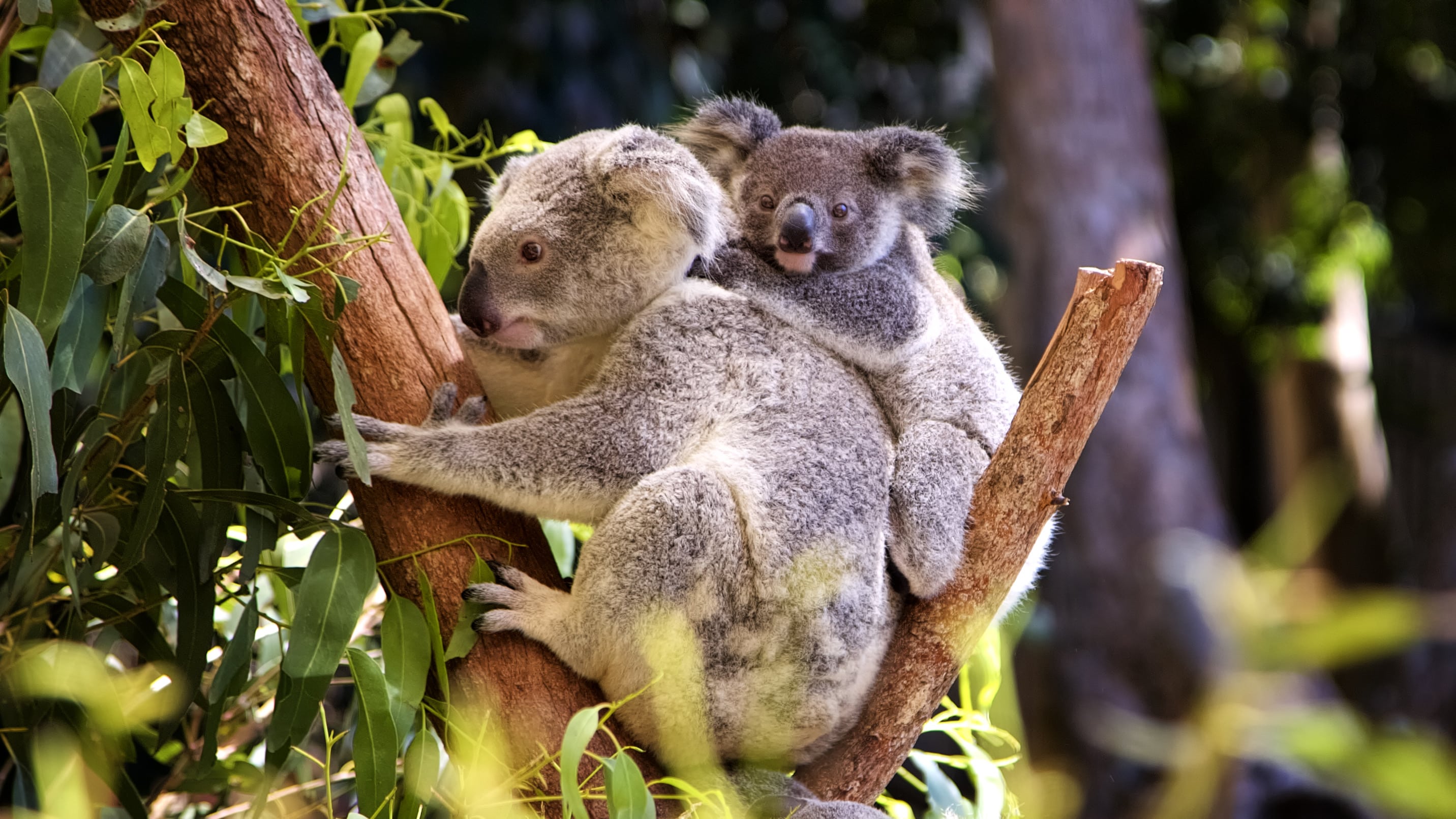
Koalas are often mistakenly referred to as koala bears — they are not bears but are more closely related to wombats. Koalas spend up to 18-20 hours a day resting, largely because their diet of eucalyptus leaves is toxic to most animals and provides very little energy.
Young koalas eat their mother’s droppings for a few weeks before they can start eating eucalyptus leaves — one of those facts that sounds impossible until you look it up.
Koalas have fingerprints that are virtually indistinguishable from human fingerprints, even under an electron microscope — a case of convergent evolution, given that koalas and humans last shared a common ancestor roughly 70 million years ago. Each koala’s prints are unique to the individual, and they have occasionally confused crime scene investigators in Australia who unknowingly collected koala prints at outdoor crime scenes. They also have two opposable thumbs on each front paw rather than one, which helps them grip smooth eucalyptus branches.
Koalas are listed as vulnerable in Australia, with populations under pressure from habitat loss, disease and climate change. Seeing one in the wild is increasingly special.
Where to see them: Kennett River on the Great Ocean Road (Victoria), Kangaroo Island (South Australia), Currumbin Wildlife Sanctuary (Gold Coast), Bimbi Park at Cape Otway (Victoria).

Platypus
Possibly the strangest animal on Earth. The platypus is one of only two egg-laying mammals (monotremes) on Earth. It uses electroreceptors in its bill to detect the electrical signals of prey underwater — a trait found in no other mammal. Its blend of mammalian, reptilian and bird-like traits left early European naturalists baffled, with some believing it was a hoax.
Male platypuses have venomous spurs on their hind legs capable of causing intense pain in humans — another fact that seems invented.
Where to see them: Tidbinbilla Nature Reserve (ACT), Broken River (Queensland), Eungella National Park (Queensland), Yarra River tributaries (Victoria). Dawn and dusk are the best times.

Echidna
One of only two monotremes (egg-laying mammals) in the world. These spiky animals look something like a hedgehog crossed with an anteater. A baby echidna is adorably known as a puggle.
On the spines: Echidna spines are genuinely sharp — strong, keratinous, and capable of causing a painful puncture wound if you handle one or accidentally step on one in the bush. They do not have barbs, do not detach like porcupine quills, and are not toxic or venomous. The risk is almost entirely self-inflicted: an echidna’s response to any perceived threat is to curl into a tight ball, dig rapidly into the ground, or wedge itself under a rock — it will not pursue or attack. If you encounter one, observe from a short distance and let it go about its business. Never pick one up.
Echidnas are surprisingly common — you may encounter one crossing a path in a suburban park, moving with an unhurried determination that suggests they know full well nobody is going to bother them.
Where to see them: Found throughout Australia, including suburban national parks. Simply paying attention on bush walks is often enough.

Wombat
Built like short, stocky bears, wombats are actually related to koalas and kangaroos. Being expert diggers, they use powerful claws to excavate extensive burrow systems. If threatened, a wombat dives headfirst into its tunnel, blocking the entrance with its sturdy backside.
Wombats are also the only animals in the world to produce cube-shaped droppings — a consequence of their unusually long digestive process, which takes four times longer than a human’s. The cubes are used to mark territory and attract mates, and the shape is thought to prevent them from rolling off the logs and rocks wombats prefer to defecate on. Their pouch faces backward rather than forward, so it doesn’t fill with dirt while they dig — one of nature’s more elegant engineering solutions. And if cornered by a predator, a wombat’s final defence is to back into its burrow and use its reinforced, cartilage-hardened rear end to crush the predator against the tunnel roof.
Although they usually waddle along, if threatened they can reach speeds of approximately 38km/h. A wombat running at speed is one of nature’s more surprising sights.
Where to see them: Maria Island and Cradle Mountain in Tasmania, Kosciuszko National Park (NSW), Blue Mountains National Park.

Quokka
Dubbed the world’s happiest animal, quokkas are only found on Rottnest Island near Perth. The quokka selfie has become one of Australia’s most enduring social media traditions — these small marsupials are fearless around humans and will pose obligingly.
Quokkas roam Rottnest Island with the liberty and confidence of a tourist. With no natural predators or traffic on the island, quokkas have grown accustomed to humans and often make attempts to sneak into restaurants and campsites in search of food.
Where to see them: Rottnest Island, 19km off the coast of Perth — a 30-minute ferry from Fremantle.

Tasmanian devil
The world’s largest carnivorous marsupial, found only in Tasmania. Famous for its spine-chilling screech and bone-crushing bite. Tasmanian devils are facing a severe threat from Devil Facial Tumour Disease (DFTD), a contagious cancer that has caused significant population decline. Conservation programs have stabilised wild populations and reintroduced small numbers to mainland Australia for the first time in 3,000 years.
The Tasmanian devil delivers the strongest bite for its size of any mammal in the world — its jaws open up to 80 degrees and can crush bone, and they have been known to bite through metal cage bars. They eat every part of their prey including bones, fur and organs, leaving almost nothing behind — and they store fat in their tails, which thicken visibly when food is abundant. The famous wide-mouthed “yawn” that makes them look terrifying is actually a display of anxiety and fear rather than aggression — they are telling you they are nervous, not that they want a fight. A mother gives birth to a litter of up to 40 joeys, each roughly the size of a grain of rice — but the pouch has only four teats, meaning only the first four to reach it survive.
Where to see them: Cradle Mountain, Freycinet National Park and most wildlife sanctuaries in Tasmania. A trip to Tasmania is worth planning — it is one of the most extraordinary wildlife destinations in the world.

Kookaburra
Not dangerous, not particularly rare, but unforgettable. The laughing kookaburra produces a call so extraordinary that it has been used as the standard jungle sound effect in Hollywood films for decades — including Tarzan and Jurassic Park — despite the bird living nowhere near a jungle. The laugh is not actually laughter at all: it is a territorial call to warn other birds to stay away, most often performed at dawn and dusk when family groups join in chorus together.
Kookaburras mate for life, and adult offspring from previous years stay on as helpers — incubating eggs, feeding chicks and defending the territory alongside their parents. Despite the jovial reputation, they are skilled and ruthless hunters whose diet includes lizards, small snakes, mice and frogs, with larger prey killed by bashing it against a tree branch before swallowing.
You will hear kookaburras shortly after arriving in Australia. They begin at dawn and sound unmistakably like human laughter.

Emu
The emu is the second largest bird in the world after the ostrich, standing up to two metres tall and capable of running at 50km/h. It cannot fly, but its powerful legs — the only bird with a true calf muscle — can kick hard enough to break bones, and its clawed toes can disembowel a dog. Once a breeding pair forms, the female lays her clutch and walks away — the male incubates the eggs alone for 56 days without eating, drinking or leaving the nest, losing up to a third of his body weight in the process, then raises the chicks for another 18 months.
In 1932, the Australian government deployed soldiers with Lewis machine guns and 10,000 rounds of ammunition to cull 20,000 emus that were destroying wheat crops in Western Australia. The operation was called off after six days. The major commanding the operation observed: “They can face machine guns with the invulnerability of tanks.” The emus won.

Where to see Australian wildlife near major cities
| City | Best nearby wildlife spot | What to see |
|---|---|---|
| Sydney | Royal National Park, Ku-ring-gai Chase NP | Kangaroos, echidnas, wallabies, lyrebirds |
| Melbourne | Healesville Sanctuary, Grampians NP | Koalas, wombats, platypus, emus |
| Brisbane | D’Aguilar National Park, Lamington NP | Kangaroos, gliders, koalas |
| Perth | Rottnest Island, John Forrest NP | Quokkas, kangaroos, echidnas |
| Adelaide | Cleland Wildlife Park, Kangaroo Island | Koalas, kangaroos, wombats, platypus |
| Darwin | Kakadu National Park, Darwin Crocodile Farm | Saltwater crocodiles, freshwater crocodiles, birds |
| Cairns | Daintree Rainforest, Great Barrier Reef | Cassowaries, tree kangaroos, marine life |
Part two: animals to be aware of
The actual numbers first. According to Australian Bureau of Statistics data for 2023, all of Australia’s wildlife combined caused just 36 deaths in a year. Humans killed 494 Australians through assault and homicide — more than 13 times the wildlife toll.
What surprises most people: it is not snakes or spiders sending the most Australians to hospital. That honour belongs to the humble European honey bee, responsible for over 3,500 hospitalisations annually. There have been no confirmed deaths from funnel-web or redback spiders since 1979, thanks to antivenom. On average there are approximately two snake deaths per year in Australia, out of an annual worldwide total of 140,000.
This is not to say Australian wildlife is harmless — some of it is genuinely dangerous and deserves genuine respect. But the gap between Australia’s reputation and its reality is enormous.
Eastern brown snake
Where: Eastern Australia — found in and around most major cities including Sydney, Melbourne, Brisbane and Adelaide. Common in suburban gardens, farmland, bushland and parks.
Risk: The eastern brown is responsible for more snakebite deaths in Australia than any other species — not because it is the most venomous, but because it lives alongside humans. It is highly alert, fast-moving and defensive when cornered.
What to do: If you see one, do not approach, do not try to handle it, and do not corner it. Back away slowly. Snakes will almost never pursue a human — the vast majority of bites happen when people try to handle or kill the snake.
First aid: Apply a pressure immobilisation bandage (firm, not tight) over the bite site and entire limb. Do not wash the wound — the venom residue is used to identify the snake species for antivenom. Call 000 immediately.
Reality check: Most encounters end with the snake retreating. Bites are rare. Antivenom is available and effective.
Inland taipan
Where: Arid inland areas of Queensland and South Australia — remote outback regions far from major cities.
Risk: The inland taipan has the most toxic venom of any snake in the world. However, it is extremely shy, lives in extremely remote areas, and has never killed a human.
Reality check: You will almost certainly never encounter one. This is the animal that gives Australia its fearsome reputation and has killed precisely zero people.
Redback spider
Where: Throughout Australia — found in sheltered, undisturbed locations: garden sheds, under outdoor furniture, letterboxes, woodpiles, outdoor toilets, under rocks.
Risk: The redback is found across Australia and bites thousands of people per year. The bite is painful and causes sweating, nausea and muscle pain. Thanks to antivenom (introduced in 1956), there have been no confirmed deaths from redback bites since 1979.
What to do: Shake out shoes left outside, gloves and clothing before putting them on. Check under outdoor furniture and in garden sheds. If bitten, apply a cold pack (not a pressure bandage — this is different from snake bite first aid) and seek medical attention.
Sydney funnel-web spider
Where: Sydney and surrounding areas — found in moist, cool areas including garden mulch, under rocks, in suburban gardens and bush areas around Sydney.
Risk: The male Sydney funnel-web has highly toxic venom and is regarded as one of the world’s most dangerous spiders. It is aggressive when threatened and can rear up and strike. Antivenom (introduced in 1980) has meant no confirmed funnel-web deaths since 1979.
What to do: If you find one, do not try to handle it. Call a pest controller or place an upturned bucket over it. If bitten, apply a firm pressure immobilisation bandage and call 000 immediately.
Geography note: The Sydney funnel-web is genuinely only found around Sydney and surrounds. If you are living in Melbourne, Brisbane or Perth, you will not encounter one.
Saltwater crocodile
Where: Northern Australia — rivers, estuaries and coastal areas in the Northern Territory, Queensland (north of around Mackay) and northern Western Australia. Not found south of the tropics.
Risk: The saltwater crocodile is the world’s largest living reptile and a genuine apex predator. It is fast, powerful, patient and should be treated with absolute seriousness in its habitat.
What to do: In crocodile country, follow the signage. Never swim in rivers, estuaries, mangroves or beaches that are not confirmed croc-free. Never camp or prepare food at the water’s edge. Never assume still water is safe.
Geography note: Crocodiles are only found in tropical northern Australia — if you are living in or visiting Sydney, Melbourne, Adelaide or Perth, you will not encounter one. In Darwin and Cairns, they are a genuine local consideration.
Box jellyfish and Irukandji
Where: Tropical Australian waters — along the north Queensland coast between roughly Gladstone and Broome, and the NT coast. Stinger season runs approximately October to May.
Risk: The box jellyfish is considered the most venomous marine animal on Earth. Its sting can cause excruciating pain, paralysis and cardiac arrest within minutes. The Irukandji jellyfish is barely visible — around 2.5cm — and its sting causes delayed but severe symptoms.
What to do: In stinger season in tropical northern Australia, swim only in stinger-netted enclosures. Wear a stinger suit. Vinegar is the recommended first aid to neutralise box jellyfish venom before seeking medical help.
Geography note: Box jellyfish are not found in Sydney or Byron Bay. They only inhabit tropical waters between approximately Gladstone and Broome.
Sharks
Where: Australian coastal waters — present along all coastlines but concentrated near fish, bait and areas with murky or warm water.
Risk: Shark attacks make global headlines but are statistically rare. Australia averages around 15-20 unprovoked shark encounters per year, with fatalities in single figures most years.
What to do: Swim at patrolled beaches between the red and yellow flags. Avoid swimming at dawn, dusk or at night. Avoid swimming near schools of fish or near river mouths after rain. Do not swim with open wounds.

Blue-ringed octopus
Where: Rock pools, shallow reefs, sandy bottoms and coastal waters around the entire Australian coastline — including Sydney, Melbourne and Tasmania. It is a common myth that blue-ringed octopuses are found only in the tropics.
Risk: The blue-ringed octopus carries enough venom to kill more than 20 adult humans within minutes — and there is no antivenom. Its venom contains tetrodotoxin, a neurotoxin claimed to be a thousand times more potent than cyanide, which blocks nerve signals to the muscles including those that control breathing. Victims can remain fully conscious but completely paralysed. The bite is often painless, and the characteristic iridescent blue rings only appear when the animal is agitated — meaning it may not display its warning colours before biting.
What to do: Apply a pressure immobilisation bandage over the bite site and entire limb — the same technique as for snakebite and funnel-web spider bite. Call 000 immediately. Without treatment, paralysis and respiratory failure can develop within 10 to 30 minutes. Survival depends on fast first aid and ventilatory support at a hospital.
What to avoid: Picking up shells, rocks or debris in rock pools. Do not pick up any small octopus regardless of whether blue rings are visible. Be especially careful exploring rock pools, cracks, crevices or picking up empty shells or bottles at the beach, where the octopus may be hiding.
Reality check: The blue-ringed octopus is docile and its first instinct when threatened is to flee. Bites are rare and almost always occur when people handle one. Leave it alone and the risk is effectively zero.
Kangaroos — the unexpected road hazard
Kangaroos are beloved, iconic and genuinely dangerous in one specific situation: roads.
Road risk: Kangaroos are crepuscular (most active at dawn and dusk) and move unpredictably. Hitting a kangaroo at highway speed is a serious accident. In rural and regional areas, drive cautiously at dawn and dusk. If a kangaroo appears on the road, brake firmly and do not swerve.
Direct encounters: A large male kangaroo can be 2 metres tall and weigh 90kg. If cornered or threatened, they can scratch and kick powerfully. Give them space and do not approach.
Key first aid reminders
- Snakebite: Pressure immobilisation bandage over the whole limb. Do not wash the wound. Call 000.
- Funnel-web spider: Pressure immobilisation bandage. Call 000 immediately.
- Redback spider: Cold pack. Seek medical attention. Not a pressure bandage.
- Box jellyfish: Apply vinegar to neutralise the venom. Call 000.
- Bluebottle jellyfish: Hot water (as hot as tolerable) on the sting area.
- Crocodile: Prevention only. If attacked, fight back targeting the eyes and snout.
Always: Antivenom is available for all venomous Australian species at major hospitals. Call 000 for any medical emergency.
Poisons Information Centre: 13 11 26 (24 hours, 7 days — available throughout Australia)
FAQs (frequently asked questions)
Are spiders really everywhere in Australia?
You will encounter spiders in Australia — they are part of suburban life. However, the two genuinely dangerous spiders (funnel-web and redback) are not found in every suburb. Redbacks are widespread but shy; funnel-webs are limited to Sydney and surrounds. The large spiders you are most likely to encounter — the huntsman — are harmless despite their alarming size.
Do kangaroos hop everywhere in cities?
Kangaroos are not found in inner-city areas but are common on the suburban fringe, in national parks near cities and in regional areas. Most people living near bushland see them regularly, especially at dawn and dusk.
Is it safe to swim in Australian beaches?
Sydney, Melbourne, Brisbane, Perth and Adelaide all have excellent patrolled beaches where swimming is safe. Always swim between the red and yellow flags at a patrolled beach. Crocodiles and box jellyfish are not found in southern Australian waters.
Can I pat a koala or kangaroo?
At wildlife sanctuaries, interaction is often possible under supervised conditions. In the wild, it is best to keep distance. Wild kangaroos are not aggressive but can react if approached too closely. Some wildlife parks allow koala interactions — check local laws, as Queensland banned koala holding in 2024.
What should I do if I find a snake in my garden?
Do not approach it. Call a licensed snake catcher (most areas have a local service) or your local council for referral. Do not try to move or kill the snake — this is when most bites occur.
Where is the best place to see a platypus in the wild?
Eungella National Park near Mackay in Queensland and Tidbinbilla Nature Reserve near Canberra are among the most reliable locations. Dawn and dusk at calm creek edges.
This guide is for general information only. Always follow local signage and advice, and call 000 in any medical emergency. For poison enquiries, call the Poisons Information Centre on 13 11 26.
Sources: Australian Bureau of Statistics — Causes of Death 2023 | aussieanimals.com — Most Dangerous Animal in Australia: 20 Years of Real Data | Australian Museum — Dangerous Animals | Tourism Australia — Beginner’s Guide to Australian Wildlife | World Nomads — Dangerous Animals in Australia | vic.gov.au | naturetrust.org.au | thewildlifediaries.com


