Chuseok (추석) is three days when South Korea essentially stops.
Trains sell out weeks in advance. The highways fill with cars heading south to Busan, east to Gangwon, everywhere outward from Seoul to the provinces. Shops close. The streets of the city empty. And across the country, in apartments and villages and farmhouses, families sit down together at tables laden with food — for the harvest, for their ancestors, for each other.
In 2026, Chuseok falls on Friday 25 September — making the official three-day public holiday run from Thursday 24 September to Saturday 26 September. For Koreans in Australia and New Zealand, it is the weekend when home is felt most keenly from the other side of the world.
What is Chuseok?
Chuseok — also known as Hangawi (한가위) — is Korea’s mid-autumn harvest festival, celebrated on the 15th day of the 8th lunar month, coinciding with the full moon. It is one of the two most important holidays in the Korean calendar (alongside Seollal, Lunar New Year) and is often called Korean Thanksgiving for its themes of gratitude, harvest and family reunion.
The name Chuseok means “Autumn Eve” in Korean. The alternative name Hangawi is older — from an ancient Korean term meaning “the great middle of autumn.” Both names point to the same thing: the harvest moon at the height of the autumn season, and the gathering of family beneath it.
Chuseok has roots over 2,000 years old — traced to the Silla Kingdom era, when it is said King Yuri (r. 24-57 CE) organised a month-long weaving competition between court ladies, ending in a feast and folk games. Over centuries it absorbed Confucian traditions of ancestor reverence, Buddhist influences and the agricultural rhythms of Korean rural life. Today it is all of those things at once: ancient ritual, family reunion and public holiday.
The traditions of Chuseok
Charye — ancestral rites
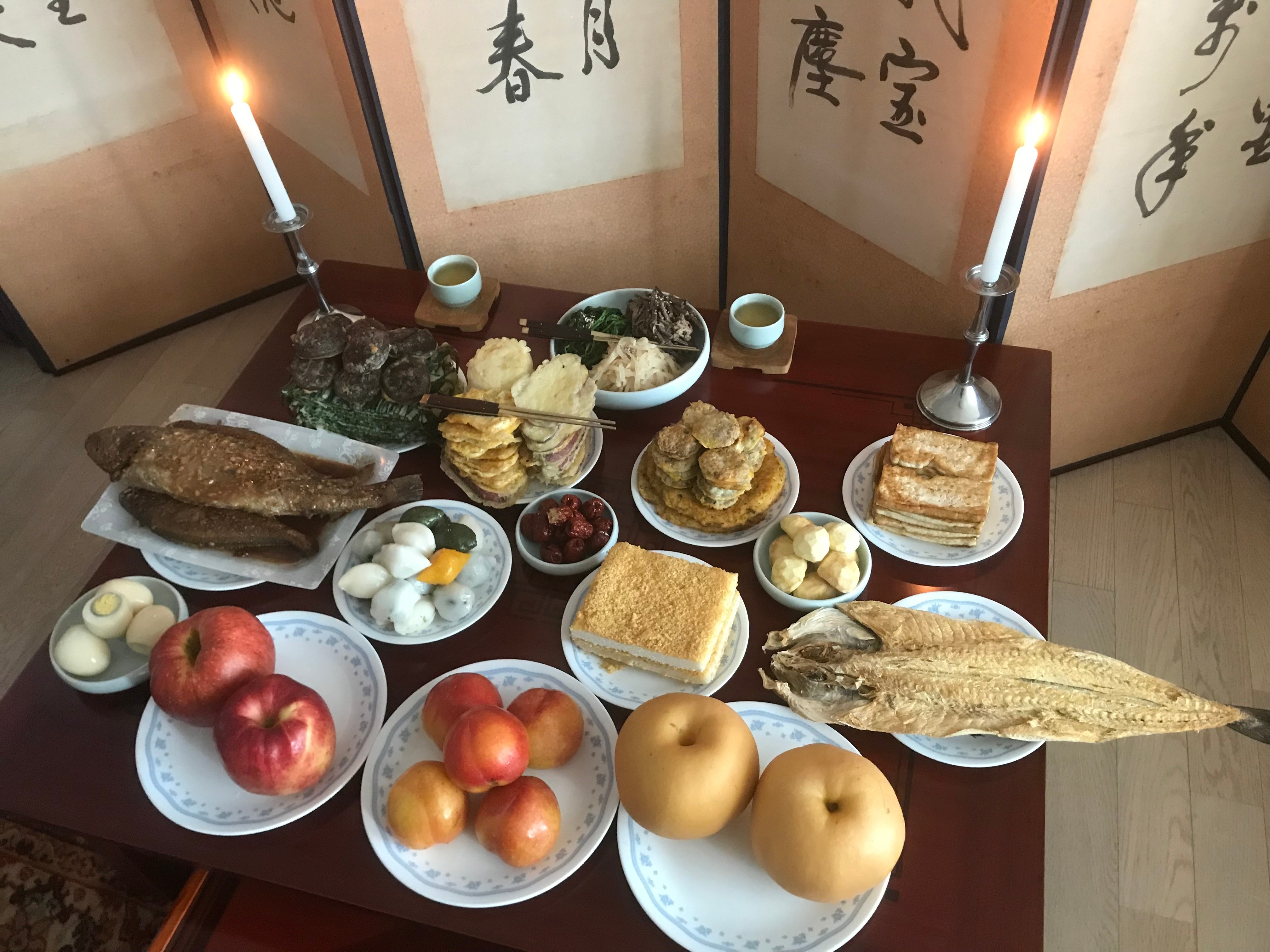
The heart of Chuseok morning is charye (차례) — a formal ceremony to honour the spirits of ancestors. Families arrange a ceremonial table (jesik) with carefully prepared foods: freshly harvested rice, songpyeon rice cakes, fruits, vegetables, fish and meat. All dishes face the proper direction, placed in a precise order that has been passed down through generations.
The eldest son opens the ceremony — symbolically inviting the ancestors in. Incense is lit. A full table setting is laid as if the ancestors will eat. The family bows deeply together, twice. Wine is poured and offered. This is not a performance or a formality — for most Korean families, it is a deeply sincere act of remembrance, a moment of continuity between the living and the dead.
After charye, the family sits together and eats the ceremonial food — sharing the meal with the memory of those who came before.
Seongmyo — visiting ancestral graves
After the morning charye, many families travel to the graves of their ancestors for seongmyo (성묘) — clearing weeds from the burial site, tidying the grave, and performing a simple outdoor ceremony. It is an act of care and respect — keeping the resting places of those who shaped the family clean and tended.
For Korean families in the diaspora, this is one of the traditions most felt from a distance — the inability to visit the family grave in person during Chuseok is a quiet, persistent ache of migration.
Songpyeon — the taste of Chuseok
If Chuseok has a single defining food, it is songpyeon (송편) — small half-moon-shaped rice cakes filled with sweet fillings (sesame seeds and honey, red bean paste, chestnut) and steamed over a bed of pine needles. The pine needles give the rice cakes a subtle, distinctive fragrance that is, for most Koreans, the smell of Chuseok itself.

Making songpyeon together as a family — grandmothers, mothers, daughters and daughters-in-law kneading dough at the same table — is one of the holiday’s most treasured rituals. There is a Korean saying: the woman who makes beautiful songpyeon will have beautiful children. This is repeated with varying degrees of seriousness depending on the grandmother saying it.
Other Chuseok foods:
- Japchae — glass noodles stir-fried with vegetables, egg and beef in sesame oil
- Galbi — marinated beef short ribs, grilled or braised
- Taro soup (toranguk) — a rich, earthy soup made from freshly harvested taro root; almost exclusively made at Chuseok
- Hangwa — traditional Korean confections: honey rice puffs, sesame candies, flower-shaped jellies
- Makgeolli — milky fermented rice wine; the classic Chuseok drink
Hanbok — traditional dress

Chuseok is one of the few occasions when Koreans across all generations wear hanbok (한복) — traditional Korean clothing. The loose, flowing robes in jewel colours — jade green, persimmon orange, ivory, deep blue — transform Chuseok mornings into something visually extraordinary.
For many Korean families, wearing hanbok at Chuseok is a connection to cultural identity that feels more meaningful with each passing year as daily Korean dress becomes indistinguishable from anywhere in the world.
Ganggangsullae — the full moon circle dance
On the eve of Chuseok, in villages and communities across Korea, women traditionally gather under the full moon and perform ganggangsullae (강강술래) — a circle dance where participants hold hands, walk slowly in a circle singing, gradually increasing the pace until the dance becomes joyful and fast. The tradition is rooted in ancient harvest celebrations and was designated a UNESCO Intangible Cultural Heritage in 2009.
Traditional folk games
Chuseok is also a time for traditional games — ssireum (씨름), Korean traditional wrestling where competitors grip each other’s cloth belt and try to throw the opponent to the ground; and yutnori (윷놀이), a board game played with four wooden sticks used as dice. Both are played in the open air, across generations, and both have been part of Korean autumn celebrations for centuries.
Chuseok for Koreans in Australia and New Zealand
South Korea is now one of Australia and New Zealand’s most significant migration source countries. There are approximately 180,000 Korean-Australians and over 30,000 Korean-New Zealanders — communities that celebrate Chuseok in church halls, community centres, Korean restaurants and living rooms across Sydney, Melbourne, Auckland and Wellington.
For these communities, Chuseok is the holiday that connects two worlds. The charye might be performed in a Melbourne apartment rather than a village house in Gyeongju. The songpyeon might be bought from a Korean grocery in Strathfield rather than made by hand over two days. But the act of gathering, remembering and giving thanks remains the same.
And every Chuseok, money moves across the Pacific — from Korean-Australians and Korean-New Zealanders back to family in Korea, to contribute to the Chuseok table, to support parents who made the ancestral rites alone this year, to say: I am thinking of you from here.
Sending money home for Chuseok
AUD to KRW and NZD to KRW transfers with OrbitRemit are fee-free — no exchange rate markup, with over 85% of transfers arriving within 2 hours. Send money home for Chuseok before the 25 September holiday so it arrives in time. New customers get our special promo rate.*
추석 잘 보내세요. Have a wonderful Chuseok.
*New customers only. Limited time offer. Rate subject to change. $500 AUD limit applies. Terms and conditions apply. Not available in conjunction with any other offer.
When is Chuseok?
| Year | Chuseok date | Public holiday |
|---|---|---|
| 2026 | Friday 25 September | 24-26 September |
| 2027 | Wednesday 15 September | 14-16 September |
| 2028 | Monday 2 October | 1-3 October |
FAQs (frequently asked questions)
When is Chuseok 2026?
Chuseok 2026 falls on Friday 25 September. The official three-day public holiday runs from Thursday 24 September to Saturday 26 September.
What does Chuseok mean?
Chuseok (추석) means “Autumn Eve” in Korean. It is also called Hangawi (한가위) — an ancient term meaning “the great middle of autumn.” Both names refer to the mid-autumn harvest moon festival.
What is the difference between Chuseok and Korean Lunar New Year (Seollal)?
Both are major three-day family holidays based on the lunar calendar. Seollal (설날) marks the start of the new year in January or February; Chuseok marks the harvest in September or October. Both involve ancestral rites, family reunions and traditional food, but the specific rituals, foods and seasonal associations differ.
Is Chuseok the same as the Chinese Mid-Autumn Festival?
They fall on the same lunar date — the 15th day of the 8th lunar month — and share harvest moon themes, but the traditions are distinct. The Chinese Mid-Autumn Festival is associated with mooncakes and the Chang’e moon legend. Chuseok centres on ancestral rites, songpyeon, seongmyo grave visits and the ganggangsullae dance.
Can I send money to South Korea for Chuseok from Australia or New Zealand?
Yes — AUD to KRW and NZD to KRW transfers with OrbitRemit are fee-free. Over 85% of transfers arrive within 2 hours.
Sources: wanderlustmagazine.com — Chuseok: Everything you need to know (October 2025) | 90daykorean.com — Chuseok in Korea (March 11, 2026) | publicholidays.co.kr — Chuseok 2026 (January 2026) | voyageblogger.com — Chuseok 2026: Korea’s Traditional Harvest Festival (June 14, 2026) | southkoreahallyu.com — Chuseok holiday South Korea guide (3 weeks ago) | Wikipedia — Chuseok


