When is Dussehra in 2026?
Dussehra 2026 falls on Tuesday, 20 October 2026.
The festival is observed on the tenth day of the bright fortnight (Shukla Paksha Dashami) of the Hindu month of Ashvin. The Dashami tithi begins at 12:50 PM on 20 October and ends at 2:11 PM on 21 October 2026.
Note on dates: Because Hindu festivals follow the lunar calendar, timings shift slightly depending on location. Parts of eastern India and West Bengal observe Bijoya Dashami — the equivalent celebration — on 21 October 2026. Check a local panchang for the precise timing for your city.
Vijay Muhurat for New Delhi: Approximately 1:59 PM to 2:45 PM on 20 October 2026.
The entire day of Dussehra is considered an abuja muhurat — meaning the whole day is auspicious, without needing to observe a specific window. Anything begun on this day is traditionally believed to end in success and victory.
What is Dussehra?
Dussehra — also known as Vijayadashami (meaning “victorious tenth day”), Dasara and Dassahra — is one of the most important Hindu festivals celebrated across India and among Indian communities worldwide. It falls on the tenth day of Navratri and marks the culmination of nine days of devotion to Goddess Durga.
The festival celebrates two great victories of good over evil — one from the Ramayana, the other from the Devi Mahatmya — and carries a message that is observed at households, fairgrounds, town squares and temple courtyards across India every year.
The two stories behind Dussehra
Lord Rama’s victory over Ravana
The most widely celebrated story associated with Dussehra is from the Ramayana — the ancient Sanskrit epic attributed to the sage Valmiki.
Ravana, the king of Lanka, abducted Sita — the wife of Lord Rama — and carried her to his island kingdom. Rama, accompanied by his brother Lakshmana and the armies of the monkey god Hanuman, crossed the ocean to Lanka to rescue her. After a long and arduous battle, Rama defeated and killed Ravana on the tenth day — the day that is now celebrated as Dussehra.
Ravana is depicted in Hindu tradition as a figure of extraordinary power and learning — a great scholar and devotee of Lord Shiva — but one whose arrogance, ego and wrongdoing ultimately led to his destruction. His defeat at the hands of Rama represents the triumph of righteousness over pride and injustice.
Goddess Durga’s defeat of Mahishasura
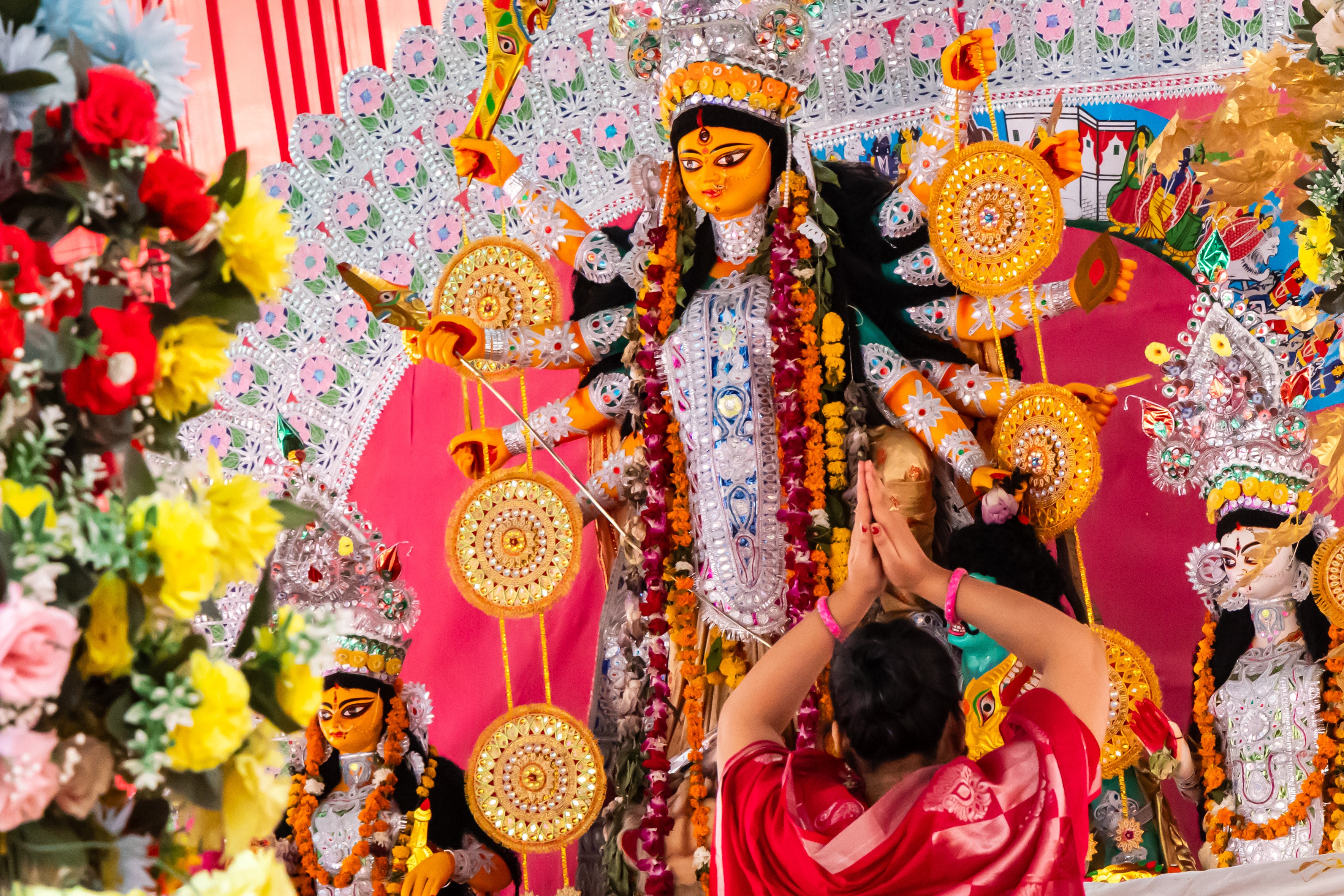
The second story comes from the Devi Mahatmya (part of the Markandeya Purana). Mahishasura, a demon king of great power, had received a boon of near-invincibility and had conquered both the earthly and heavenly realms. The gods, unable to defeat him, combined their divine energies to create Goddess Durga — a warrior goddess of supreme power. After nine days of fierce battle (the nine days of Navratri), Durga slew Mahishasura on the tenth day — Vijayadashami.
The two stories together give Dussehra its central meaning — the eternal truth that good ultimately overcomes evil, that dharma (righteousness) prevails over adharma (wrongdoing), and that even the most powerful force of darkness can be overcome.
Navratri 2026 — the nine days before Dussehra
Dussehra arrives on the heels of Navratri — nine nights of devotion to Goddess Durga in her nine forms. Navratri 2026 is expected to begin around 12 October and culminate on 20 October — the day of Dussehra itself.
During Navratri:
- Each day is dedicated to one of the nine forms of Durga (the Navadurga)
- Each day has its own colour, significance and rituals
- Devotees fast, perform aarti, visit temples and observe pujas
- Garba (a circular devotional dance form from Gujarat) and Dandiya Raas (a dance performed with decorated sticks) are celebrated in the evenings — sometimes continuing until sunrise
- Ram Leela — a dramatic enactment of the Ramayana — is performed across North India in the ten days leading up to Dussehra, with Ravana’s defeat staged on the final day
How Dussehra is celebrated
Ravana Dahan — the burning of the effigies
The most iconic image of Dussehra is the burning of enormous effigies of Ravana, his son Meghnath (Meghnad) and his brother Kumbhakarna — the three central villains of the Ramayana. The effigies, stuffed with firecrackers, are set alight at dusk while crowds gather to watch; the bursting crackers inside the burning effigies create a spectacular display.
In Delhi, the Ramlila Maidan celebrations draw hundreds of thousands of people each year. In many cities, the effigies reach 30, 50 and sometimes over 100 feet in height. Public figures and politicians often light the first arrows. The symbolism is deliberate — the burning of Ravana represents the destruction of ego, greed, arrogance and negative human tendencies within each person.
Mysuru Dasara — the royal celebration
The Mysuru Dasara (Mysore Dasara) in Karnataka is one of the most famous Dussehra celebrations in India — a 10-day festival with its roots in the royal traditions of the Wadiyar dynasty of Mysore. The culminating procession on Vijayadashami — the Jamboo Savari — features a golden howdah (ceremonial seat) mounted on a decorated royal elephant, surrounded by tableaux, musicians, folk dancers and the Karnataka police cavalry. It draws hundreds of thousands of visitors and is broadcast nationally.
Durga Visarjan
In eastern India — particularly West Bengal, Odisha and Assam — Dussehra is observed as the conclusion of Durga Puja, the five-day festival honouring Goddess Durga. On Bijoya Dashami (the final day), the clay idols of Durga that have been worshipped through the festival are carried in procession to nearby rivers, lakes or the sea and immersed in the water — a farewell to the goddess until the following year. The immersion (Visarjan) is an intensely emotional occasion — the clay idols return to the earth, and the goddess returns to her heavenly abode.
Shastra Puja and Ayudha Puja
Dussehra is also the occasion for Shastra Puja — the worship of weapons, tools and the instruments of one’s livelihood. In South India, this is known as Ayudha Puja and is typically observed on the ninth day (Mahanavami). Farmers worship their ploughs and farming tools; craftspeople and artisans honour their instruments; vehicles (cars, motorcycles, tractors) are decorated with flowers and blessed; police and military units perform ceremonial cleaning and puja of their equipment.
The tradition reflects a deeper principle — that the tools through which one earns a living and serves the world are worthy of gratitude and respect.
Shami Puja and the exchange of leaves
In parts of Maharashtra and Karnataka, Dussehra involves the worship of the Shami tree — associated in the Mahabharata with the Pandavas’ period of exile — and the exchange of Shami leaves (sometimes replaced with gold leaf or Apta leaves, depending on the region) as a symbol of prosperity and goodwill.
Dussehra in Australia and New Zealand
India is the second largest source country of migrants to Australia and one of the fastest growing migrant communities in New Zealand. Dussehra is celebrated by Indian communities across both countries — in community halls, temple grounds and open parks with Garba, Ram Leela performances, cultural programs and family gatherings.
In Australia: Large Dussehra and Navratri celebrations are held in Melbourne, Sydney, Brisbane, Adelaide and Perth — organised by regional Indian associations, temple committees and cultural organisations. Melbourne’s Indian community in the western and northern suburbs hosts some of the largest Garba nights in the Southern Hemisphere.
In New Zealand: Wellington, Auckland and Christchurch all have active Indian community organisations that celebrate Navratri and Dussehra with cultural programs and gatherings.
Sending money home for Dussehra
Dussehra and the festive season that follows (Diwali is approximately three weeks later, on 8 November 2026) is one of the most important times of year for Indian families — a time of gifting, new purchases, family gatherings and celebrations.
For Indian-Australians and Indian-New Zealanders sending money home for the festive season, OrbitRemit offers fee-free AUD to INR and NZD to INR transfers — with the rate locked at the time of confirmation.
Key dates — Indian festive season 2026
| Festival | Date |
|---|---|
| Navratri begins | ~12 October 2026 |
| Dussehra / Vijayadashami | 20 October 2026 |
| Diwali | ~8 November 2026 |
| Bhai Dooj | ~10 November 2026 |
FAQs (frequently asked questions)
When is Dussehra in 2026?
Tuesday, 20 October 2026. Some eastern regions observe Bijoya Dashami on 21 October. Check a local panchang for your city’s precise timing.
What is Dussehra?
Also known as Vijayadashami, Dasara and Dassahra — a major Hindu festival marking the victory of good over evil; celebrated on the tenth day of Navratri; commemorating Lord Rama’s defeat of Ravana and Goddess Durga’s defeat of the demon Mahishasura.
What is Ravana Dahan?
The ritual burning of effigies of Ravana, his son Meghnath and his brother Kumbhakarna — symbolic of the destruction of ego, arrogance and evil; the most iconic public event of Dussehra celebrations across North India.
Is Dussehra a public holiday in India?
Yes — Dussehra (Vijayadashami) is a gazetted public holiday across India.
What comes after Dussehra?
Diwali — the festival of lights — follows approximately three weeks after Dussehra. In 2026, Diwali falls on approximately 8 November.
How is Dussehra different from Navratri?
Navratri is the nine-day festival of devotion to Goddess Durga that precedes Dussehra. Dussehra is the tenth and culminating day — the victory day — that follows the nine nights of Navratri.
Related guides
- India travel guide 2026 →
- Send money to India guide →
- Cheapest ways to send money to India from Australia and New Zealand →
- What is UPI?
Festival dates are based on the Hindu lunisolar calendar and may vary by one day depending on location. Always verify with a local panchang or community calendar. Last updated September 2026.
Sources: divinehindu.in — Dussehra 2026 Date (1 day ago) | prinjal.com — Dussehra 2026: Date, Significance, History & Celebration (2 weeks ago) | shriprasadam.in — Dussehra 2026 Date, Timing, Muhurat, History & Significance (1 week ago) | bharatbhoomitimes.com — When is Dussehra in 2026 (3 weeks ago) | indiabonds.com — When Is Dussehra 2026 (March 13, 2026) | calendarlabs.com — Dussehra in 2026


