Summary
Australian and New Zealand passport holders can visit Portugal visa-free for up to 90 days — as part of the Schengen Area’s standard 90-day visa exemption for eligible nationalities — no advance application, no fee, no prior approval required; simply arrive with a valid passport (6 months validity beyond your planned departure from Portugal), a return or onward ticket and evidence of sufficient funds if asked; the 90-day limit applies across all 29 Schengen countries combined, not per country; the Entry/Exit System (EES) has been operational at all Schengen borders since April 2026 — biometric data is collected on your first entry; ETIAS pre-travel registration is expected from 2027
Portugal is consistently ranked among the best-value destinations in Western Europe — cheaper than Spain, France and Italy on almost every measure; Lisbon and Porto offer world-class food, wine, museums and architecture at prices that feel genuinely affordable by Australian and New Zealand standards; the Algarve’s beaches rival the Mediterranean at significantly lower cost; a mid-range couple can eat well, stay comfortably and move around the country for AUD $250-350 per day
Portugal rewards slow travel — Lisbon alone warrants 3-4 days; Porto deserves 2-3; Sintra, the Algarve, the Douro Valley wine region, the Alentejo plains and the islands of Madeira and the Azores each add days or weeks; two weeks covers the main circuit from Porto to Lisbon to the Algarve; three weeks lets you slow down and go deeper into the country’s quieter corners
Portugal is one of the most popular European destinations for Australians and New Zealanders — and for good reason. It sits at the western edge of continental Europe with 17 UNESCO World Heritage Sites, 300 days of sunshine per year in the south, extraordinary food and wine at reasonable prices, and an atmosphere that is warm, unhurried and genuinely welcoming to visitors. It is also one of the safest countries in Europe.
Visa and entry requirements
Visa-free entry — no application required
Australian and New Zealand passport holders enter Portugal without a visa for stays of up to 90 days in any rolling 180-day period — as part of the Schengen Area’s standard visa exemption for eligible countries.
Key details:
| Visa required | No |
| Maximum stay | 90 days in any rolling 180-day period |
| Scope | Applies across all 29 Schengen countries combined |
| Passport validity | At least 6 months beyond your planned departure from Portugal |
| Return or onward ticket | Required — have it ready to show at check-in and on arrival |
| Proof of funds | May be requested — a credit card or travel card is generally sufficient |
The Entry/Exit System (EES) — operational since April 2026
Since April 2026, all Schengen borders use the EES — a digital border management system that records every non-EU traveller’s fingerprints and facial image on their first entry, replacing the physical passport stamp. On subsequent entries, automated gates use your biometrics for faster processing. Allow extra time at your first Schengen border crossing.
ETIAS — expected from 2027
ETIAS (European Travel Information and Authorisation System) is a planned pre-travel online registration for visitors from eligible countries including Australia and New Zealand. As of October 2026, the EU has removed the Q4 2026 launch target — 2027 is now the most likely launch year. Until ETIAS launches, no pre-registration is required. The official ETIAS portal when live: travel-europe.europa.eu/etias
Youth Mobility Visa
Australians and New Zealanders aged 18-35 can also apply for Portugal’s Youth Mobility Visa — allowing a longer stay of up to one year in Portugal with the right to work. This is separate from the Schengen visa-free entry and must be applied for before travel through the Portuguese embassy or consulate.
Smartraveller rating: Exercise Normal Safety Precautions.
Best time to visit
Portugal’s climate varies significantly between the north and south — the Algarve and Lisbon are considerably warmer and drier than Porto and the north.
Spring (April to June) — best overall Warm, green and uncrowded; wildflowers across the Alentejo and the interior; comfortable temperatures in Lisbon (18-24°C) and Porto (15-20°C). The Festival of Santo António (Lisbon, 12-13 June) and the Festa de São João (Porto, 23-24 June) are two of Portugal’s finest urban festivals — both centred on street parties, grilled sardines and genuine local celebration. Avoid Easter week for Lisbon and Porto if you want smaller crowds.
Autumn (September to October) — equally excellent Still warm after the summer heat dissipates; the Douro Valley grape harvest (September) is one of Portugal’s most spectacular seasonal events; crowds thin significantly from mid-September; accommodation prices drop. The Algarve in September is still warm enough for beach days (water temperature 22-23°C) but without the July-August peak.
Summer (July to August) — hot and busy Lisbon and the Algarve can reach 38-40°C; the Algarve is at peak capacity with European holiday traffic; hotels and flights are at their most expensive. Still excellent — but book well ahead and prepare for heat.
Winter (November to March) — quiet and mild in the south Lisbon and the Algarve remain mild (14-18°C); significantly cheaper; far fewer tourists; Lisbon’s museums, restaurants and cultural life are excellent year-round. Porto and the north are wetter and cooler. The interior of Portugal and the mountains (Serra da Estrela) can see snow.
Getting there
From Australia
No direct flights from Australia — all routes connect via hub airports in Europe, the Middle East or Asia.
| City | Route | Approx flight time |
|---|---|---|
| Sydney to Lisbon | Via Dubai, Doha, London or Amsterdam | ~22-26 hours total |
| Melbourne to Lisbon | Via Dubai, Doha or Singapore | ~22-26 hours total |
| Perth to Lisbon | Via Dubai or Doha (shorter from Perth) | ~20-22 hours total |
Cost: Return flights from Australia to Lisbon typically range from AUD $1,400-$2,600 booked ahead. Lisbon (LIS) is the main entry point; Porto (OPO) is served by more European carriers and worth considering if you plan to start your trip in the north.
From New Zealand
All routes connect via Australian cities or Asian/European hubs.
Cost: Return flights from Auckland to Lisbon typically range from NZD $1,900-$3,200.
Getting around Portugal
Train — the best way between major cities
Portugal’s rail network connects Lisbon, Porto, Sintra, Cascais and major Algarve towns efficiently. Trains are comfortable and significantly cheaper than taxis or hire cars for city-to-city travel.
Key journey times:
| Route | Time | Notes |
|---|---|---|
| Porto to Lisbon | ~3 hours | Alfa Pendular intercity; frequent service |
| Lisbon to Faro (Algarve) | ~2.5-3 hours | Alfa Pendular; book ahead |
| Lisbon to Sintra | 40 minutes | Frequent suburban trains from Rossio station |
| Lisbon to Cascais | 40 minutes | Frequent coastal train from Cais do Sodré |
| Porto to Aveiro | 1 hour | Frequent service |
Book at: cp.pt (Comboios de Portugal) — book at least a few days ahead for intercity trains on popular routes, particularly in summer.
Car hire
A car is essential for the Douro Valley, the Alentejo, the Serra da Estrela mountains and smaller coastal villages not served by trains. Drive on the right. Toll roads (auto-estradas) are common — most are electronic tolls (Via Verde). If hiring a car, ensure the hire includes a Via Verde transponder or purchase a temporary pass.
City transport
Lisbon has an excellent metro (4 lines), trams, buses and the iconic yellow electric trams (including Tram 28). Porto has a metro system (6 lines) connecting the city centre to the airport and the suburbs. Both cities are very walkable in their historic centres — though Lisbon’s hills can be steep.
Top destinations
Lisbon — the white city on seven hills
Lisbon is one of Europe’s most beautiful and characterful capitals — a city of pale limestone buildings, blue-and-white azulejo tile facades, miradouros (hilltop viewpoints), melancholy fado music floating from tascas and extraordinary food at prices that feel almost impossible by Sydney or Auckland standards. Lisbon was largely rebuilt after the catastrophic 1755 earthquake that destroyed most of the original city, giving the Baixa (lower city) its distinctive grid-plan layout while leaving the older Alfama neighbourhood — built on the hillside above — relatively intact.

Belém: The district 6km west of the city centre where Portugal’s Age of Discovery left its greatest monuments. The Belém Tower (Torre de Belém) — built on the northern bank of the Tagus between 1514 and 1520 as part of the Tagus estuary defence system — is a UNESCO World Heritage Site and one of Portugal’s most iconic landmarks; a masterpiece of Manueline architecture (the ornate Portuguese late-Gothic style incorporating maritime motifs). Adjacent to it, the Jerónimos Monastery (Mosteiro dos Jerónimos) — also UNESCO-listed (1983) — is the finest Manueline building in Portugal, commissioned by King Manuel I to give thanks for Vasco da Gama’s successful voyage to India. The Pastéis de Belém café next to the monastery has sold the same recipe of custard tarts (pastéis de nata) since the early 19th century — the queue is always worth it.

Alfama: Lisbon’s oldest neighbourhood — a dense tangle of narrow lanes, whitewashed houses, laundry strung between buildings and the city’s finest miradouros; the Castelo de São Jorge (São Jorge Castle) at the top offers panoramic views over the city and the Tagus; at night, tascas in the Alfama host fado performances — the melancholy, soulful music genre that is UNESCO Intangible Cultural Heritage.

LX Factory: A repurposed 19th-century industrial complex under the 25 de Abril Bridge — independent restaurants, bookshops, design studios, a weekend market and some of the best brunch in Lisbon.
Mouraria and Intendente: Lisbon’s most authentic and multicultural neighbourhood — less tourist-facing than the Alfama; the Praça do Intendente has undergone significant regeneration and now hosts excellent restaurants and community life.
Sintra — palaces in the hills
Sintra is one of the most extraordinary day trips in all of Europe — a UNESCO World Heritage town in the misty forested hills 30km west of Lisbon, packed with extraordinary 19th-century royal palaces and medieval castles, and reachable by train in 40 minutes from Rossio station.
Pena Palace (Palácio da Pena): A wildly colourful Romanticist palace perched at the top of the Sintra mountains — one of the Seven Wonders of Portugal; built in the 19th century by King Ferdinand II on the ruins of a monastery; its yellow-and-red Bavarian towers, Arab minarets, Manueline windows and Gothic arches make it one of the most architecturally eclectic royal palaces in Europe; can be seen from Lisbon on a clear day.

Quinta da Regaleira: A neo-Manueline palace and estate filled with esoteric symbolism — underground tunnels, an inverted tower (the Initiation Well) descending 27 metres into the earth and gardens full of hidden grottos and fountains. One of Sintra’s most distinctive and memorable experiences.


Sintra National Palace (Palácio Nacional de Sintra): The town centre palace — recognisable by its two enormous conical chimneys; the oldest parts date to the 15th century; the seat of the Portuguese royal court for centuries.

Practical note: Sintra is extremely popular in summer — visit early (before 9am) and on weekdays where possible. Book palace entry online in advance.
Porto — fado, port wine and the Douro
Porto is Portugal’s second city and in many ways its most characterful — a grittier, more authentically working-class city than Lisbon, built on steep terraced hillsides above the Douro River, with a historic centre (the Ribeira district) that is UNESCO-listed. Porto gave port wine to the world and the city remains inseparable from its production.

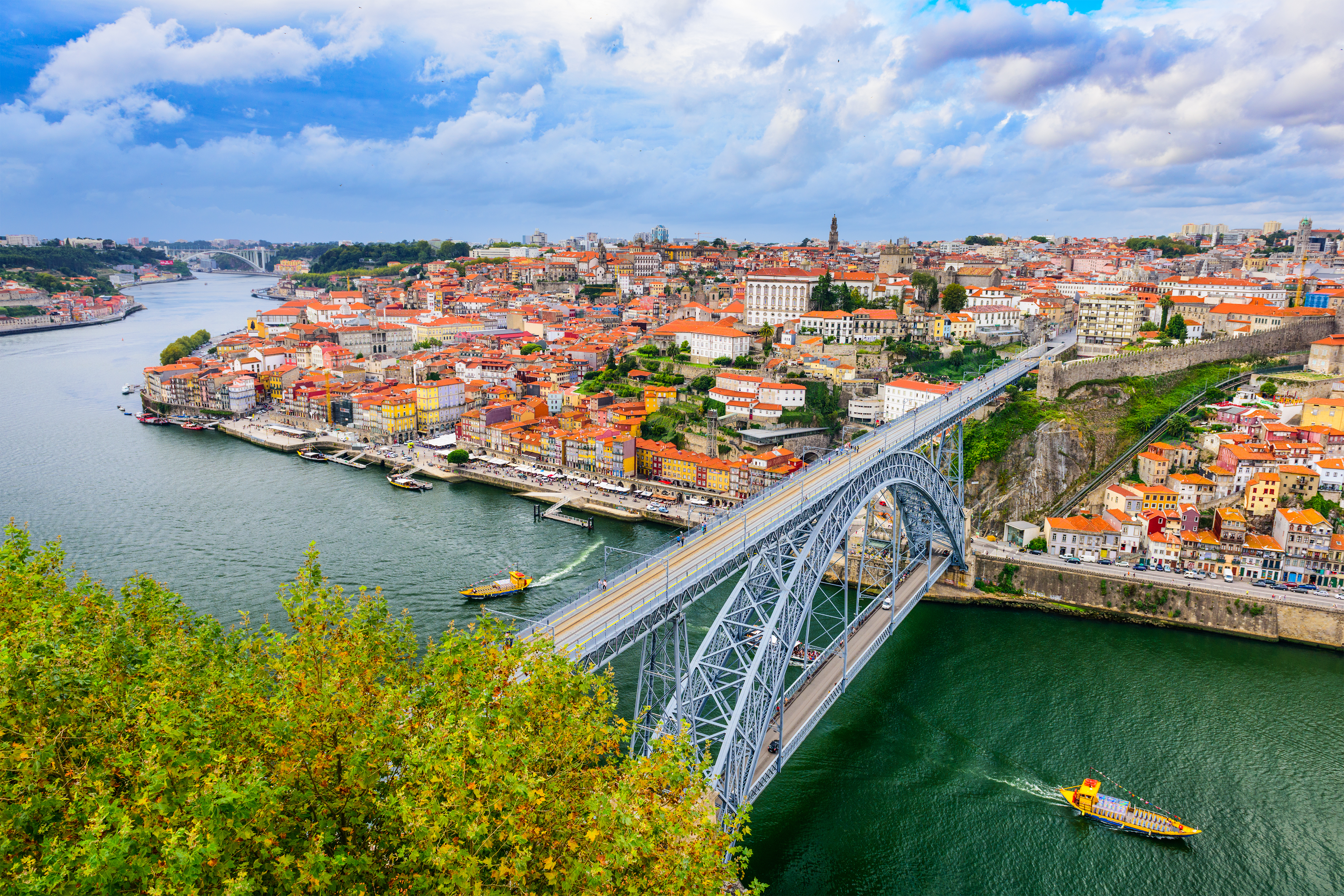
Ribeira District: The medieval riverside neighbourhood of narrow streets, brightly painted townhouses and restaurants overlooking the Douro — the heart of Porto’s historic centre and the natural starting point for any visit. The Dom Luís I Bridge (1886) — a double-deck iron arch bridge designed by Théophile Seyrig, a former partner of Gustave Eiffel, and the longest metal arch span in the world when completed — connects the Ribeira to the Vila Nova de Gaia side of the river where the port wine cellars are located; the upper deck, 60 metres above the Douro, now carries the Porto Metro and a pedestrian walkway with views over both banks.

Port wine cellars (Gaia): Across the Dom Luís I Bridge in Vila Nova de Gaia, the lodges (caves) of the great port wine houses — Sandeman, Taylor’s, Graham’s, Calem, Ramos Pinto and others — line the south bank of the Douro. All offer cellar tours and tastings; book ahead in summer. Port wine comes in several styles: ruby (fruity, young), tawny (nutty, aged in wooden casks), vintage (single year, exceptional), white (lighter, often served chilled with tonic) and LBV (Late Bottled Vintage — excellent value). For the uninitiated, a tasting flight at any major lodge is the best introduction.
Livraria Lello: One of the most beautiful bookshops in the world — a 1906 neo-Gothic building on Rua das Carmelitas featuring a breathtaking double staircase in red carved wood; widely cited as a partial inspiration for Harry Potter’s Hogwarts library; an entry fee applies (redeemable against a book purchase).
Bolhão Market: Porto’s historic iron-and-stone market hall — fully restored and reopened; fresh produce, cheese, charcuterie, pastries and flowers from local vendors.
Day trips from Porto:
- Aveiro (1 hour by train): known as the “Venice of Portugal” for its network of canals navigated by colourful moliceiro boats; also famous for ovos moles (egg-yolk sweets) and Art Nouveau architecture
- Braga (1 hour by train): Portugal’s oldest city and a centre of religious tradition; the Bom Jesus do Monte sanctuary (Baroque staircase ascending a forested hill) is among Portugal’s most striking monuments
- Douro Valley (2 hours by car): UNESCO-listed wine region of terraced vineyards carved into steep schist hillsides above the Douro River; wine quinta visits, river cruises and one of Portugal’s great scenic drives
The Algarve — beaches and cliffs
The Algarve is Portugal’s southern coast — 150km of Atlantic coastline ranging from the dramatic golden limestone cliffs and sea caves of the west (Lagos, Sagres) to the wide sandy beaches and golf resorts of the east (Vilamoura, Tavira). It is Portugal’s most visited region and its warmest — summers are reliably hot (28-35°C) with virtually no rain from June to September.

Lagos: The most scenic town on the western Algarve — a whitewashed historic centre within medieval walls, golden cliffs and extraordinary rock formations at Praia Dona Ana and Praia do Camilo; boat tours from the marina access the sea caves and grottos of Ponta da Piedade; one of the most popular bases for the western Algarve.

Benagil Cave (Algar de Benagil): One of the most photographed natural formations in Portugal — a sea cave accessible only by boat, kayak or paddleboard from Benagil beach; the cathedral-like interior opens to a skylight in the cliff above; accessible on boat tours from Benagil, Carvoeiro or Lagos.

Sagres: At the southwestern tip of continental Europe — windswept, dramatic and largely unspoiled; the Fortaleza de Sagres (Sagres Fortress) at the tip of the headland was the legendary base of Prince Henry the Navigator and the Portuguese school of navigation that launched the Age of Discovery; one of the finest sunsets in Europe from the fortress walls.
Tavira: The most elegant town in the eastern Algarve — a quiet, authentic city of whitewashed buildings, Roman bridges, churches and the quieter Ria Formosa nature reserve beaches accessible by ferry.
Portuguese food and wine
Portuguese cuisine is one of Europe’s most underrated — generous, flavourful and deeply rooted in the country’s Atlantic fishing and agricultural traditions.
Pastéis de nata: The custard tart that defines Lisbon — a crisp pastry shell filled with creamy egg custard, dusted with cinnamon; found everywhere; best at Pastéis de Belém (original recipe, unchanged since the early 19th century) or Manteigaria in Lisbon’s Chiado district.

Bacalhau (salt cod): Portugal’s national ingredient — said to have 365 preparations, one for every day of the year; bacalhau com natas (salt cod with cream and potatoes), bacalhau à brás (shredded with scrambled egg and fries) and bacalhau à Gomes de Sá (with potato and boiled egg) are among the most common versions; an acquired taste for some Australians and New Zealanders but central to understanding Portuguese food culture.

Grilled fish and seafood: Fresh sardines (grilled on charcoal, best in June and July during the sardine season), barnacles (percebes — a local delicacy), spider crab (sapateira), razor clams (lingueirão), octopus (polvo) and Algarve prawns are all exceptional.
Bifanas: A pork sandwich — thin marinated pork cutlet in a soft roll with mustard; the definitive cheap street food of Lisbon and Porto.

Francesinhas: Porto’s answer to a croque monsieur — a thick sandwich of bread, ham, linguiça sausage, steak and melted cheese, drowned in a spiced beer and tomato sauce; extraordinary and extremely filling.
Port wine: See Porto section above. Drink white port with tonic and a slice of orange as an aperitif — the standard Porto local drink.
Vinho Verde: “Green wine” — a light, slightly fizzy white wine from the Minho region in the north; low in alcohol (9-11%), high in acidity; perfect with seafood; extremely affordable.
Alentejo wines: Portugal’s best red wines come primarily from the Alentejo — full-bodied, warm-climate reds from Aragonez (Tempranillo), Touriga Nacional and Trincadeira grapes.
Money and costs
Currency: Euro (EUR). As of October 2026, approximately AUD $1 = EUR 0.60; NZD $1 = EUR 0.52.
Daily budgets:
| Budget level | Daily spend (per person) | What you get |
|---|---|---|
| Budget | €50-80 (~AUD $83-133) | Hostel, local restaurants, public transport |
| Mid-range | €120-180 (~AUD $200-300) | Hotel, good restaurants, activities |
| Luxury | €300+ (~AUD $500+) | Boutique hotel, fine dining, private tours |
Portugal is significantly more affordable than France, Italy or Spain. A full restaurant meal with wine in Lisbon or Porto costs €15-25 per person at a good neighbourhood restaurant. The Algarve is slightly more expensive than the rest of the country in peak summer.
ATMs: Widely available; accept foreign cards. Bank of Portugal-regulated ATMs at Caixa Geral, BCP and Millennium BCP are reliable. Avoid Euronet ATMs (higher fees, unfavourable exchange rates).
FAQs (frequently asked questions)
Do Australians need a visa for Portugal?
No — Australian passport holders enter Portugal visa-free for up to 90 days in any rolling 180-day period, as part of the Schengen Area visa exemption. The 90-day limit applies across all 29 Schengen countries combined.
Do New Zealanders need a visa for Portugal?
Same as Australians — no visa required for up to 90 days. Confirmed from visainfoguide.com (February 2026) and lonelyplanet.com (February 2026).
When is the best time to visit Portugal?
May-June and September-October offer the best balance of warm weather, smaller crowds and lower prices. July-August is peak season — hot, busy and expensive, particularly in the Algarve.
How long does it take to get from Lisbon to Porto?
Approximately 3 hours on the Alfa Pendular intercity train. Frequent departures from Lisbon Santa Apolónia or Oriente stations.
Is Portugal expensive for Australians?
No — Portugal is one of the most affordable destinations in Western Europe for Australians and New Zealanders. Mid-range travel costs roughly AUD $200-300 per person per day, significantly less than France, Italy or Spain.
What is fado?
Portugal’s most distinctive musical tradition — a melancholic vocal genre typically performed in intimate restaurants or dedicated fado houses, accompanied by the Portuguese guitar (guitarra portuguesa); recognised as UNESCO Intangible Cultural Heritage; best experienced live in the Alfama in Lisbon or in Coimbra.
Is Portugal safe?
Yes — Portugal is consistently ranked among the safest countries in Europe and the world. Smartraveller rates Portugal at Exercise Normal Safety Precautions, the baseline level. Standard urban precautions (pickpocketing in tourist areas) apply in Lisbon and Porto.
Do I need to speak Portuguese?
No — English is widely spoken in tourist areas, hotels, restaurants and transport hubs across Lisbon, Porto and the Algarve. Learning a few words of Portuguese (obrigado/obrigada = thank you; por favor = please; com licença = excuse me) is appreciated.
Related guides
- What is the Schengen Area? →
- Italy travel guide 2026 →
- France travel guide 2026 →
- Ireland travel guide 2026 →
- Best travel money cards in Australia 2026 →
- Best travel money cards in New Zealand 2026 →
Visa and entry requirements are subject to change — always verify at Smartraveller (smartraveller.gov.au) or Safetravel (safetravel.govt.nz) and the Portuguese embassy before travel. Last updated October 2026.
Sources: visago.dev — Portugal Visa Requirements for Australian Citizens (March 12, 2026) | schengentraveler.com — Travel to Portugal: Everything You Need to Know (July 2026) | mcs.pt — What are the requirements to enter Portugal in 2026? (June 17, 2026) | lonelyplanet.com — Visa Requirements for Portugal (February 10, 2026) | visainfoguide.com — Portugal Entry Requirements in 2026 (February 25, 2026) | airalo.com — Portugal Travel Guide (July 8, 2026) | royalcaribbean.com — Famous Landmarks in Portugal (March 20, 2026) | pelago.com — Belém Highlights including the Famous Pastries, Lisbon (2026) | chasingwhereabouts.com — Portugal travel blog (2026)


