Summary
Australian and New Zealand passport holders can enter France visa-free for up to 90 days in any 180-day period — France is part of the 29-country Schengen Area; the 90-day limit applies across all Schengen countries combined, not just France; since 10 April 2026, all Schengen borders have introduced the Entry/Exit System (EES) — a biometric digital border check replacing the traditional passport stamp; plan for longer queues at Charles de Gaulle Airport, particularly on first entry
ETIAS — the EU’s new digital travel authorisation — has been delayed and is not yet operational — the European Commission confirmed the launch target of Q4 2026 in June 2026 but quietly removed it from the official website in mid-July 2026; a 2027 launch is now the most likely outcome; when it does launch, Australian and New Zealand travellers will need to apply for ETIAS before each trip (€20, valid 3 years, multiple entries); until ETIAS is live, no pre-registration is required — and any website currently charging for ETIAS applications is fraudulent
France is the most visited country in the world — and for Australians and New Zealanders it offers an extraordinary range of destinations beyond Paris; from the châteaux of the Loire Valley and the lavender fields of Provence to the clifftop beaches of Normandy, the medieval wine villages of Bordeaux and the glamour of the French Riviera, France is a country that takes multiple trips to properly understand
France has been visited more times than any other country on earth. It has been written about more, painted more, argued over more and eaten in more than almost anywhere else. For Australians and New Zealanders — many of whom have French heritage, Irish-French connections through migration or simply a deep association with France through language, culture and cuisine — it is both a familiar and an endlessly surprising destination.
This guide covers everything you need for 2026, including two important entry changes that affect every traveller from Australia and New Zealand.
Visa and entry requirements
Visa-free — no application required
Australian and New Zealand passport holders do not need a visa to visit France for tourism, visiting family, business meetings or short courses under 90 days.
The Schengen 90/180 rule: You can stay in the Schengen Area for up to 90 days in any rolling 180-day period. This applies across all 29 Schengen countries combined — not 90 days per country. If you spend 30 days in Germany, then 30 in Italy, you have 30 days remaining in the period, not a fresh 90.
Passport requirements:
- Valid for at least 3 months beyond your planned departure date from France
- At least one blank page for the EES biometric scan
The Entry/Exit System (EES) — active from 10 April 2026
The biggest practical change for travellers to France in 2026 is the Entry/Exit System (EES) — a new EU digital border check that became fully operational across all 29 Schengen countries on 10 April 2026.
What it replaces: The traditional passport stamp. Border officers no longer stamp your passport when you enter or exit the Schengen Area.
What it means for you:
- On your first entry into the Schengen Area after 10 April 2026, you will have your fingerprints scanned and a digital facial image captured at the border — a one-time biometric registration
- On subsequent entries within the EES validity period, you scan your fingerprints and face again at automated gates
- The EES digitally tracks your entry and exit dates, replacing the manual stamp system
Allow extra time at Charles de Gaulle Airport. The first-time registration process adds time to border control queues — particularly at major international hubs. Most sources recommend arriving with 3+ hours for connections at CDG during this initial rollout period.
No pre-registration required. The EES is processed at the border. You do not apply for anything in advance — it happens when you arrive.
ETIAS — coming, but not yet
The European Travel Information and Authorisation System (ETIAS) is a pre-travel online registration system for visa-exempt travellers — similar to the US ESTA or Australia’s own ETA — that will eventually be required for Australians and New Zealanders visiting France and the rest of the Schengen Area.
Current status: ETIAS is not yet operational. No applications are being accepted. The European Commission confirmed a Q4 2026 (October-December) launch in early 2026 but removed the target from the official website in mid-July 2026 — a 2027 launch is now most likely, with enforcement following 6 months after launch.
When it launches:
- Australian and New Zealand travellers will need to apply online before each trip
- Fee: €20 per person (confirmed by European Commission, 17 July 2025) — under 18 and over 70 exempt from the fee but must still apply
- Valid for 3 years or until passport expires, whichever comes first
- Multiple entries permitted
- Official portal (when live): travel-europe.europa.eu/etias — the only legitimate site
Scam warning: Numerous websites are currently accepting “ETIAS applications” and charging €50-€100+. These are fraudulent. ETIAS is not open. Do not pay any website for ETIAS applications until the system is officially launched.
Until ETIAS launches, no pre-travel registration is needed beyond the EES biometric at the border.
Best time to visit
Spring: April to June — best overall
Paris in spring is exactly what it sounds like — blossom in the parks, outdoor café terraces filling up, comfortable temperatures (15-20°C) and the city at its most photogenic. Provence in May and June is extraordinary — wild flowers, green hills, not yet the July-August heat and crowds. Bordeaux wine country is beautiful in late spring as the vines come into leaf.
Summer: July to August — hot, busy and full
France in summer is very full. July and August are the months when most of France takes its own holidays — the motorways south fill bumper to bumper every August. The French Riviera is at its peak; Provence is dry and hot (35°C+); Normandy and Brittany offer cooler alternatives. The Tour de France runs in early July — in 2026 it started in Barcelona on 4 July. Paris in August is quieter than usual as locals leave — but tourist volumes remain very high.
Autumn: September to October — outstanding
September is one of the best months to visit France — the summer crowds have thinned, the harvest is underway in Burgundy, Bordeaux and the Loire, and the light across the countryside is extraordinary. The Vendanges (grape harvest) in Burgundy and Bordeaux in September and October is one of France’s great seasonal events. October sees the first autumn colour in the forests of Alsace and Normandy.
Winter: November to February — cold but compelling
Paris in winter has its own particular character — museums at their quietest, the Christmas markets of Alsace (among the finest in Europe, running throughout December), the ski resorts of the French Alps and Pyrenees in full operation and accommodation prices at their lowest. Provence in winter is cold but bright — the Mistral wind sweeps the region clear and the light is exceptional.
Getting there
From Australia
Direct flights: Qantas operates direct Perth to London Heathrow; from there, the Eurostar to Paris takes 2.5 hours. Most other Australian cities connect to Paris Charles de Gaulle via Singapore, Dubai or other hubs.
| City | Airlines | Approx flight time |
|---|---|---|
| Sydney to Paris CDG | Qantas, Air France, Singapore Airlines, Emirates | ~22-24 hours |
| Melbourne to Paris CDG | Qantas, Air France, Emirates | ~22-24 hours |
| Perth to Paris CDG | Via London (Qantas direct to LHR + Eurostar) | ~20 hours |
Cost: Return flights from Australia typically range from AUD $1,800-$3,000 booked 3-6 months ahead. Business class and premium economy fares vary significantly.
From New Zealand
All routes connect via Australian cities or Asian/European hubs.
Cost: Return flights from Auckland to Paris typically range from NZD $2,200-$3,800.
Getting around France
High-speed trains (TGV and Ouigo)
France has one of the world’s finest high-speed rail networks — the TGV connects Paris to most major French cities in 2-3 hours or less:
- Paris to Lyon: 2 hours
- Paris to Bordeaux: 2 hours 5 minutes
- Paris to Marseille: 3 hours 20 minutes
- Paris to Nice: 5.5 hours
- Paris to Strasbourg: 1 hour 45 minutes
Book at sncf-connect.com — advance fares on the low-cost Ouigo service can be as low as €10-€19 one way between major cities. Full-price TGV fares are significantly higher.
Driving
France is one of the great countries for road trips — the Routes Nationales wind through countryside that motorways bypass entirely. Driving is on the right. Your Australian or New Zealand licence is valid in France. An International Driving Permit is recommended for rental companies and police interactions.
Vignette: France does not require a motorway vignette (unlike Switzerland, Austria and some neighbouring countries) — motorway tolls are paid at toll booths (credit and debit cards accepted).
Crit’Air stickers: Major French cities including Paris, Lyon and Grenoble operate Low Emission Zones requiring a Crit’Air vehicle classification sticker. Check requirements before driving into any major city.
Paris public transport
The Paris Métro — 16 lines, comprehensively covering central Paris and many suburbs — runs from approximately 5:30am to 1:15am (later on Friday and Saturday nights). The RER suburban rail network extends to Versailles, Disneyland Paris, CDG Airport and other destinations beyond the Périphérique.
Navigo Easy card: A reloadable contactless card for single tickets and carnet bookings — available at any Métro ticket machine. Contactless bank cards (including Australian and New Zealand Visa and Mastercard) work directly on Paris public transport.
Top destinations
Paris — the capital
Paris is one of the world’s great cities — and one that repays return visits more than almost any other. The 20 arrondissements (districts) each have their own distinct character; the museums contain some of the most extraordinary collections in the world; the food and café culture is genuinely as good as the reputation; and the city’s physical beauty — Haussmann’s boulevards, the Seine, the parks — is consistent and extraordinary.
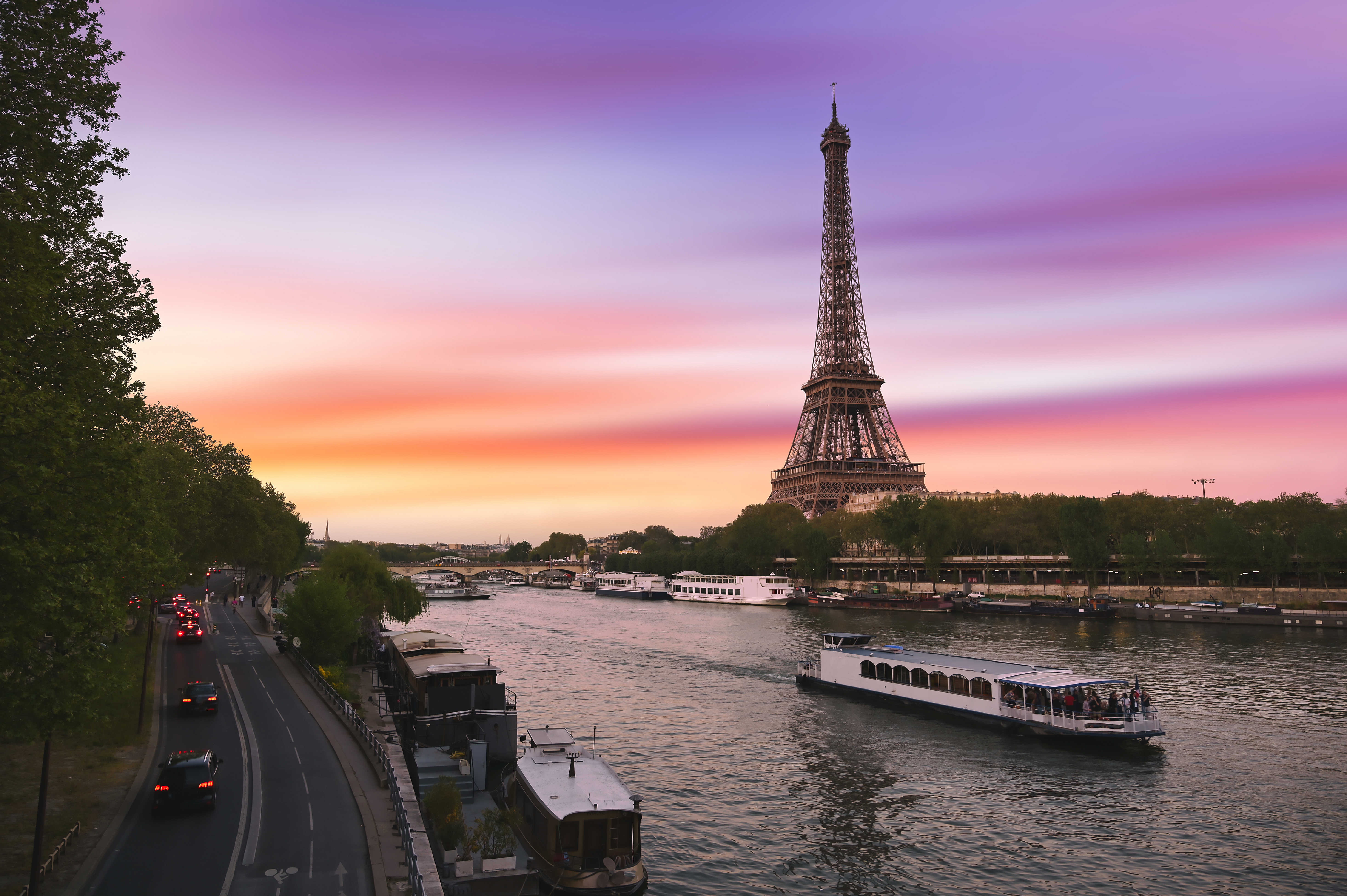
The Eiffel Tower: Completed in 1889 for the Paris World Exposition — at the time the tallest structure in the world; now 330 metres tall. Queue for the summit for views over Paris; visit at dusk for the light, or return after dark for the timed light show that runs every hour on the hour from nightfall. Book tickets in advance online.

The Louvre: The world’s most visited museum — the former royal palace housing 35,000 works across 72,000 square metres. The Winged Victory of Samothrace, the Venus de Milo, Leonardo da Vinci’s Mona Lisa and tens of thousands of other works. Allow a full day minimum; book in advance to avoid queues. Free on the first Friday evening of each month for under-26s.

Musée d’Orsay: The Louvre’s great rival for the title of Paris’s finest museum — housed in a converted Belle Époque railway station on the Left Bank; home to the world’s largest collection of Impressionist and Post-Impressionist art; Monet’s Water Lily series, Van Gogh, Renoir, Degas, Cézanne. Arguably the more pleasurable museum experience of the two. Book tickets in advance.

Notre-Dame de Paris: The 12th-century Gothic cathedral at the heart of the Île de la Cité — severely damaged by fire in April 2019 and reopened in December 2024 after five years of extraordinary restoration. The rebuilt interior is one of the most remarkable architectural achievements in recent French history. Free entry to the nave; tower access ticketed.

Versailles: The Palace of Versailles — 23km from Paris, reached in 40 minutes by RER C — was the seat of French royal power for over a century; the Hall of Mirrors, the Royal Apartments, the Grand Trianon and the extraordinary formal gardens designed by André Le Nôtre across 800 hectares. Book timed-entry tickets in advance; the gardens are free on most days.

Le Marais: Paris’s most historically layered neighbourhood — medieval streets, the Place des Vosges (the oldest planned square in Paris, completed 1612), the Picasso Museum, the Jewish quarter around the Rue des Rosiers, the LGBTQ+ community along the Rue Sainte-Croix-de-la-Bretonnerie and some of Paris’s finest falafel, galleries, boutiques and cafés. Entirely walkable.
Montmartre: The hill above Paris — the Sacré-Cœur basilica at its summit, the Place du Tertre artists’ square, the vineyard that still produces wine annually and the winding lanes of the Butte that retain more of pre-Haussmann Paris than anywhere else in the city.

Paris by arrondissement — a practical guide
Paris is divided into 20 arrondissements (districts), arranged in a clockwise spiral from the centre. Understanding which arrondissement suits your style and budget makes choosing where to stay significantly easier.
1st (1er) — Louvre and Châtelet The historic heart — the Louvre, the Palais Royal, the Tuileries Garden and the Pont Neuf. Central and convenient but expensive and very touristy. Few residents; many hotels. Good for first-timers who want to be close to the main sites.
2nd (2e) — Bourse A compact business district centred on the Bourse (stock exchange) — quieter than the 1st, with excellent covered passages (Galerie Vivienne, Passage des Panoramas) and the emerging Montorgueil food street. Underrated for staying — central but less crowded.
3rd (3e) — Temple / Upper Marais The upper half of the Marais — arts galleries, independent boutiques, the Musée des Arts et Métiers and the northern end of the Rue de Bretagne with its excellent market. Less polished than the 4th; more local.
4th (4e) — Île de la Cité, Île Saint-Louis and Marais Notre-Dame, the Île Saint-Louis, the Place des Vosges, the Pompidou Centre and the heart of the Marais. One of Paris’s most visited and most characterful arrondissements. Expensive but extremely well-located.
5th (5e) — Latin Quarter The university district on the Left Bank — the Panthéon, the Jardin des Plantes, the Sorbonne and centuries of student cafés and bookshops. Shakespeare and Company (the famous English-language bookshop) is here. Charming and relatively affordable by central Paris standards.
6th (6e) — Saint-Germain-des-Prés The literary and intellectual heart of Paris — the Café de Flore, the Café des Deux Magots, the Musée d’Orsay, the Luxembourg Gardens and some of Paris’s most elegant streets. Expensive; excellent for walking. The 6th is where Hemingway, Sartre and Simone de Beauvoir drank. Still one of the finest neighbourhoods in Europe.
7th (7e) — Eiffel Tower and Invalides Dominated by the Eiffel Tower, the Musée d’Orsay (technically bordering the 6th), the Hôtel des Invalides (Napoleon’s tomb) and wide, quiet streets of ministries and embassies. Expensive; residential; excellent for families who want proximity to the Eiffel Tower without staying directly in the tourist scrum.
8th (8e) — Champs-Élysées The grand commercial axis — the Champs-Élysées from the Arc de Triomphe to the Place de la Concorde. Very tourist-heavy and expensive along the avenue itself; the streets behind (the “Golden Triangle” of haute couture) are more interesting. The 8th is for luxury shopping and grand boulevard walking, not neighbourhood character.
9th (9e) — Opéra and Grands Boulevards The Palais Garnier (Opéra National de Paris), the Galeries Lafayette and Printemps department stores, and the northern reaches of the Right Bank. Practical and central; more affordable than the 1st-8th. The Pigalle and South Pigalle (SoPi) areas at the southern end of the 9th have evolved into one of Paris’s best neighbourhood dining and bar scenes.
10th (10e) — Canal Saint-Martin The Canal Saint-Martin — the tree-lined iron-bridge canal made famous by the film Amélie — is the centrepiece of the 10th; surrounded by independent cafés, wine bars and restaurants. The 10th is one of the most enjoyable and affordable neighbourhoods for staying. The Gare du Nord and Gare de l’Est train stations are also here.
11th (11e) — Bastille and Oberkampf The most consistently excellent neighbourhood for eating and drinking in Paris — the streets around Oberkampf, Parmentier and Charonne contain some of the city’s best independent restaurants, natural wine bars and cocktail bars. Not particularly touristy; very much how Parisians actually live. The Place de la Bastille (where the famous prison stood until 1789) is at its western edge.
12th (12e) — Gare de Lyon and Bois de Vincennes Residential and spread out — the Gare de Lyon (trains south to Lyon, Marseille and beyond), the Promenade Plantée (the original elevated garden railway walkway that inspired New York’s High Line) and the Bois de Vincennes park at its eastern edge. Less visited; good value.
13th (13e) — Chinatown and Butte-aux-Cailles Paris’s largest Chinatown (around the Place d’Italie — actually dominated by Vietnamese, Chinese and Southeast Asian communities) and the village-like Butte-aux-Cailles neighbourhood. Affordable; local; genuinely residential.
14th (14e) — Montparnasse The Tour Montparnasse (the only skyscraper in central Paris, recently renovated) and the Cimetière du Montparnasse (where Simone de Beauvoir, Jean-Paul Sartre, Samuel Beckett and Man Ray are buried). A solid residential arrondissement; the Daguerre market street is excellent on weekend mornings.
15th (15e) — Vaugirard The largest arrondissement by population — almost entirely residential; few tourists. Good value accommodation; excellent for a local neighbourhood experience but requires Métro rides to reach the main sights.
16th (16e) — Trocadéro and Passy Wealthy, quiet and very residential — the Palais de Chaillot (with the best views of the Eiffel Tower from across the Seine), the Musée Marmottan Monet (the largest collection of Monet’s works in the world) and the Bois de Boulogne park. Expensive and conservative; suits families wanting quiet proximity to the Eiffel Tower.
17th (17e) — Batignolles A large mixed arrondissement — the Batignolles village neighbourhood around the Parc Martin Luther King is one of Paris’s most pleasant and genuinely residential areas; the southern parts near Porte de Clichy are less interesting. Good value; emerging food scene.
18th (18e) — Montmartre Montmartre — the hilltop village neighbourhood, the Sacré-Cœur basilica, the Moulin Rouge (Boulevard de Clichy), the artists’ quarter around the Place du Tertre and the winding cobbled streets of the Butte. Very touristy around the Sacré-Cœur; more authentic in the residential streets below. Staying here gives a distinctly village-like Paris experience.
19th (19e) — Buttes-Chaumont The Parc des Buttes-Chaumont — one of Paris’s most underrated parks, with dramatic artificial cliffs and a lake — is the centrepiece. Genuinely local and diverse; good restaurants emerging; well served by the Métro.
20th (20e) — Belleville and Père Lachaise The Père Lachaise cemetery (where Jim Morrison, Edith Piaf, Oscar Wilde, Frédéric Chopin and Marcel Proust are buried) and the Belleville neighbourhood — one of Paris’s most diverse, with a strong North African, Chinese and artistic community. The Belleville Brûlerie (roastery) is one of Paris’s great coffee spots. Increasingly trendy; still affordable.
The Loire Valley stretches 280km along the Loire River from Orléans to Angers — a UNESCO World Heritage Site designated for its extraordinary concentration of royal and aristocratic châteaux. The valley contains more than 300 castles and manor houses; the most visited are Chambord, Chenonceau, Amboise, Azay-le-Rideau and Cheverny.

Château de Chambord: The largest château in the Loire — 426 rooms, 77 staircases and a double-helix staircase in the centre (attributed by some to Leonardo da Vinci, who spent his final years at Amboise nearby). The roof terraces give extraordinary views over the royal hunting forest that still surrounds the château.
Château de Chenonceau: Built across the Cher River on a series of arches — one of the most photographed buildings in France; the gallery spanning the river was built for Catherine de Médicis. Surrounded by formal gardens on both sides of the river.
Amboise: The town and château where Leonardo da Vinci died in 1519 — buried in the Chapelle Saint-Hubert at the château; the nearby Clos Lucé manor where he spent his final years is open as a museum of his designs and inventions.
Getting there: TGV from Paris to Tours in 1 hour; hire a car or join a guided tour from Tours to explore the châteaux (most are not accessible by public transport).
Normandy — history and coastline
Normandy occupies the northwest coast of France — a landscape of bocage (hedgerow farmland), apple orchards, dairy farms (Camembert, Livarot, Pont-l’Évêque), medieval cities and the D-Day beaches where Allied forces landed on 6 June 1944.
Mont Saint-Michel: A UNESCO World Heritage Site — a medieval abbey and monastery built on a tidal island connected to the Normandy coast by a causeway; visible from 50km on clear days; at high tide the island is completely surrounded by the sea, which rushes in at the speed of a galloping horse on the highest tides. One of the most extraordinary built environments in Europe. Book accommodation in the village itself to experience it before and after the day-trippers leave.

The D-Day beaches: The five beaches — Utah, Omaha, Gold, Juno and Sword — where Allied forces landed on 6 June 1944, transforming the course of the Second World War. The American cemetery at Colleville-sur-Mer above Omaha Beach contains 9,388 graves. The Mémorial de Caen is the finest museum covering the Battle of Normandy. For Australians and New Zealanders, Bayeux — home of the Bayeux Tapestry (an 11th-century embroidered chronicle of the 1066 Norman Conquest) and the Commonwealth War Graves Commission cemetery — is an essential visit.

Getting there: Train from Paris Saint-Lazare to Caen in 2 hours; hire a car from Caen to explore the coast and beaches at your own pace.
Provence — sun, lavender and markets
Provence is the sun-drenched region of southeastern France — stretching from the Rhône River to the Italian border; a landscape of lavender fields (June-July), olive groves, Roman ruins, hilltop villages and one of France’s greatest concentrations of markets, cheese and rosé wine.
Avignon: A walled medieval city on the Rhône — home of the Palais des Papes (Palace of the Popes), the largest Gothic palace in the world; capital of Western Christianity from 1309 to 1377 when the papacy relocated from Rome. The famous Pont d’Avignon (the Pont Saint-Bénézet, built 1177-1185) now extends into the river without reaching the other bank.

The Luberon: A range of hills east of Avignon — dotted with some of Provence’s most beautiful hilltop villages: Gordes (built entirely in pale stone on a dramatic ridge), Roussillon (a village literally built from ochre-coloured rock), Ménerbes, Lacoste and Bonnieux. Peter Mayle’s A Year in Provence was set here and still drives significant British and Australian visitor numbers.

Arles: A small city on the Rhône delta that was, for a year in 1888-89, home to Vincent van Gogh — he produced 300 paintings here, including the Bedroom, the Night Café and several self-portraits; the Roman arena (still hosting bullfights), the ancient theatre and the compact old town are extraordinary.
Aix-en-Provence: The elegant university city — fountain-lined boulevards (the Cours Mirabeau), excellent markets (Tuesday, Thursday and Saturday on the Place Richelme), and the Atelier Cézanne (the studio where Paul Cézanne painted the Montagne Sainte-Victoire series, exactly as he left it at his death in 1906).

Getting there: TGV from Paris to Avignon in 2.5 hours, Aix-en-Provence in 3 hours. Hire a car from Avignon or Aix to explore the Luberon and surrounding villages.
The French Riviera (Côte d’Azur)
The French Riviera runs 115km along the Mediterranean coast from Menton on the Italian border to Toulon — a sun-drenched coastline of rocky coves, azure water, belle-époque hotels and hillside medieval villages that has drawn visitors since the 19th century.
Nice: The Riviera’s capital and most liveable city — the old town (Vieux-Nice) of pastel-painted baroque buildings, the Cours Saleya flower and food market, the Promenade des Anglais along the pebble beach and the Colline du Château (a hilltop park with views over the bay). The Musée Matisse and Musée Marc Chagall are among the finest small museums in France. Nice has its own international airport with direct connections to Paris and many European cities.

Monaco: The tiny principality — a 2km² sovereign state between Nice and Menton; the Monte Carlo Casino, the Grand Prix circuit (the Monaco Grand Prix is held each May), the Oceanographic Museum founded by Prince Albert I, and a perspective on extreme wealth that is genuinely unique. 25 minutes by train from Nice.

Cannes: Famous for the annual Cannes Film Festival each May — a relatively small city with an extraordinary main seafront (the Croisette), excellent beaches and the old quarter (Le Suquet) overlooking the bay.

Èze: A medieval village perched 427 metres above the Mediterranean — one of the most dramatically situated villages in France; the narrow lanes of the fortified village lead to a cactus garden at the summit with views along the coast toward Nice and Monaco.

The Corniche roads: Three roads run parallel above the Riviera coast — the Grande Corniche (highest, most dramatic), the Moyenne Corniche (middle, passing through Èze) and the Basse Corniche (lowest, closest to the sea). Driving any of the three, or all three in sequence, is one of France’s great road trip experiences.
Bordeaux — wine and architecture
Bordeaux is a UNESCO World Heritage city of extraordinary elegance — 18th-century neoclassical architecture, a 4km arc of stone facades along the Garonne River and the surrounding wine regions (Médoc, Pomerol, Saint-Émilion, Graves, Sauternes) that produce some of the world’s most celebrated wines.

The Cité du Vin: A landmark contemporary museum of wine culture — a striking building on the Bordeaux waterfront that opened in 2016; interactive exhibitions on the history and culture of wine from antiquity to the present; a panoramic wine bar on the rooftop with views over the city.
Saint-Émilion: A medieval wine village 40km east of Bordeaux — built almost entirely of golden limestone; its underground monolithic church (12th century, carved directly from the rock) is the largest monolithic church in France; the surrounding vineyards produce the region’s most prestigious wines.

Wine tasting: The Bordeaux wine region surrounding the city produces more fine wine than almost anywhere on earth. Most prestigious châteaux offer tastings and tours — book directly with the château; the tourist office in Bordeaux city and Saint-Émilion can recommend smaller producers open to visitors without a reservation.
Getting there: TGV from Paris Montparnasse to Bordeaux in 2 hours 5 minutes.
French food — what to eat
French cuisine is one of the world’s great food traditions — UNESCO recognised it as an Intangible Cultural Heritage of Humanity in 2010. The fundamentals are worth understanding before you arrive.
The boulangerie (bakery): The foundation of French daily life — a proper croissant (buttery, layered, shatteringly flaky) at a good boulangerie in the morning is one of travel’s reliable pleasures; a baguette tradition (the traditional baguette protected by French law since 1993) with cheese for lunch is another.


Cheese: France produces more than 1,200 varieties of cheese — the Normandy cheeses (Camembert, Livarot, Pont-l’Évêque), the mountain cheeses (Comté, Reblochon, Beaufort), the blues (Roquefort, Bleu d’Auvergne) and the soft cheeses (Brie de Meaux, Chaource) are all worth seeking out at their regional source.

Bistro classics: Steak frites (steak and fries), moules marinières (mussels in white wine and shallots), soupe à l’oignon gratinée (onion soup with a floating crouton of melted Gruyère), confit de canard (slow-cooked duck leg), bouillabaisse (Marseille’s great saffron-and-shellfish fish stew).

Oysters: France is one of the world’s great oyster nations — the oysters of Brittany, Normandy (Belon, Isigny) and the Arcachon basin near Bordeaux are among the finest; eaten raw with a squeeze of lemon or a mignonette of shallots and red wine vinegar; available at any seafood bar or market; surprisingly affordable.
Wine: French wine is inseparable from French food and French life. The regional wine traditions are deep — Burgundy (Pinot Noir and Chardonnay), Bordeaux (Cabernet Sauvignon and Merlot blends), Champagne (sparkling), Loire Valley (Sauvignon Blanc, Chenin Blanc, Cabernet Franc), Rhône Valley (Syrah, Grenache), Provence (rosé) and Alsace (Riesling, Gewurztraminer) each represent centuries of accumulated viticulture.

The café: The French café is not primarily about coffee — it is about the right to sit at a table outside, order a single café (espresso) and remain there as long as you wish. The service may be slow. The table is yours. This is one of the genuinely great French institutions.

Money and costs
Currency: Euro (€). France is part of the Eurozone — the same currency as Germany, Italy, Spain, Portugal, Greece, the Netherlands and 15 other EU member states. As of September 2026, approximately AUD $1 = €0.61; NZD $1 = €0.53.
Daily budgets:
| Budget level | Daily spend | What you get |
|---|---|---|
| Budget | AUD $120-180 | Hostel, boulangerie meals, Métro, free museums |
| Mid-range | AUD $250-400 | Hotel, bistro meals, day trips, wine |
| Luxury | AUD $600+ | Design hotel, fine dining, private guides |
Paris and the Riviera are expensive by Asian standards but reasonable by northern European standards. Provence, Normandy and the Loire Valley are significantly cheaper than Paris for accommodation.
Tipping: Not obligatory. A service charge (service compris) is included in all restaurant bills by law. Rounding up the bill or leaving €1-2 for good service is appreciated but not expected. Never expected at a bar or café.
What it means for your transfers
AUD to EUR and NZD to EUR transfers with OrbitRemit — check current fees and rates at orbitremit.com before sending.
FAQs (frequently asked questions)
Do Australians need a visa for France?
No — Australian passport holders enter France visa-free for up to 90 days in any 180-day period. The 90-day limit applies across the entire 29-country Schengen Area combined.
Do New Zealanders need a visa for France?
No — same as Australians. Visa-free for 90 days in any 180-day period across the Schengen Area.
What is the EES and how does it affect my trip?
The Entry/Exit System — operational from 10 April 2026 — digitally records all entries and exits to the Schengen Area using biometric data (fingerprints and facial image). It replaces the passport stamp. First-time registration adds time at border control — allow extra time at CDG Airport.
Do I need to apply for ETIAS before visiting France?
Not yet — ETIAS is not currently operational. The EU has delayed the launch beyond the original Q4 2026 target; 2027 is now the most likely launch year. Do not pay any website for ETIAS applications — the system is not live, and any site charging for it is fraudulent.
What is the best time to visit France?
Spring (April-June) and autumn (September-October) offer the best balance of weather and manageable crowds. July-August is peak season — very busy and expensive. Paris in winter has its own appeal.
How long do I need for France?
Three days is the minimum for Paris highlights. Ten days covers Paris plus one or two regions. Three weeks allows Paris and two or three regions at a comfortable pace.
Is France safe for Australian and New Zealand travellers?
The Australian Government’s Smartraveller advisory for France is Exercise a High Degree of Caution — noting the risk of terrorism; France has experienced several significant terrorist incidents in recent years and the French government maintains a high-level national security alert. Tourist areas are generally safe; be aware of pickpockets at major tourist sites and on the Paris Métro.
Related guides
- England travel guide 2026 →
- Scotland travel guide 2026 →
- European currencies: a complete guide →
- The 5 best travel money cards in Australia 2026 →
- The 5 best travel money cards in New Zealand 2026 →
Visa requirements, EES and ETIAS information are subject to change — always verify at the French Ministry of Foreign Affairs, Smartraveller (smartraveller.gov.au) or Safetravel (safetravel.govt.nz) before travel. Last updated September 2026.
Sources: schengentraveler.com — France entry requirements 2026 (August 10, 2026) | francevibe.com — EES Entry/Exit System France 2026 Complete Guide (July 25, 2026) | European Commission — ETIAS fee confirmed €20 (home-affairs.ec.europa.eu, 17 July 2025) | schengentraveler.com — ETIAS cost and fees 2026 (3 weeks ago) | traveltourister.com — ETIAS Q4 2026 launch confirmed (June 20, 2026) | 1cover.co.nz — Do I need a visa for Europe? (New Zealand Schengen guide) | lokatours.com — France travel guide 2026 (April 1, 2026) | designerjourneys.com — Things to do in France 2026 (June 3, 2026) | travelexplorer.info — Best places to travel in France 2026


