Summary
India is now Australia’s largest overseas-born community — overtaking England-born residents for the first time; there are 1,681 Indian restaurants across Australia as of April 2026, more than any other Asian cuisine.
Indian food in Australia has evolved well beyond butter chicken — South Indian dosas, street food chaats, regional biryanis and modern Indo-Australian fusion are all now part of the mainstream; Dosa Hut alone serves over seven million customers annually across Australia.
Food is how Indian culture travels — from the tiffin box packed for lunch to the biryani made for Eid or Diwali, Indian food in Australia is a living expression of one of the world’s most diverse culinary traditions.
For most of Australia’s history, “Indian food” meant butter chicken, chicken tikka masala and garlic naan. That was never the whole story — and increasingly, it is not even the main story. India’s culinary tradition is one of the most varied on earth, shaped by 29 states, dozens of languages, multiple religions, thousands of years of agricultural history and six distinct regional cooking styles. As India’s community in Australia has grown into the country’s largest migrant group, that diversity has followed.
The Indian community in Australia
The Indian diaspora has become Australia’s largest overseas-born community, overtaking the England-born population for the first time. As of April 2026, there are 1,681 Indian restaurants across Australia — the top three states are Victoria with 473, New South Wales with 418, and Queensland with 330.
The Indian community spans every major Australian city, with large concentrations in western Sydney (Parramatta, Blacktown, Harris Park), Melbourne’s outer south-east (Dandenong, Clayton, Point Cook), Brisbane’s south side and Perth’s northern suburbs. Harris Park in Parramatta — sometimes called “Little India” — has been a hub of Indian food, culture and commerce for decades.
What is Indian food?
Indian cuisine is not one cuisine — it is dozens, loosely grouped into broad regional traditions that have little in common beyond the use of spices.
North Indian cuisine is what most Australians know first. Rich, dairy-heavy gravies (butter chicken, dal makhani, paneer butter masala), tandoor-baked breads (naan, roti, paratha), tikka-marinated meats and thick kormas. The Punjabi community were among the earliest Indian immigrants to Australia, and their cooking shaped how Australians understood Indian food for decades.
South Indian cuisine is entirely different — rice-based rather than bread-based, with lentil-forward dishes, tamarind-soured sambar, crispy dosas and idlis, coconut-rich curries and seafood. South Indian food is lighter, sourer and more aromatic than the north. As more South Indians have moved to Australia, their cuisine has found a passionate following.
Street food and chaat — pani puri, bhel puri, vada pav, samosa chaat — are now firmly part of the Australian Indian food scene. Delhi Streets in Melbourne, Gopi Ka Chatka, and dozens of others serve the kind of food Indians actually eat every day: quick, cheap, intensely flavoured, eaten standing up.
Biryani — slow-cooked rice and meat or vegetables, layered and sealed and steamed — is one of India’s most beloved dishes and now one of the most ordered Indian dishes in Australia. Hyderabadi biryani, Lucknowi biryani, Ambur biryani, Kolkata biryani — each style is distinct, and dedicated biryani restaurants have proliferated in Sydney, Melbourne and Brisbane.
Must-try Indian dishes in Australia
Butter chicken (murgh makhani)
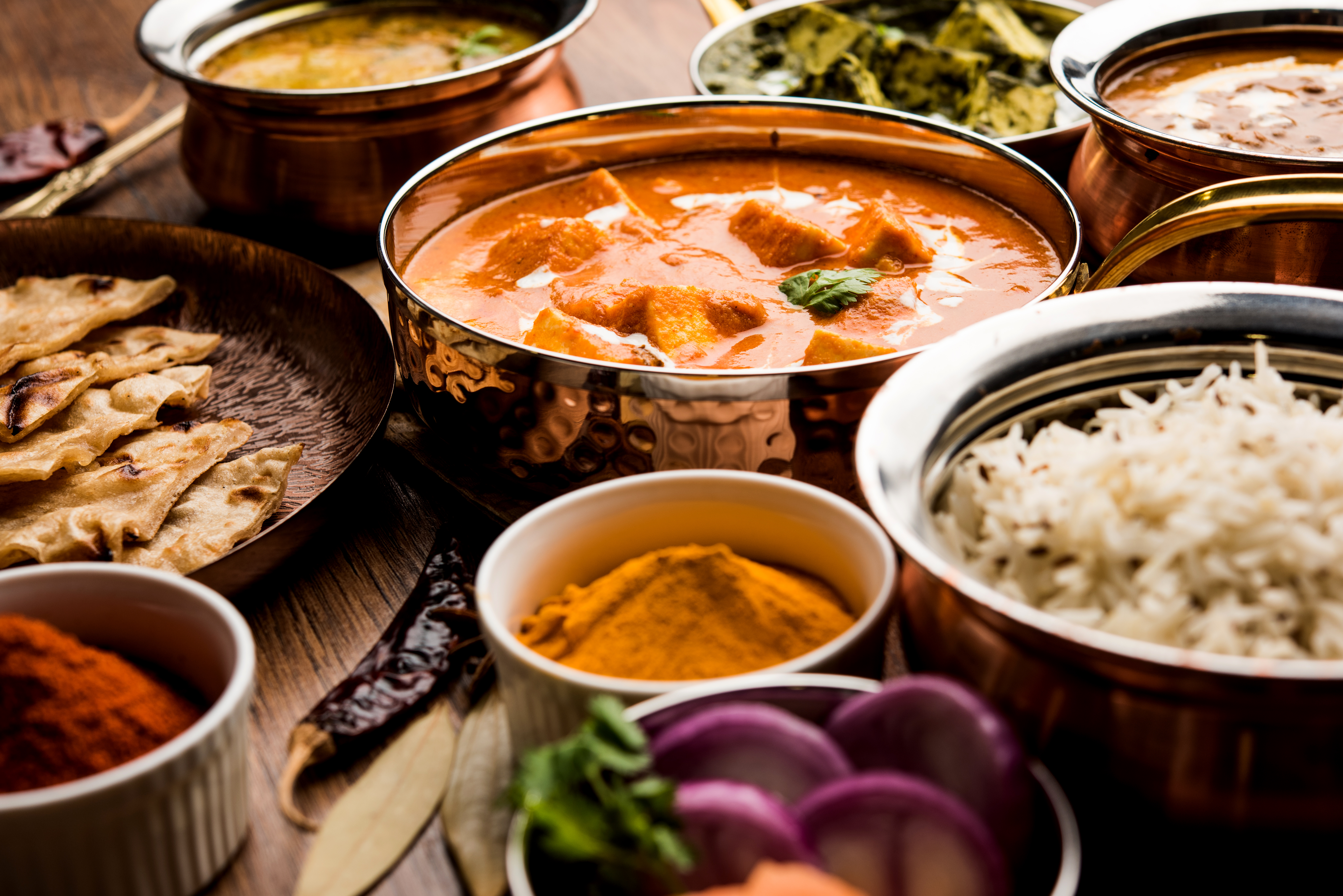
The dish that introduced most Australians to Indian food. Tender chicken in a rich, mildly spiced tomato and cream sauce. Invented in Delhi in the 1950s at Moti Mahal restaurant by Kundan Lal Gujral — not an ancient recipe, but one that travelled the world. Order it at a good North Indian restaurant and the version you get today will be significantly better than the butter chicken of Australian-Indian restaurants in the 1990s.

Dosa
A crispy, paper-thin fermented rice and lentil crepe, served with sambar (lentil soup) and coconut chutney. The masala dosa is filled with spiced potato — one of the great breakfasts in the world, and a revelation for anyone who has only encountered it in dry cafeteria form. Dosa Hut opened its first store in Footscray, Melbourne in 2007 and now operates dozens of stores across Australia, serving over seven million customers annually.

Biryani
Fragrant basmati rice layered with marinated meat (chicken, goat, lamb or prawn), dum-cooked (sealed and slow-steamed) with fried onions, saffron and whole spices. The ratio of rice to meat, the depth of the spice, and the quality of the caramelised onions all signal the pedigree of the biryani. Every Indian community has a preferred regional style.

Chaat
The collective name for Indian street food. Pani puri — hollow crispy shells filled with spiced water, potato and tamarind chutney. Bhel puri — puffed rice with chutneys, onion and coriander. Sev puri. Dahi puri. Aloo tikki chaat. These are the foods Indians eat at roadside stalls, not in restaurants — and their appearance in Australian dining reflects the growing sophistication of the diaspora market.
Dal
Lentils, spiced and slow-cooked. Dal makhani (black lentils with butter and cream) is the North Indian classic. South Indian sambar (a thinner, more sour lentil soup with vegetables) accompanies almost every South Indian meal. Dal is the backbone of Indian vegetarian cooking and one of the most nutritionally complete dishes in the world.

Chettinad cuisine
From the Chettinad region of Tamil Nadu in South India — arguably the most complex and fiery regional cuisine in India. Dry spice pastes, kalpasi (stone flower), marathi mokku (dried flower pods) and freshly ground spice blends. When Vikram Arumugam and Preeti Elamaran opened Nithik’s Kitchen in Sydney in 2013, Australians hadn’t heard of Chettinad food — they wanted tandoori chicken or butter naan. That has changed significantly.
Paneer dishes
Paneer (fresh Indian cottage cheese) is the go-to protein for vegetarian Indians. Paneer butter masala, palak paneer (with spinach), kadai paneer (with peppers) and paneer tikka (grilled cubes marinated in spiced yoghurt) are all staples at North Indian restaurants. Fresh paneer made in-house is significantly better than the packaged variety — ask.

Gulab jamun and kheer
The two most universally loved Indian desserts in Australia. Gulab jamun: soft milk-solid balls soaked in rose-flavoured sugar syrup, served warm. Kheer: rice pudding with cardamom, saffron and pistachios. Both appear at every Indian celebration and at the end of every restaurant meal worth its reputation.

The evolution of Indian food in Australia
For most of the 20th century, Indian food in Australia meant one thing: North Indian curries adapted for local palates. Butter chicken was made milder. Sauces were thicker. The heat was reduced. Menus were nearly identical from Sydney to Perth.
That began to change as the Indian community grew and diversified — and as the second generation became more vocal about authentic representation.
The key shifts:
South Indian food found its audience. As Tamil, Telugu and Malayali migrants arrived in larger numbers — particularly as IT and healthcare workers — restaurants serving dosas, idlis, sambar and appam opened. Saravanaa Bhavan, the Chennai-based vegetarian chain with 120 outlets in 28 countries, opened its first Australian store in Parramatta in 2014.
Street food entered mainstream dining. A new generation of chefs, inspired by what they ate growing up and emboldened by a more food-literate Australian public, began serving chaats, rolls and kati rolls. Delhi Streets in Melbourne brought bhel puri and pani puri to diners who had never encountered them.
Regional Indian cuisine became a point of pride. Chettinad, Hyderabadi, Goan, Bengali and Lucknowi cooking are all now represented in Australian cities. The assumption that all Indian food was the same gave way to curiosity about specificity.
Indo-Australian fusion emerged. Curry-flavoured sausage rolls, masala meat pies, dahl-inspired shepherd’s pie. Indian ingredients — curry leaves, mustard seeds, turmeric, tamarind — have crossed into Australian home cooking and fusion menus.
Where to eat Indian food in Australia
Sydney
- Harris Park (Parramatta) — Sydney’s Little India; dozens of restaurants including authentic South Indian, chaat stalls, biryani specialists and sweet shops; the highest concentration of Indian food in Australia
- Nithik’s Kitchen — pioneering Chettinad cuisine in Sydney
- Chat Street — authentic North Indian street food
Melbourne
- Clayton and Dandenong — Melbourne’s Indian food heartland in the south-east; large South Indian community, excellent dosa restaurants
- Footscray — Dosa Hut’s original location; still one of the best dosa restaurants in Australia
- Delhi Streets — chaat and street food in the CBD
- Tonka — modern Indian cuisine, consistently rated among Melbourne’s best
Brisbane
- Punjab Curry Club — Brisbane institution; celebrating regional Indian diversity
Perth
- Northbridge — Perth’s multicultural dining hub includes a strong Indian restaurant scene
Indian food and celebration
Indian food is inseparable from celebration. In Australia, the Indian community’s festival calendar drives some of the most vibrant food events of the year.
Diwali — sweets are central to Diwali celebrations. Boxes of mithai (Indian sweets) — ladoo, barfi, halwa, rasgulla — are exchanged between families and neighbours. Indian sweet shops in Harris Park and Clayton sell hundreds of kilograms of mithai in the weeks before Diwali.
Eid al-Fitr — for Muslim Indians (particularly from Hyderabad, Gujarat and West Bengal), biryani, sheer khurma (vermicelli pudding with dates and nuts) and haleem (a slow-cooked meat and lentil porridge) are the dishes of Eid.
Holi — the festival of colour is accompanied by thandai (a spiced milk drink), gujiya (sweet dumplings), and a general relaxation of dietary rules that sees non-vegetarians and vegetarians eating together more freely.
Fun facts about Indian food in Australia
- Australia is one of the world’s largest importers of Indian spices — turmeric, cumin, coriander and cardamom sourced from India appear in kitchens across the country, not just Indian ones
- Curry is not a single spice — there is no single spice called “curry.” The word comes from the Tamil “kari” and refers to a dish of spiced sauce; the “curry powder” sold in supermarkets is a British invention with no direct equivalent in Indian cooking
- India has more vegetarians than any other country in the world — approximately 30% of India’s population follows a vegetarian diet, more than 400 million people; Australian Indian restaurants routinely offer the most extensive vegetarian menus of any cuisine
- The relationship between Australia and India has evolved from the “3 Cs” (Cricket, Curry, Commonwealth) to the “4 Ds” — Democracy, Defence, Diaspora and Dosti (friendship) — a diplomatic framing that acknowledges how central food and cultural exchange have become to the bilateral relationship
- Indian-born taxpayers contributed AUD $5.8 billion in income tax to Australia — a figure that reflects the economic contribution of a community that has grown from under 100,000 in the 1990s to well over 800,000 today
Sending money to India with OrbitRemit
For Indians in Australia and New Zealand, food and family are the two things that pull strongest from home. OrbitRemit supports $0 fee AUD to INR transfers from Australia directly to all major Indian banks and UPI.
- $0 fee on AUD to INR transfers from Australia — always fee-free
- NZD to INR: flat $4 fee (fee-free above NZD $10,000)
- Over 85% of transfers arrive within 2 hours
- UPI delivery supported — send directly to your recipient’s UPI ID
- Supported banks: SBI, HDFC Bank, ICICI Bank, Axis Bank, Canara Bank, PNB, Union Bank, Bank of Baroda, Federal Bank, South Indian Bank
- Regulated by ASIC in Australia (AFSL: 470646) | DIA-supervised in New Zealand (FSP7721)
- Rated Excellent on Trustpilot from over 34,000 reviews
This guide is for general information and cultural appreciation. Restaurant listings are current as of mid-2026 and subject to change. Last updated July 2026.
Sources: Rentechdigital.com — Indian restaurants in Australia (April 2026) | Scroll.in — How Indian restaurants in Australia are reconstructing Indian food | globalindian.com — How Indian cuisine is exploding in Australia | StudyIQ — Indian Diaspora in Australia (July 2026) | DFAT — Understanding Australia’s Indian Communities: A Statistical Snapshot | Indian Century — Global Charm of Indian Food | ambafoods.com.au — Indian cuisine down under


