Summary
Filipino food is having its moment — there are now more than 200 Filipino eateries across Australia, from casual carinderias in Sydney’s Marrickville to sleek modern restobars in Melbourne’s CBD; April is officially Filipino Food Month in Sydney.
The cuisine is more varied than most Australians realise — rooted in Malay, Chinese, Spanish and American influences across 7,641 islands, Filipino food spans everything from vinegar-sharp kinilaw to rich peanut-based kare-kare, sweet-salty silogs and the ceremonial spectacle of lechon.
Food is how Filipinos show love — whether it’s a family kamayan feast eaten by hand on banana leaves, a neighbourhood carinderia serving silog breakfasts, or a box of polvoron sent home to family, Filipino food culture is fundamentally communal.
For decades, Filipino food has hovered at the edges of Australia’s culinary conversation — beloved within the community, but rarely in the spotlight. That is changing fast. A new generation of Filipino-Australian chefs is bringing bold flavours out of family kitchens and into mainstream dining, and Australians are paying attention.
The Filipino community in Australia
The Philippines is one of the largest source communities for migrants in Australia. There are now more than 200 Filipino eateries across Australia, from casual carinderias to sleek modern restobars, reflecting a community that has grown significantly over the past two decades.
Filipino migrants are spread across every major Australian city — Sydney and Melbourne have the largest communities, but Brisbane, Perth and Adelaide all have well-established Filipino neighbourhoods, restaurants, churches and cultural organisations. The community spans nurses, engineers, teachers, hospitality workers, carers and students — one of the most occupationally diverse migrant communities in the country.
What is Filipino food?
Filipino cuisine is one of the most distinctive and complex in Southeast Asia — and one of the most underappreciated. It is rooted in the cooking traditions of over a hundred ethnolinguistic groups across 7,641 islands, shaped by centuries of Chinese, Spanish, and American influence layered over a Malay-Polynesian base.
The result is a cuisine unlike anything else: bold but balanced, sour and salty and sweet in the same mouthful, deeply communal, and tied to celebration and family in a way that few cuisines match.
The dominant flavour principles of Filipino cooking are:
- Sour (asim): vinegar, tamarind and calamansi (native citrus) appear in almost every corner of the cuisine
- Salty (alat): fish sauce (patis), soy sauce and fermented shrimp paste (bagoong)
- Sweet (tamis): balances the acidity, particularly in desserts and marinades
- Umami: from fermented condiments and slow-cooked meat dishes
Must-try Filipino dishes
Adobo — the national dish
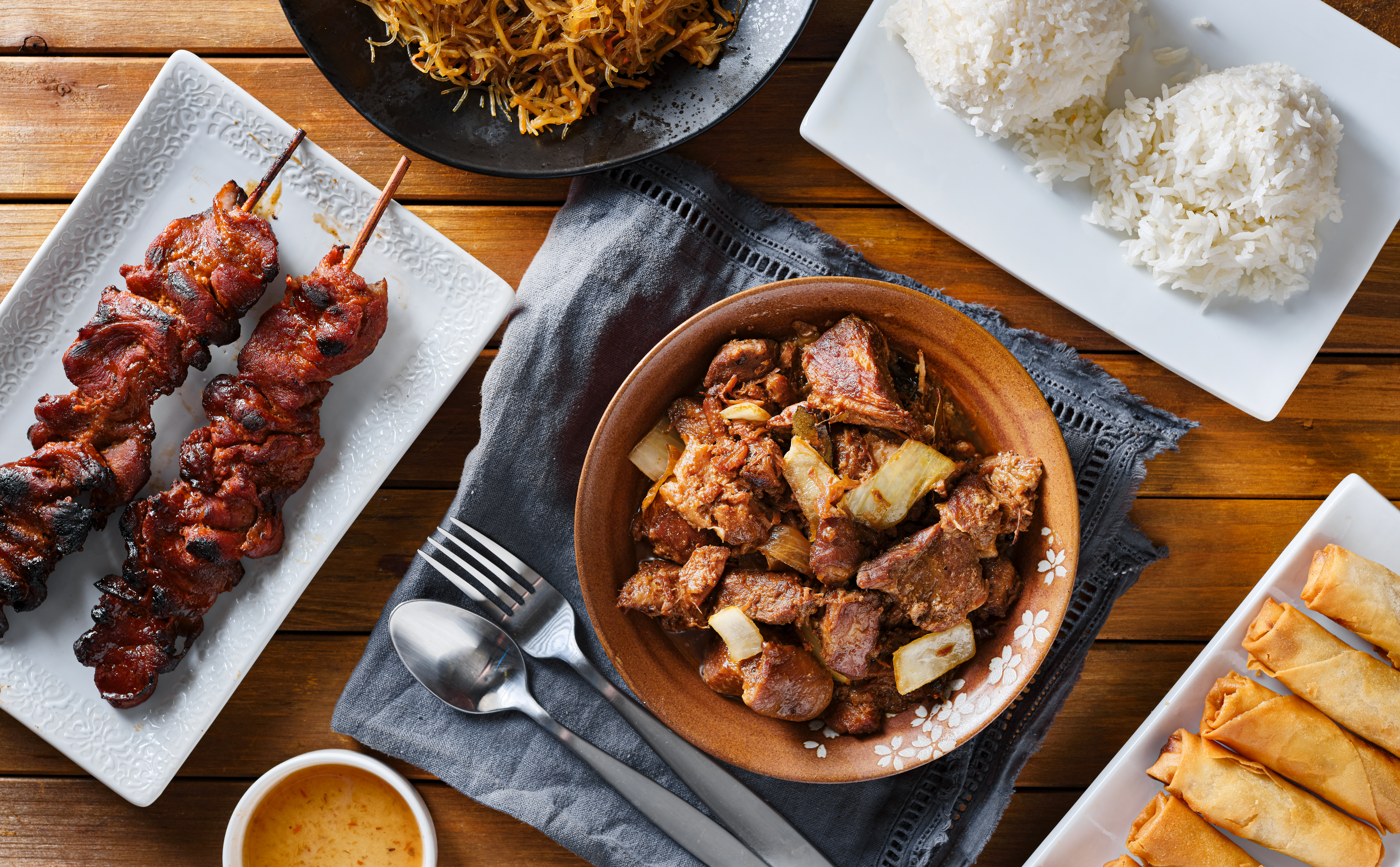
If you try one Filipino dish in Australia, make it adobo. Chicken or pork (or both) braised slowly in vinegar, soy sauce, garlic, bay leaves and black peppercorns until the meat is tender and the sauce has reduced to a sticky, deeply flavoured glaze. Every family has a different recipe — some with coconut milk, some dry-fried after braising, some with extra vinegar, some sweet. Adobo is the dish that defines Filipino cooking’s central tension: sour meeting savoury, producing something greater than both.

Sinigang — the sour soup
Sinigang is the comfort food of the Philippines — a sour tamarind-based soup with pork, shrimp or fish, and vegetables including water spinach (kangkong), eggplant and long beans. It is bracingly sour and deeply restorative. The kind of dish Filipinos make when someone is sick, homesick, or simply in need of something that tastes like home.

Lechon — the centrepiece of celebration
A whole pig, slow-roasted over charcoal for hours until the skin blisters and cracks into the most extraordinary crackling, and the meat inside falls apart with a richness that is hard to describe. Lechon is the dish of fiestas, baptisms, birthdays and weddings. Sydney Cebu Lechon is one of Sydney’s most renowned Filipino restaurants, drawing both Filipino and non-Filipino diners for the authentic whole-roasted experience.

Kare-Kare — the festive stew
A rich, nutty stew of oxtail, tripe or vegetables (or all three) in a thick sauce made from ground peanuts, annatto and toasted rice. Served with bagoong (fermented shrimp paste) on the side — the saltiness and pungency of the paste cutting through the richness of the peanut sauce. Kare-kare is the dish Filipinos make for important occasions, and it takes hours to prepare.
Sisig — the sizzling classic
Originally from Pampanga province, sisig is chopped and seasoned pork — typically using the cheeks, ears and liver — served sizzling on a cast iron plate with calamansi, chilli and a raw egg cracked on top at the table. It is one of the most irresistible bar snacks in the world, and a dish that non-Filipino Australians consistently discover and obsess over. Melbourne’s Busog restaurant serves Papa’s Crispy Pork Sisig — deep-fried pork jowl, tossed in onions and chilli and topped with house-made aioli — a modern take on a classic.

Pancit — noodles for long life
Pancit is a broad term for Filipino noodle dishes, most of which trace back to Chinese culinary influence. Pancit bihon (thin rice noodles stir-fried with meat and vegetables), pancit palabok (with rich shrimp sauce and egg) and pancit canton (egg noodles) are among the most common. Traditionally served at birthdays because noodles symbolise a long life.

Silog — the all-day breakfast
Sinangag (garlic fried rice) plus itlog (egg) plus a protein — that’s a silog. Tapsilog adds cured beef (tapa); tocilog adds sweet pork tocino; longsilog adds longanisa (Filipino sausage); bangsilog adds bangus (milkfish). Silog is a staple Filipino dish — “have it for brekkie like a local,” as one Melbourne reviewer put it. The garlic fried rice alone, fragrant and crispy at the edges, is one of the great breakfasts in the world.

Halo-Halo — the ultimate dessert
Halo-halo means “mix-mix” in Filipino — and that is exactly what it is. Shaved ice over sweetened beans, jellies, corn, jackfruit, palm fruit and leche flan, topped with ube (purple yam) ice cream and evaporated milk. It looks chaotic. It is chaotic. It is also one of the most refreshing and joyful desserts on the planet, especially on a hot Australian afternoon.

Ube — the purple yam
Ube (pronounced OO-beh) has gone global — and Australians are now deeply familiar with the distinctive purple colour and sweet, vanilla-adjacent flavour. Ube appears in ice cream, cakes, pastries, doughnuts, and drinks across Filipino cafés throughout Australia. Halaya, a café on Sprint Street in Melbourne, is popular for its ube-based cakes, pastries and desserts, and its customer mix has shifted from almost 80% Filipino to a much broader audience as the ingredient has crossed over.

Filipino food culture: the way it’s eaten matters as much as what’s eaten
Filipino food is not just about what is on the table — it is about how it is eaten and who is at the table.
Kamayan: Eating by hand from a spread of food laid out on banana leaves — no plates, no cutlery. Kamayan feasts are increasingly popular at Filipino restaurants across Australia as a communal dining experience. At Palay in Melbourne, cutlery is optional on Boodle Fight Feast nights, with dishes served on banana leaves — and bookings are essential.
Family-style service: Filipino food is almost always shared. Multiple dishes come to the table at once — rice at the centre, surrounded by proteins, vegetables and soups — and everyone serves themselves and each other. The concept of eating alone is almost alien to Filipino food culture.
The carinderia: The carinderia is the Filipino equivalent of a canteen — a casual neighbourhood eatery serving home-style food in large pots, chosen by pointing at what you want. Tita Carinderia in Sydney’s Marrickville, with its colourfully-painted walls, lace curtains and framed photos of Filipino celebrities, feels like a slice of home with a twist.
Where to find Filipino food in Australia
Sydney
Sydney has the largest and most diverse Filipino food scene in Australia, spread across the inner west, western suburbs and the Blacktown area — home to one of the highest concentrations of Filipino Australians in the country.
Inner west and city:
- Tita Carinderia (Marrickville) — neighbourhood carinderia with home-style silogs, pandesal and ube soft serve; one of Sydney’s most talked-about Filipino cafés
- Askal (Sydney CBD) — three-level venue with inventive modern Filipino dishes; John Rivera won S.Pellegrino Young Chef of the Year 2018
- Sydney Cebu Lechon (Newtown/Enmore Road) — one of Sydney’s most renowned Filipino restaurants; whole-roasted Cebu-style lechon the speciality
- Halo Halo Café (Willoughby, 130 Mowbray Road) — a cosy Filipino-Vietnamese fusion café on the North Shore; known for top-tier halo-halo (ube ice cream, leche flan, jellies, sweet beans over shaved ice), longsilog breakfasts and banh mi rolls; uses coffee beans from The Grounds Coffee Roastery; praised for its family-like atmosphere
- Halo Halo Café (Parramatta, Shop 1/20 Wentworth St) — Filipino-Asian inspired café in the heart of Parramatta’s Little India precinct; known for silogs, chicken BBQ skewers, ube sweet rice porridge and Filipino-style adobo burger; open Monday–Friday 7am–3pm
- Descanso (Glebe) — “Descanso” means “relax” in Tagalog and Spanish; cosy café serving adobo, Cebu lechon, tapsilog, lechon sisig and halo-halo; also offers Filipino catering for events; a popular North Shore and inner west community spot
Western Sydney and Blacktown:
- Mate Burger (Mount Druitt Village) — the bricks-and-mortar home of a beloved Sydney Filipino food truck; famous for the Ensaymada Burger (smashed beef patty, Kraft cheese, maple sriracha bacon in a sweet Filipino-style bun) and chicken adobo loaded fries; a must for anyone in the area
- Sydney Cebu Lechon (Blacktown) — second location serving the same authentic lechon to the western Sydney Filipino community
- Fiesta Avenue (Blacktown) — near Blacktown station; known for kare-kare described by VICE as the best in Sydney, and boodle fight-karaoke nights
- Kusina ni Lola (Blacktown) — traditional home-style Filipino cooking; pancit bihon, kare-kare and crispy pata
- Angel’s Filipino Barbeque (Glendenning) — Filipino barbecue in the heart of the Blacktown area
- Mama Lor Restaurant & Bakery — popular for barbecue dishes and Filipino baked goods
Why Blacktown? The Blacktown local government area has one of the highest concentrations of Filipino Australians in New South Wales. For the Filipino community in western Sydney, Blacktown and the surrounding suburbs — Glendenning, Mount Druitt, Seven Hills — are home ground: where the best turo-turo (point-point) eateries, Filipino grocery stores, and community celebrations happen.
Melbourne
- Serai (CBD) — contemporary Filipino cuisine combining Philippine flavours with Australian ingredients; one of Melbourne’s most recognised Filipino restaurants
- Halaya (Fitzroy) — ube-based cakes, pastries and desserts; a growing community hub
- Busog — comfort food classics including sisig and kare-kare; family business with a warm neighbourhood feel
- Palay — shared dining and boodle fight feasts on banana leaves
Canberra
- Lolo & Lola — cult favourite in the ACT Filipino community
Perth, Western Australia
Perth has a thriving Filipino community — particularly in the southern suburbs around Cockburn, Medina and Fremantle — and a growing number of Filipino restaurants reflecting it.
- Pala — Filipino fusion brunch; famous for ube French toast, adobo eggs benedict, ube waffles with fried chicken and sinigang salmon; one of Perth’s most photographed Filipino spots
- Chibugan Corner (Fremantle Markets) — a pint-sized stall at the Fremantle Markets serving some of Perth’s most legit sisig, adobo, lumpiang and more; great casual entry point to Filipino food
- Henerasyon (Coventry Village, Morley) — casual market restaurant with a glowing bain-marie of silogs, sisigs, grilled liempo and sinigang; authentic home-style cooking
- House of Pinoy (Beechboro) — chorizo de Cebu, crispy pata, oxtail kare-kare; a community favourite in the northern suburbs
- Congee House (Cockburn Central) — Filipino-Chinese fusion; known for arroz caldo-style congee alongside adobo, sisig and kaldereta
- Parilla Barbeque And Grill — highly rated on Yelp for grilled squid and dinuguan; described by regulars as “better than Gerry’s Grill”
Brisbane, Queensland
Brisbane’s Filipino community is centred in the southern suburbs, and the restaurant scene reflects it with a mix of home-style eateries and community hubs.
- Rex’s Cuisine (Acacia Ridge, Elizabeth Street) — one of Brisbane’s most beloved Filipino restaurants; described as “wonderfully soulful” with generations of Filipino recipes; kare-kare regularly called a standout
- Yes Please Filipino Restaurant (Dine In & Takeaway) — one of Brisbane’s top-rated on Yelp; known for warm service and authentic home cooking
- Kainan Sa Valley — Filipino dining in the Valley; popular with the community for traditional dishes
- Bodega Grill — Filipino grill dishes with a focus on quality meats and traditional marinades
Adelaide, South Australia
Adelaide has a smaller but dedicated Filipino food scene, with a community focused in the northern suburbs.
- 118 Kovenant (Pooraka, Bridge Road) — described as bringing “something genuinely unique to South Australia”; a vibrant café and restaurant in the heart of Pooraka serving both Filipino café fare and restaurant dishes; party trays and bulk orders available for community events
- Adelaide’s Filipino community, while smaller than Sydney or Melbourne, is tightly knit — community events, church gatherings and cultural celebrations are often where the best home-style Filipino cooking appears
Filipino food festivals in Australia
Some of the most vibrant Filipino food experiences in Australia happen not in restaurants but at festivals — where home cooks, community organisations and small businesses bring the full spectrum of Filipino food culture to the streets.
Philippine Christmas Pasko Festival — Darling Harbour, Sydney
The biggest Filipino Christmas celebration in New South Wales. Hosted by the Philippine Community Council of NSW (PCCNSW), the Pasko Festival takes over Tumbalong Park at Darling Harbour for two days in November each year — usually the second or third weekend in November. Entry is free.
The festival transforms Tumbalong Park into a showcase of Filipino culture: mountains of authentic Filipino food stalls serving lechon, barbecue skewers, whole fried fish, chicharrón, ube ice cream and halo-halo; live entertainment and performances; colourful lantern-making competitions (inspired by the Pampanga Giant Lantern Festival); cultural exhibitions; and onsite Philippine Government agency stalls for consular services.
In the Philippines, Christmas is not just a day — it’s a season. The festive countdown begins in September (“Ber months”) making the Philippines home to the longest Christmas celebration in the world. The Pasko Festival brings that spirit to Sydney.
When: Usually second or third weekend of November — check Darling Harbour’s What’s On calendar for the 2026 date
Where: Tumbalong Park, Darling Harbour, Sydney
Entry: Free
Organised by: Philippine Community Council of NSW (PCCNSW)
FiloFomoFest — Parramatta, Sydney
FiloFomoFest is a full-day Filipino food, culture and community festival run by Filipino Food Movement Australia Inc. In 2026, FiloFomoFest came to Western Sydney for the first time — held at Centenary Square, Parramatta on Saturday 27 June — bringing together over 30 Filipino food stalls, small businesses and live entertainment in the heart of Australia’s largest Filipino community.
The festival features over 30 authentic stalls serving traditional Filipino street food and modern fusion dishes, live entertainment including an open-mic karaoke experience and Latin dance workshops, and a free dedicated Kids Zone with jumping castles.
At the heart of FiloFomoFest is the spirit of Bayanihan — the Filipino value of community, unity and helping one another. The event runs on a timed entry system (Early Feast, Lunch Rush, Sunset Vibes) to manage crowd flow.
When: Annually in June (Filipino Food Month) — check filipinofoodmovementaustralia.org for dates
Where: Centenary Square, Parramatta (moved to Western Sydney in 2026)
Entry: $2 donation
Organised by: Filipino Food Movement Australia Inc.
Grand Philippine Fiesta Kultura — Fairfield Showgrounds, Sydney
Australia’s largest Filipino cultural festival. Held annually at Fairfield Showgrounds every October Labour Day weekend, Fiesta Kultura is a massive celebration of Philippine culture, food, dance, music and community. A pilgrimage event for the Filipino community across NSW.
When: October Labour Day weekend annually
Where: Fairfield Showgrounds, Sydney
Entry: Check fiestakultura.com.au for tickets
Bayanihan Festival — Logan, Queensland
The Bayanihan Festival is a vibrant celebration of Filipino culture in Logan, Queensland, bringing the community together for a day of performances, food, connection and more than 100 stalls. Logan is home to one of the largest Filipino communities in Queensland.
When: Annually in June — check ourlogan.com.au for dates
Where: Logan, Queensland
Entry: Free
Bayanihan Festival — Kingston Butter Factory, Brisbane
Organised by the Filipino Australian Brisbane Society (FABS), the Brisbane Bayanihan Festival brings Filipino culture, food and live entertainment to the Kingston Butter Factory Cultural Precinct. The 2026 festival was held on 13 June and featured Filipino food stalls, cultural performances and RnB artist Jay-R.
When: Annually in June (Filipino Food Month) — check FABS social media for dates
Where: Kingston Butter Factory Cultural Precinct, Brisbane
Entry: Free
Gold Coast Philippine Festival — Broadwater Parklands
Held at Broadwater Parklands, Marine Parade, Southport, the Gold Coast Philippine Festival runs annually in June from 10am to 6pm — free entry, with food, games, dance and music celebrating Filipino culture. The 2026 festival began a three-year cultural journey through the regions of the Philippines — starting with Mindanao, then Visayas and Luzon in subsequent years.
When: Annually in June — 2026 date: 14 June
Where: Broadwater Parklands, Southport, Gold Coast
Entry: Free
Melbourne Food and Wine Festival — Filipino program
The 2026 Melbourne Food and Wine Festival featured a dedicated Filipino food program, including a headline event at Serai with Manila-based Michelin Bib Gourmand chef JP Anglo cooking alongside Serai’s Ross Magnaye and Shane Stafford. As Filipino cuisine gains global recognition, Melbourne’s food festival has made it a recurring centrepiece of its program.
When: March annually — check melbournefoodandwine.com.au for the program Where: Various Melbourne venues; Serai is a recurring Filipino venue
April is officially Filipino Food Month in Sydney, coordinated by the Filipino Food Movement Australia and the Philippine Embassy in Canberra. Throughout April, Filipino restaurants across Sydney hold special menus, pop-up events, cooking demonstrations and cultural experiences. Entree Pinays (a Filipino women’s food collective) runs events throughout the month. Check the Filipino Food Movement Australia website and social media for the 2026 calendar.
Fun facts about Filipino food
- The Philippines has over 7,641 islands — each with distinct sub-cuisines and regional specialties; the adobo in Manila is different from the adobo in Cebu which is different again from adobo in Pampanga
- Lechon de leche (roasted suckling pig) is on the UNESCO Intangible Cultural Heritage consideration list as part of Philippine festive food culture
- TasteAtlas ranked Filipino cuisine as the 23rd best in the world, while chicken inasal and sisig were ranked among the best dishes globally
- Calamansi is the soul of Filipino cooking — a small native citrus that is neither lime nor lemon but has characteristics of both; it appears in marinades, dipping sauces, drinks and desserts
- Filipinos are among the world’s largest consumers of instant noodles — Lucky Me! is a national institution, available at every Filipino grocery store in Australia
Sending money to the Philippines with OrbitRemit
For Filipinos in Australia and New Zealand, food is one of the strongest connections to home. The other is family — and the regular transfers that keep those connections alive.
OrbitRemit supports $0 fee AUD to PHP transfers from Australia directly to GCash, BPI, BDO, Metrobank, PNB, UnionBank and all major Philippine banks.
- $0 fee on AUD to PHP mobile wallet transfers (GCash and others) from Australia — always fee-free
- $4 fee on AUD to PHP transfers from Australia
- NZD to PHP: flat $4 fee (fee-free above NZD $10,000)
- Over 85% of transfers arrive within 2 hours
- GCash delivery supported
- Regulated by ASIC in Australia (AFSL: 470646) | DIA-supervised in New Zealand (FSP7721)
- Rated Excellent on Trustpilot from over 34,000 reviews
This guide is for general information and cultural appreciation. Restaurant listings are current as of mid-2026 and subject to change. Last updated July 2026.
Sources: SBS Food — Is Filipino food finally having its moment? (2025) | This is Media — From Adobo to Askal: The Rise of Filipino Food in Australia | Palawan News — Filipino flavors bring Australia and the Philippines closer (June 2026) | Urban List — Melbourne’s Best Filipino Restaurants 2026 | Wikipedia — Filipino cuisine | Cozymeal — Filipino foods guide 2026


