Summary
Mid-Autumn Festival 2026 falls on Friday 25 September — the 15th day of the 8th lunar month, when the moon is at its fullest and brightest of the year; a public holiday in mainland China, Hong Kong, Macau and Taiwan; celebrated by Chinese and Vietnamese communities worldwide
The festival is known by different names across Asia — Zhōngqiū Jié (中秋節) in Chinese, Tết Trung Thu in Vietnam, Chuseok in Korea, Tsukimi in Japan; all fall around the same lunar date; all share themes of harvest, family and the full moon
For the Chinese and Vietnamese communities in Australia and New Zealand, the Mid-Autumn Festival is one of the most important cultural events of the year — celebrated with mooncakes, lantern festivals, family dinners and community events in Cabramatta, Footscray, Chinatown and Asian community hubs across the country
If Lunar New Year is loud, full of firecrackers and red envelopes, the Mid-Autumn Festival is its quieter, more contemplative counterpart. It is the look-up-at-the-sky holiday — a time to gather with family under the year’s fullest moon, share a slice of mooncake and, in some corners of the celebration, pass down one of the oldest stories in Chinese mythology.
The festival is second only to Lunar New Year in cultural importance for Chinese communities — and for Vietnamese communities, it holds a unique place as the children’s festival of the year, lit by lanterns and the sound of lion dances echoing through streets lined with families.
When is Mid-Autumn Festival 2026?
Friday 25 September 2026 — the 15th day of the 8th month of the Chinese lunisolar calendar.
The festival always falls on the night of the year’s brightest and most perfectly round full moon. The date shifts each year against the Gregorian calendar — in 2025 it fell on 6 October; in 2026, 25 September; in 2027, 15 September.
Public holiday status:
- Mainland China: 1-day public holiday (25-27 September is a three-day weekend)
- Hong Kong and Macau: public holiday
- Taiwan: public holiday
- Vietnam: public holiday (Tết Trung Thu is observed the same night)
- Singapore and Malaysia: not a statutory public holiday but widely and enthusiastically celebrated
- Australia and New Zealand: not a public holiday; celebrated by Chinese and Vietnamese communities through community events, mooncake festivals and family gatherings
The legend of Chang’e — the story behind the Moon Festival
The Mid-Autumn Festival is inseparable from the legend of Chang’e (嫦娥) — the Moon Goddess. The story exists in several versions, but the most common tells it this way:
In ancient times, ten suns appeared simultaneously in the sky, scorching the earth and making life unbearable. A divine archer named Hou Yi shot down nine of the ten suns, saving humanity. As a reward, the Queen Mother of the West gave him an elixir of immortality.
Hou Yi did not want to become immortal without his wife Chang’e, so he hid the elixir at home. A treacherous apprentice named Feng Meng tried to steal it while Hou Yi was away. To prevent it from falling into the wrong hands, Chang’e swallowed the entire elixir herself and floated up to the moon, where she has lived ever since — immortal, separated from her husband, accompanied only by a jade rabbit.
On the night of the full moon in the eighth lunar month — the night the moon is closest and brightest — Hou Yi would set out offerings of the foods Chang’e loved, gazing at the moon in longing. Families have done the same ever since.
The jade rabbit (玉兔, Yùtù) — Chang’e’s companion on the moon — is another iconic symbol of the festival. In the legend, the rabbit pounds the elixir of immortality with a mortar and pestle. Its image appears on mooncakes, lanterns and festival decorations worldwide.
Mooncakes — the defining food of the festival
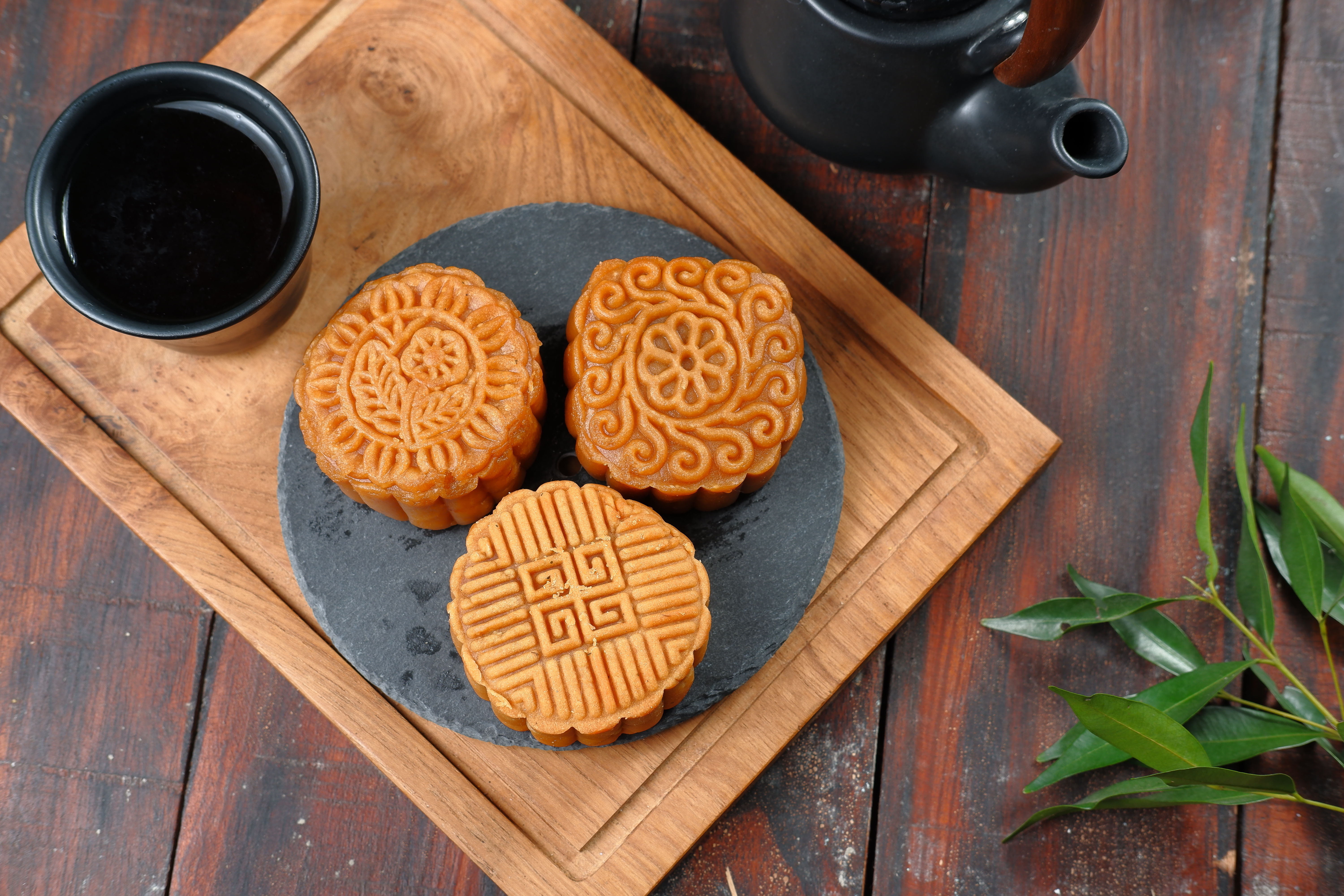
No single food is as central to a festival as the mooncake is to the Mid-Autumn Festival. These dense, ornate pastries are given as gifts, shared at family dinners and stacked in increasingly elaborate boxes that are themselves a form of social currency.
What a traditional mooncake is:
A round pastry (symbolising the full moon) with a thin, tender crust and a dense, sweet filling. The top is usually embossed with Chinese characters for “longevity” or “harmony,” or an image of the moon, the jade rabbit or Chang’e. A salted duck egg yolk is often baked inside the centre — representing the full moon — rich, slightly savoury and visually dramatic when cut in half.
Traditional fillings:
- Lotus seed paste (蓮蓉, liánróng) — the most classic; smooth, sweet and slightly floral
- Red bean paste (豆沙, dòushā) — the most common; earthy, sweet and dense
- Five kernel (五仁, wǔrén) — a mixture of five types of nuts and seeds; traditional, and increasingly polarising (this is the mooncake people have strong feelings about)
- Salted egg yolk — often combined with lotus or red bean; the golden yolk in the centre is the visual centrepiece
Modern variations:
- Snow skin mooncakes (冰皮月餅) — made with a soft, mochi-like exterior instead of baked pastry; refrigerated rather than shelf-stable; popular in Singapore and Hong Kong; often in delicate pastel colours
- Ice cream mooncakes — a modern invention now mainstream in Singapore, Malaysia and increasingly in Australia; available at many Asian supermarkets from mid-August
- Chocolate, matcha and durian — now widely available; particularly popular with younger generations
The social politics of mooncake gifting:
In Chinese business culture, mooncakes are a serious social transaction. The brand of tin you give — and the quality of the fillings — signals your relationship with the recipient and, implicitly, your budget. Luxury hotel mooncake boxes from establishments like the Mandarin Oriental or Peninsula Hotels can cost hundreds of dollars. Giving mooncakes to business associates, clients and seniors is expected; not giving them can be noticed.
Where to buy mooncakes in Australia:
Mooncakes become available in late August and September at:
- Chinese bakeries and Hong Kong-style cake shops across Chinatown (Sydney and Melbourne)
- Asian supermarkets — Cabramatta, Springvale, Sunnybank and Richmond’s Victoria Street
- BBT (bubble tea) chains increasingly stock limited-edition mooncake flavours in September
- Online from specialist Chinese bakeries — order early as stock is limited
How the festival is celebrated across Asia
China
Family reunion dinners on the evening of the 15th, followed by moon gazing together. Public parks and cultural spaces host lantern displays. Mooncake boxes are exchanged in the weeks leading up to the festival. Cities organise large-scale lantern festivals. In southern China, dragon dances and fire dragon performances are traditional.
Vietnam — Tết Trung Thu
Vietnam’s version is notably different from China’s. In Vietnam, Mid-Autumn Festival is primarily a children’s festival. Adults participate, but children lead — carrying star-shaped lanterns through the streets in processions, performing lion dances and receiving mooncakes and gifts from family members. The streets of Hà Nội’s Old Quarter and Hội An’s ancient town glow with paper lanterns. In Australia, Vietnamese community celebrations in Cabramatta and Footscray reflect this child-centred energy — lanterns, lion dances and community street festivals.
Malaysia and Singapore
No public holiday but extremely enthusiastic celebrations. Shopping malls host elaborate lantern exhibitions weeks in advance. Mooncake fairs run through September. Chinatown in Singapore’s Outram Park district becomes one of the most photogenic festival streets in the world during this period.
South Korea — Chuseok
The Korean equivalent falls on the same lunar date. Chuseok is one of Korea’s most important national holidays — a harvest festival with ancestral rites (charye), the sharing of songpyeon (half-moon-shaped rice cakes) and family travel across the country. Quite different from Chinese and Vietnamese traditions despite the shared lunar date.
Japan — Tsukimi
Japan’s “moon viewing” festival is quieter and more contemplative — sake cups, rice dumplings (tsukimi dango) and arrangements of pampas grass arranged to honour the moon. Less commercialised than the Chinese or Vietnamese versions.
Mid-Autumn Festival in Australia and New Zealand
The Chinese and Vietnamese communities in Australia and New Zealand celebrate the Mid-Autumn Festival with events across major cities in late September.
Sydney: Chinatown’s Dixon Street precinct hosts lantern displays and cultural performances. The Vietnamese community in Cabramatta typically holds community events around the festival date. Asian grocery stores in the city begin stocking mooncakes from late August.
Melbourne: The Springvale Vietnamese and Chinese community organises events around Tết Trung Thu. Victoria Street, Richmond — Melbourne’s Vietnamese food street — becomes busier than usual in late September. The Box Hill Chinese community also marks the festival.
Brisbane: Sunnybank’s Asian community precinct hosts Chinese and Vietnamese community events. Local community organisations organise family lantern evenings.
Auckland (New Zealand): The Auckland Chinese community and Vietnamese communities in South Auckland hold events around the festival. Check local community Facebook groups and evensi.com for 2026 Auckland Mid-Autumn Festival event listings.
Mooncake recipe — the classic lotus paste and salted egg
Making mooncakes at home is an ambitious but deeply satisfying project. Here is what you need:
For the pastry (makes approximately 8 mooncakes):
- 100g golden syrup
- 30ml vegetable oil
- 1 tsp lye water (碱水, available at Asian grocery stores)
- 130g plain flour
For the filling:
- 400g store-bought lotus seed paste (available at most Asian grocery stores)
- 4-8 salted duck egg yolks (available from Asian supermarkets)
Method:
- Combine golden syrup, oil and lye water. Add flour and mix to form a soft dough. Rest for 30 minutes.
- Divide lotus paste into equal portions. Wrap one salted egg yolk in each portion of paste.
- Divide dough into equal portions. Flatten each piece, wrap around the lotus paste filling and press into a mooncake mould.
- Bake at 170°C for 10 minutes, brush with egg wash, then bake a further 15 minutes until golden.
- Rest for 2 days before eating — the skin softens and the flavours develop over this time.
FAQs (frequently asked questions)
When is Mid-Autumn Festival 2026?
Friday 25 September 2026 — the 15th day of the 8th lunar month.
What is a mooncake?
A round pastry with a thin crust and dense sweet filling — traditionally lotus seed paste or red bean paste, often with a salted duck egg yolk in the centre representing the full moon. Mooncakes are gifted and shared during the Mid-Autumn Festival.
What is the legend of Chang’e?
Chang’e is the Moon Goddess of Chinese mythology — the wife of divine archer Hou Yi who swallowed an elixir of immortality to prevent a villain from stealing it, and floated to the moon where she lives with a jade rabbit. The festival involves offerings to Chang’e and moon gazing in her memory.
How is Tết Trung Thu different from the Chinese Mid-Autumn Festival?
In Vietnam, the festival is primarily a children’s celebration — children carry lanterns in processions, perform lion dances and receive gifts. In China, it centres on adult family reunions and moon gazing. Both traditions celebrate the same lunar date.
Where can I buy mooncakes in Australia?
From Asian bakeries and supermarkets in Chinatown (Sydney and Melbourne), Cabramatta, Springvale, Victoria Street Richmond and Sunnybank (Brisbane). Available from late August through September.
What it means for your transfers
The Mid-Autumn Festival is a time for family connection across borders. Whether you are sending money home to Vietnam for Tết Trung Thu celebrations or to family in China, Malaysia or Singapore, OrbitRemit supports affordable transfers from Australia and New Zealand.
NZD to CNY: NZD $0.99 flat fee from New Zealand
AUD to CNY: AUD $0.99 flat fee from Australia
AUD to VND: fee-free from Australia
NZD to VND: NZD $4 flat fee from New Zealand
Festival dates are based on the Chinese lunisolar calendar. Last updated August 2026.
Sources: Wikipedia — Mid-Autumn Festival | chinahighlights.com — Mid-Autumn Festival 2026 date (5 days ago) | mylingasia.com — Mid-Autumn Festival 2026 guide (July 2026) | holidaytribe.ai — Mid-Autumn Festival traditions (1 month ago) | sacredcal.com — Mid-Autumn Festival 2026 (5 days ago) | mylingblog.com — Mid-Autumn Mooncake 2026 explained (July 2026)


