Summary
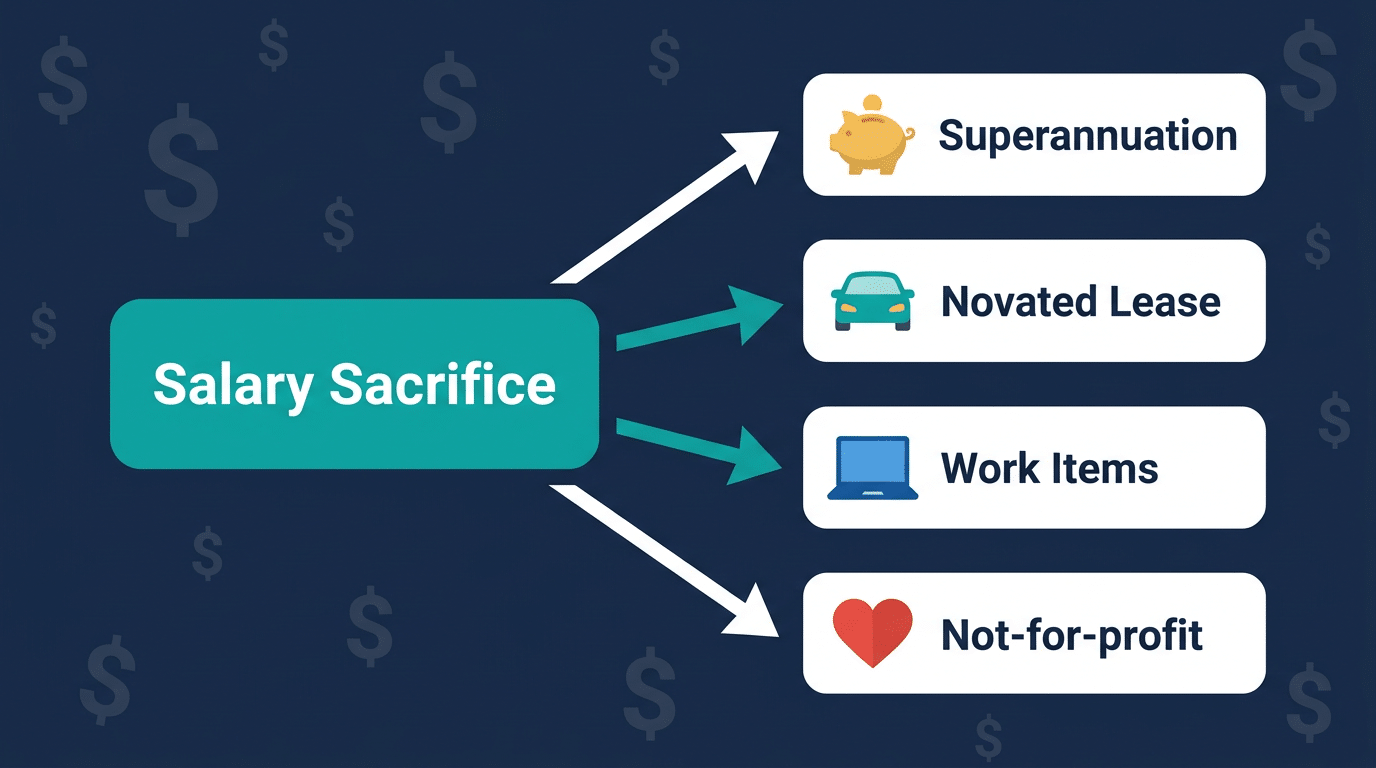
Salary sacrifice is an arrangement where you agree with your employer to receive less of your salary in cash and more in non-cash benefits — reducing your taxable income — also called salary packaging or total remuneration packaging; because benefits are paid from pre-tax income rather than after-tax salary, you effectively pay less income tax; the arrangement must be agreed before you perform the work and cannot apply to salary already earned. In Australia, this concept is often referred to as salary sacrifice Australia.
The most common salary sacrifice arrangement is additional superannuation contributions — salary sacrificed into super is taxed at 15% rather than your marginal income tax rate; for someone on a 32.5% or higher marginal rate, this creates a meaningful tax difference; the concessional contributions cap for 2025-26 is $30,000 (including your employer’s SG contributions), rising to $32,500 for 2026-27
Fringe Benefits Tax (FBT) applies to most non-super salary sacrifice benefits and is paid by your employer — but the employer’s FBT cost is often reflected in what they offer; some benefits are FBT-exempt (electric vehicles below the luxury car threshold, work-related laptops and devices primarily used for work) and some sectors have special concessions (charities and public benevolent institutions up to $15,900 per FBT year; public and non-profit hospitals up to $9,010 per FBT year)
Salary sacrifice is one of the most commonly mentioned but least understood workplace benefits in Australia. It appears in employment contracts, in HR conversations and on job advertisements — but what it means in practice, what it actually saves you and where the traps are is rarely explained clearly.
What is salary sacrifice?
Salary sacrifice is an arrangement between you and your employer where you agree to receive part of your remuneration as a non-cash benefit instead of cash salary. The benefit is provided from your pre-tax income — before income tax is calculated — which reduces your assessable taxable income.
The ATO defines it: “You and your employer agree for you to receive less income before tax and in return your employer pays for certain benefits of similar value for you. This means you pay less tax on your income.”
What it is also called: Salary packaging, total remuneration packaging. Same concept, different terms used by different employers.
The key rule: The arrangement must be agreed and in writing before you perform the work. You cannot retrospectively salary sacrifice salary already earned — the ATO treats backdated arrangements as ordinary income and taxes accordingly.
How salary sacrifice reduces your tax
The tax saving comes from the difference between your marginal income tax rate and the tax rate that applies to the benefit.
Example — salary sacrifice into super:
| Without salary sacrifice | With $5,000 sacrifice into super | |
|---|---|---|
| Gross salary | $80,000 | $80,000 |
| Salary sacrificed | — | $5,000 |
| Taxable income | $80,000 | $75,000 |
| Income tax + Medicare (approx.) | ~$17,816 | ~$16,216 |
| Tax saving | — | ~$1,600 |
| Take-home pay | ~$62,184 | ~$58,784 |
| Amount into super | Employer SG only | Employer SG + $5,000 |
The $5,000 sacrificed into super is taxed at 15% (the concessional super contributions rate) rather than the 32.5% marginal rate that applies at $80,000. The saving is the difference between those two rates.
Figures are illustrative based on 2024-25 ATO rates. Individual circumstances vary — consult a financial adviser or registered tax agent for personal modelling.
What you can salary sacrifice
1. Additional superannuation contributions
The most widely used salary sacrifice arrangement — and for most employees, the most tax-effective.
How it works: Your employer pays extra contributions to your super fund from your pre-tax salary. These contributions are treated as employer contributions — they are not fringe benefits and do not attract FBT.
Tax rate: 15% on the way in (concessional contributions tax) — versus your marginal income tax rate on ordinary salary.
Concessional contributions cap:
- 2025-26: $30,000 (including employer SG contributions)
- 2026-27: $32,500 (including employer SG contributions)
Important: The cap includes your employer’s compulsory Super Guarantee contributions. From 1 July 2025, the SG rate is 12%. Subtract your employer’s SG before deciding how much to sacrifice — exceeding the cap means the excess is taxed at your marginal rate, erasing the benefit.
Carry-forward rule: If your total super balance was below $500,000 on 30 June of the previous financial year, you may be able to use unused cap amounts from up to the previous five years.
HECS/HELP note: Salary sacrificed super contributions are added back as “reportable employer super contributions” for the purpose of calculating your HECS/HELP repayment income — sacrificing into super does not reduce your compulsory student loan repayments.
Division 293 tax: If your income plus concessional contributions exceeds $250,000, an additional 15% Division 293 tax applies on the concessional contributions — reducing but not eliminating the super sacrifice advantage.
2. Novated lease (car)
A novated lease is a three-way arrangement between you, your employer and a finance company — allowing you to finance a car and its running costs (fuel, insurance, registration, servicing) from your pre-tax salary.
FBT applies to most novated leases — calculated using either the statutory formula method or the operating cost method. The FBT cost is typically reflected in the salary sacrifice amount your employer deducts.
Electric vehicles (EVs) — FBT exemption: From 1 July 2022, eligible battery electric vehicles (BEVs) provided through a novated lease are exempt from FBT, provided the vehicle’s value is below the luxury car tax threshold for fuel-efficient vehicles ($91,661 in 2026-27). This makes EV novated leases significantly more tax-effective than petrol or diesel equivalents.
Plug-in hybrid vehicles (PHEVs): No longer eligible for the FBT exemption from 1 April 2025 (subject to transitional rules).
2026-27 budget change — three-phase restructure confirmed:
- Until 31 March 2027: Full FBT exemption continues for eligible BEVs under $91,661
- From 1 April 2027: EVs under $75,000 retain the full FBT exemption; EVs between $75,000 and $91,661 receive a 25% FBT discount only
- From 1 April 2029: Full exemption ends for all vehicles — all eligible EVs receive a 25% FBT discount only
Existing leases are not affected by the restructure. Check ato.gov.au for current guidance as legislation is finalised.
3. Work-related items (laptops, phones, devices)
Laptops, tablets and smartphones used primarily for work can be salary sacrificed free of FBT — the benefit is FBT-exempt when the item is used primarily for work purposes.
From 1 April 2027: ATO has announced that work-related items provided through a salary sacrifice arrangement will no longer be automatically exempt from FBT — they will become subject to FBT from that date. Items provided outside a salary sacrifice arrangement will remain exempt. Check the ATO website for current guidance as this change approaches.
4. Not-for-profit and hospital sector — special FBT concessions
Employees of certain organisations can access significantly more generous salary sacrifice concessions:
Public Benevolent Institutions (charities, aid organisations): Up to $15,900 of everyday living expenses (rent, mortgage repayments, groceries, bills) can be salary packaged FBT-free per FBT year. An additional $2,650 for meal entertainment and venue hire is also available.
Public and non-profit hospitals: Up to $9,010 of everyday living expenses FBT-free per FBT year, plus the $2,650 meal entertainment cap.
The FBT year runs 1 April to 31 March. These caps are on top of any salary sacrifice into super.
If you work in healthcare, a charity, an aid organisation or a not-for-profit, check with your employer’s salary packaging provider — the tax savings available are significantly larger than in the private sector.
What salary sacrifice does NOT cover
- Salary already earned — you cannot backdated or retrospectively sacrifice income already accrued
- Leave entitlements, bonuses or commissions accrued before the arrangement is in place — these cannot be salary sacrificed
- Gym memberships and health programs — these are fringe benefits subject to full FBT; generally not tax-effective for most employees
- Groceries (for most private sector employees) — only available as FBT-free salary packaging for eligible NFP and hospital sector employees
Key things to check before salary sacrificing
1. Does your employer offer it? Salary sacrifice must be offered by your employer — not all employers do, and there is no legal obligation to offer it.
2. Get it in writing. The ATO strongly recommends a written salary sacrifice agreement — it protects both you and your employer and confirms the details of the arrangement.
3. Check your SG obligations. From 1 July 2025, your employer must calculate Super Guarantee on your full pre-sacrifice ordinary time earnings — they cannot use your salary-sacrificed super to offset their SG obligations.
4. Watch the concessional cap. The 2026-27 cap is $32,500 including employer SG. Exceeding it means excess contributions are included in your assessable income and taxed at your marginal rate — losing the benefit.
5. Check how benefits affect other calculations. Salary sacrifice can affect income-tested benefits and payments — including HECS/HELP repayments (reportable employer super contributions), Family Tax Benefit, childcare subsidy and others. Seek financial advice to model your specific situation.
FAQs (frequently asked questions)
What is salary sacrifice in Australia?
An arrangement with your employer to receive less cash salary and more non-cash benefits — reducing your taxable income. Also called salary packaging. Common benefits include additional super contributions, novated car leases and work devices. Must be agreed before you earn the income.
Does salary sacrifice reduce my tax?
Yes — benefits are paid from pre-tax income rather than after-tax salary. The tax saving depends on the type of benefit, your marginal tax rate and whether FBT applies. Seek financial advice for personal modelling.
What is the salary sacrifice super cap for 2026-27?
$32,500 in total concessional contributions — including your employer’s Super Guarantee contributions. The 2025-26 cap was $30,000.
Does salary sacrifice reduce my HECS repayment?
Salary sacrificed super contributions are added back as reportable employer super contributions for HECS/HELP repayment calculations — sacrificing into super does not reduce your compulsory student loan repayment.
Can I salary sacrifice a car?
Yes — through a novated lease arrangement. FBT applies to most vehicles. Battery electric vehicles below the luxury car tax threshold (~$91,387) are currently FBT-exempt, making EV novated leases significantly more tax-effective than petrol or diesel equivalents.
I work for a charity — what can I salary sacrifice?
Employees of registered Public Benevolent Institutions can salary package up to $15,900 of everyday living expenses FBT-free per FBT year, plus $2,650 for meal entertainment. Public and non-profit hospital employees can package up to $9,010. These caps are in addition to any salary sacrifice into super.
Related guides
- Understanding your Australian payslip →
- What is superannuation? →
- What is a tax file number (TFN)? →
- What is the Medicare levy? →
This guide is for general information only and does not constitute financial or tax advice. Salary sacrifice rules, FBT rates and concessional caps change annually — always verify at ato.gov.au and seek advice from a registered tax agent or financial adviser. Last updated September 2026.
Sources: ATO — Salary sacrificing for employees (ato.gov.au, August 11, 2026) | ATO — FBT changes for salary sacrificed work-related benefits (ato.gov.au, 5 days ago) | hrblock.com.au — Salary Sacrifice in Australia Explained (February 17, 2026) | auinfohub.com.au — Salary Sacrifice Australia 2026 (1 month ago) | taxserve.com.au — Salary Packaging and Salary Sacrifice Australia 2025-26 (August 11, 2026) | futureadvisory.com.au — What is Salary Sacrificing? Complete Guide 2026 (July 27, 2026) | workcalc.com.au — Salary Sacrifice Calculator Australia 2026-27 (August 5, 2026) | remserv.com.au — What is salary sacrifice in Australia


