Summary
Australian and New Zealand passport holders can enter South Korea visa-free for up to 90 days — and the K-ETA requirement is waived until 31 December 2026 — no visa, no pre-authorisation fee and no 72-hour waiting window; what most visitors miss is the mandatory e-Arrival Card, which must be submitted online within 72 hours before departure at immigration.go.kr
South Korea is one of the most accessible, affordable and rewarding destinations in Asia — ancient palaces beside gleaming glass towers, world-class street food from KRW 1,000, a bullet train network that makes the whole country navigable, and a culture shaped by 5,000 years of history and a global pop phenomenon; budget travellers can live well on AUD $55 per day
The best times to visit are spring (April to May) for cherry blossoms and autumn (late September to October) for autumn foliage — both seasons sell out fast; July and August bring the monsoon, heavy humidity and the worst crowds; book spring and autumn trips months in advance
South Korea is the easiest ambitious trip in Asia. The trains run on time, the apps work, the food is extraordinary and affordable, and the cities — Seoul, Busan, Gyeongju — each offer a completely different dimension of the country. You can move between ancient Buddhist temples and hypermodern shopping districts within the same afternoon. You can eat a Michelin-starred meal and a KRW 3,000 street food snack within the same hour. South Korea is built for discovery — and it keeps pulling people back.
Visa and entry requirements
Visa-free — no K-ETA required until 31 December 2026
Both Australian and New Zealand passport holders can enter South Korea visa-free for up to 90 days. The K-ETA (Korea Electronic Travel Authorization) — a pre-arrival digital authorisation system — has been waived for Australian and New Zealand passport holders until 31 December 2026, confirmed by the South Korean Ministry of Justice.
What this means: No visa application, no K-ETA fee (KRW 10,000 ≈ AUD $12) and no 72-hour waiting window before your trip. Simply arrive with a valid passport.
Passport requirement: Valid for at least 6 months beyond your planned return date, with at least two blank pages.
90-day limit: The 90-day limit is firm and cannot be extended inside South Korea for tourist stays. If you need longer for work, study or family reasons, apply for the appropriate visa at the Embassy of the Republic of Korea before departure.
What’s changing from 1 January 2027
The K-ETA waiver ends on 31 December 2026. From 1 January 2027, Australian and New Zealand travellers will likely need to apply for a K-ETA before each trip:
- Cost: KRW 10,000 (approximately AUD $12)
- Processing time: 24-72 hours; apply 3-5 days before departure
- Validity: Up to 3 years with multiple entries
If your trip is January 2027 or later, build the K-ETA into your planning timeline.
The e-Arrival Card — mandatory for all travellers
Even with the K-ETA waiver, all travellers entering South Korea must complete the e-Arrival Card — a mandatory digital entry declaration that replaced paper landing cards entirely in 2026.
Submit it at: immigration.go.kr When: Within 72 hours before your flight departs — not on arrival What it covers: Passport details, flight information and accommodation address in South Korea Time required: Approximately 5-10 minutes
This is the step most visitors miss. Immigration officers at Incheon International Airport will check for it. Complete it before you board.
Best time to visit
Spring: April to May — the best overall season
Cherry blossom season transforms South Korea from late March through April — Seoul’s Yeouido island, Gyeongju’s Bomun Lake and Jeju’s coastal paths all bloom spectacularly. The weather is mild (15-20°C), crowds are manageable and the country is at its most visually stunning. Late April to early May is the sweet spot — blossoms fading but temperatures perfect and tourists thinning.
Autumn: Late September to October — spectacular foliage
South Korea’s autumn foliage rivals Japan’s — the mountains around Seoul, Seoraksan National Park in the northeast and the ancient city of Gyeongju turn amber, red and gold from late September. Perfect hiking weather with cool, dry days. Arguably the best season for anyone who can choose.
Winter: December to February — cold but magical
Seoul winters are genuinely cold (-5 to 5°C) with occasional snow — but the city transforms into a world of light festivals, ice skating rinks and steaming hotpot restaurants. Ski resorts (Alpensia, Yongpyong) are 2-3 hours from Seoul and world-class.
Avoid: July to August — monsoon season
The summer monsoon brings heavy rain, suffocating humidity (35°C+) and the largest domestic tourism crowds of the year. Accommodation prices peak and outdoor activities become uncomfortable. Skip unless dates are fixed.
Getting there
From Australia
Direct flights:
- Sydney to Seoul Incheon (ICN): ~10 hours — Korean Air, Qantas, Asiana
- Melbourne to Seoul: ~10 hours — Korean Air, Asiana
- Brisbane to Seoul: ~10 hours — Korean Air
- Perth to Seoul: ~8.5 hours — Korean Air, Asiana
Cost: Return flights from Australia typically range from AUD $700-$1,100 booked 2-3 months ahead. Sale fares from Sydney can reach AUD $500-$700 return.
From New Zealand
No direct flights from New Zealand. All routes connect via Australian cities or Asian hubs (Singapore, Hong Kong, Tokyo).
Flight time: Auckland to Seoul approximately 12-14 hours with connection.
Cost: Return flights from New Zealand typically range from NZD $1,000-$1,600 booked ahead.
Getting around South Korea
KTX Bullet Train
The KTX (Korea Train eXpress) is the defining transport experience of South Korea — a bullet train network connecting Seoul to Busan in approximately 2.5 hours (versus 4-5 hours by car). The trains are punctual, comfortable and fast.
Key routes:
- Seoul to Busan: ~2.5 hours — KTX from Seoul Station or Suseo Station
- Seoul to Gyeongju: ~2 hours 10 minutes
- Seoul to Jeonju: ~1 hour 40 minutes
Book at Korail (letskorail.com) in advance — particularly for spring and autumn travel.
Seoul Metro
Seoul’s subway system is one of the best in the world — 23 lines, English signage throughout, remarkably clean and punctual, and extending to most major attractions. The T-money card (a rechargeable transit card available at any convenience store) works on the subway, buses and even some taxis across Seoul.
Load KRW 30,000-50,000 on arrival — it covers multiple days of transit. Top up at any convenience store.
Domestic flights to Jeju
The Seoul Gimpo (GMP) to Jeju (CJU) route is one of the world’s busiest air routes. Flights run every 15-20 minutes during peak hours and cost from KRW 30,000 (~AUD $22) if booked 2+ weeks ahead with Jeju Air or Air Seoul. The flight takes approximately 1 hour.
Naver Map and Papago
Two apps are essential outside of Seoul:
- Naver Map: South Korea’s dominant navigation app — more accurate than Google Maps for Korean addresses and transit directions
- Papago: The best translation app for Korean; camera translation for menus and signs is particularly useful
Download both before you leave.
Top destinations
Seoul — the capital
Seoul is a city of extraordinary contradictions — 600-year-old palaces surrounded by glass skyscrapers, ancient street markets beside K-beauty flagship stores, Buddhist temples inside mountains accessible by city metro. It is one of the world’s great cities, and most travellers need at least 5-7 days to begin to understand it.

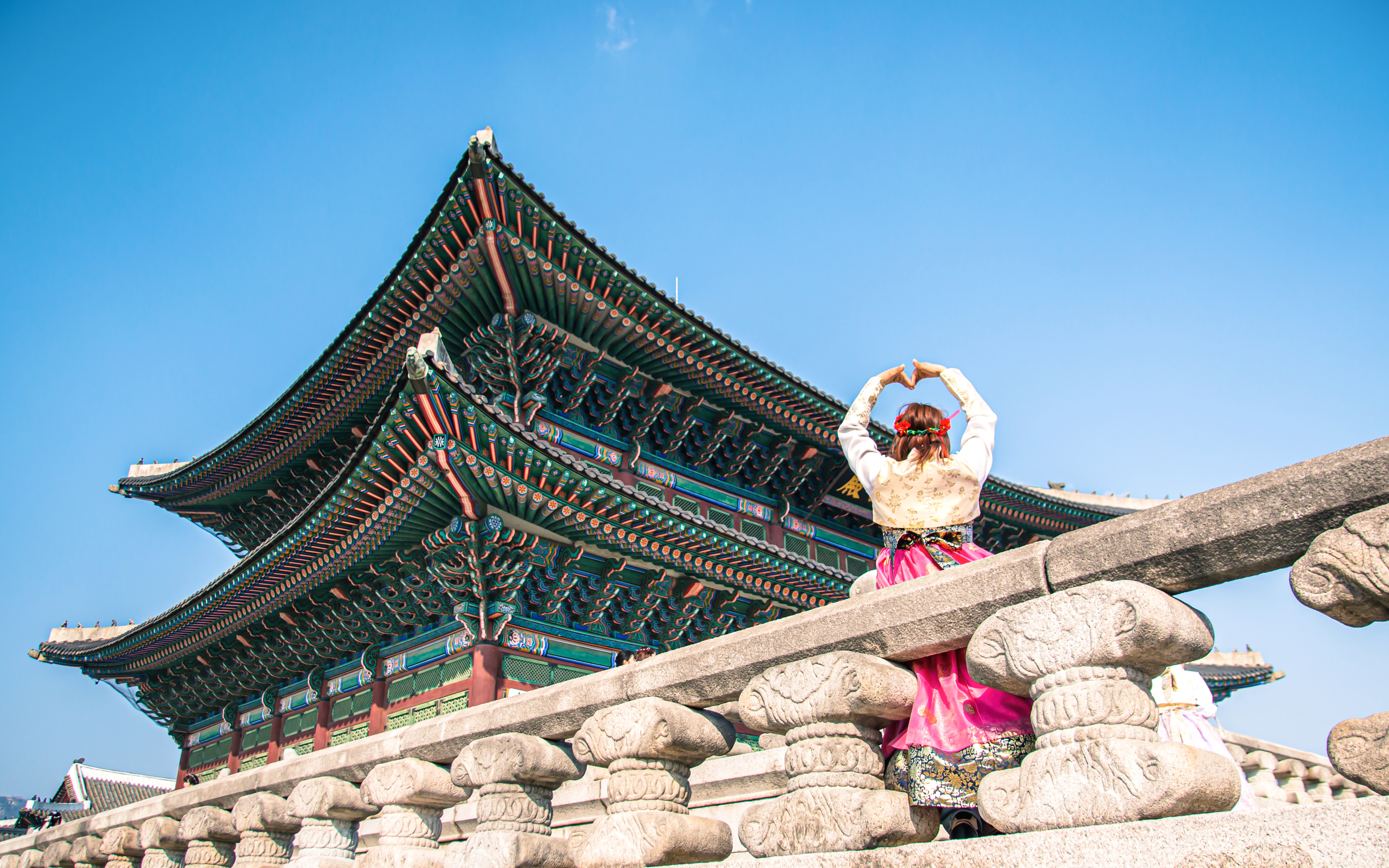
Gyeongbokgung Palace: The grandest of Seoul’s five Joseon-era royal palaces — built in 1395 as the seat of the Joseon dynasty. The Changing of the Guard ceremony (10am and 2pm daily) is one of Seoul’s most photographed moments. Wear a hanbok (traditional Korean dress) for free entry — rental shops surround the palace.
Bukchon Hanok Village: A hillside neighbourhood of 600+ traditional Korean wooden houses (hanok) that has survived Seoul’s modernisation. Narrow alleyways winding between tile-roofed homes, with views over the city below. Go before 10am to experience it without crowds.

Insadong: Seoul’s most traditional commercial street — antique shops, tea houses, artisan craft shops and street food stalls. The nearby Ikseon-dong alley is a newer, trendier neighbour — renovated hanok buildings converted into cafés, boutiques and restaurants.
N Seoul Tower (Namsan): A communications tower atop Namsan mountain with 360-degree views over Seoul. Reach it by cable car or a 20-minute walk through Namsan Park. Go at sunset for the most dramatic views.
Hongdae: Seoul’s university district — the centre of indie music, street performance, youth fashion and nightlife. Live around the clock from afternoon to pre-dawn. The busking performances on weekend afternoons are genuinely excellent.
Myeongdong: Seoul’s busiest shopping and street food district — dense with K-beauty stores (Innisfree, Etude House, Nature Republic), global brands and street stalls selling tteokbokki, hotteok, corn dogs and egg bread. Tourist-heavy but genuinely fun.
DMZ Day Trip: The Demilitarized Zone between North and South Korea — 60km north of Seoul — is one of the most extraordinary geopolitical sites on earth. Guided day tours from Seoul visit the Joint Security Area at Panmunjom, the Third Infiltration Tunnel (dug by North Korea discovered in 1978) and Dora Observatory with views into North Korea. Book through a licensed tour operator.
Busan — the coastal city
South Korea’s second city is completely different from Seoul — slower, warmer, more relaxed, with a port city energy shaped by the sea. Busan has some of the best food in Korea, beaches within city limits and a creative culture that feels genuinely local rather than tourist-polished.

Haeundae Beach: Busan’s most famous beach — a long crescent of sand backed by high-rise apartments and hotels. Spectacular at night when the Gwangan Bridge (Diamond Bridge) lights up across the bay. The beach itself is packed in summer — visit in spring or autumn for a calmer experience.
Gamcheon Culture Village: A hillside slum redeveloped into an open-air gallery of colourful houses, murals, sculptures and independent cafés — often called the “Korean Santorini.” The maze of steep alleyways and painted walls is endlessly photogenic.
Jagalchi Fish Market: Korea’s largest seafood market — a three-storey building and outdoor market where the morning catch is sold fresh by vendors. Choose a live fish from the tanks downstairs; eat it sliced raw (hoe) on the second floor with sesame oil, salt and gochujang.
Haedong Yonggungsa Temple: A Buddhist temple built dramatically on the rocky sea cliffs north of Busan — one of the few temples in Korea built directly on the coast. The views of the East Sea (Sea of Japan) from the temple grounds are extraordinary.
Gwangalli Beach: Busan’s second beach — smaller and more local than Haeundae, with cafés, bars and restaurants lining the beachfront and the Gwangan Bridge as a backdrop. Better for an evening out than a beach day.
Gangnam — Psy, K-pop and the most expensive real estate in Korea
Gangnam literally means “south of the river” — the affluent district south of the Han River that became globally famous in 2012 when Psy released “Gangnam Style,” a satirical commentary on the district’s wealthy, status-obsessed culture. The music video became the first YouTube video to reach one billion views and introduced South Korea to an audience of hundreds of millions of people who had never thought about the country before.
The actual Gangnam district — spanning neighbourhoods like Apgujeong, Cheongdam-dong and Sinchon — is exactly as the song described: expensive, fashionable and image-conscious. It is home to Seoul’s luxury designer stores, the most prestigious plastic surgery clinics in Asia (the area around Apgujeong Station is called the “Beauty Belt”), and the highest property prices in South Korea.

SMTOWN Museum: The flagship cultural attraction for K-pop fans — a multi-storey museum and retail space in the heart of Gangnam operated by SM Entertainment (home of EXO, aespa, NCT and others). Interactive exhibitions, artist merchandise and a café. Essential for any K-pop fan.
K-Star Road: A 600-metre stretch of Apgujeong Rodeo Street lined with giant character statues (called GangnamDols) representing K-pop idol groups. Each statue was designed by the group’s fan club. A pilgrimage site for international K-pop fans.
Cheongdam-dong: The ultra-luxury street running through Gangnam — Chanel, Hermès, Prada, Dior, Bottega Veneta flagship stores and some of Seoul’s most expensive restaurants. Window-shopping is free.
Coex Mall: One of Asia’s largest underground shopping malls — beneath the Coex Convention Centre in Gangnam; the Starfield Library inside Coex (a cathedral-like two-storey library open to the public) is one of Seoul’s most photographed spaces.
Tip: Gangnam Station (Line 2 and Shinbundang Line) is the main transit hub. From central Seoul, take Line 2 (the green circular line) southbound — approximately 25 minutes from City Hall.
Gyeongju — the ancient capital
Gyeongju was the capital of the Silla Kingdom for nearly 1,000 years (57 BCE – 935 CE) — one of the three kingdoms of ancient Korea. The city is sometimes called “the museum without walls” — it is so dense with ancient tombs, temples and palace ruins that UNESCO designated the entire historic area as a World Heritage Site.

Bulguksa Temple: A masterpiece of Buddhist architecture — the supreme temple of the Silla period, dating to 528 CE and rebuilt extensively in the 8th century. UNESCO World Heritage Site. The stone pagodas (Dabotap and Seokgatap) in the courtyard are among the finest examples of Silla-era stonework.
Seokguram Grotto: A granite-domed artificial cave temple on a mountain above Bulguksa — housing a seated stone Buddha of extraordinary serenity. UNESCO World Heritage Site. The view from the grotto entrance down to the East Sea on a clear morning is one of the most beautiful in Korea.
Tumuli Park (Daereungwon): Twenty-three enormous grassy burial mounds — the royal tombs of Silla kings and queens — rising from the centre of Gyeongju like a dreamscape of green hills. Walk among them at golden hour.
Jeju Island — volcanic paradise
Jeju is South Korea’s largest island — a volcanic sub-tropical island off the southern tip of the peninsula that has been called the “Hawaii of Korea.” It is a UNESCO World Natural Heritage Site and a UNESCO Global Geopark, recognised for its extraordinary volcanic landscape.

Hallasan: South Korea’s highest peak at 1,947m — a dormant volcano that occupies the centre of Jeju. The crater lake (Baeknokhdam) at the summit is one of the most dramatic mountain landscapes in East Asia. Multiple hiking trails; the Seongpanak and Gwaneumsa routes are the most popular. Allow 8-10 hours for the summit.
Seongsan Ilchulbong (Sunrise Peak): A UNESCO World Heritage volcanic crater rising 182m from the sea — the 20-minute hike to the rim delivers one of Korea’s most iconic landscapes. Go at sunrise for the most dramatic light.
Jusangjeolli Cliff: Hexagonal basalt columns formed by volcanic lava meeting the sea — a natural geometric formation of extraordinary beauty on Jeju’s western coast.
Hallim Park and Manjanggul Cave: Manjanggul is one of the world’s longest lava tube caves — over 13km, with a 1km section open to visitors. Cool and dramatic underground.
Getting there: Fly from Seoul Gimpo (GMP) — 1 hour from KRW 30,000 (~AUD $22) with Jeju Air or Air Seoul, booked 2+ weeks ahead. This is one of the world’s busiest air routes — book early.
Korean food — essential eating
Korean cuisine is one of the world’s great food traditions — bold, fermented, communal and deeply regional. The price-to-quality ratio is extraordinary: an excellent meal at a local restaurant costs KRW 8,000-15,000 (AUD $6-$11).
The essentials:
Korean BBQ (Samgyeopsal / Galbi): Thick-cut pork belly or beef short ribs grilled at the table on a charcoal or gas grill. Wrap in lettuce with garlic, sliced green onion, fermented soybean paste (doenjang) or spicy ssamjang. The ultimate Korean dining experience — social, hands-on and extraordinarily satisfying.

Bibimbap: A bowl of warm rice topped with sautéed vegetables, a fried egg, gochujang (fermented chilli paste) and — in the Jeonju version — a raw egg and prime beef. Mix everything together. Jeonju is bibimbap’s spiritual home — the dish there is considered the standard.

Tteokbokki: Chewy cylindrical rice cakes simmered in a fiery gochujang sauce — one of Korea’s most popular street foods. Available everywhere; the best are at pojangmacha (street stalls) at night.

Samgyetang: A whole young chicken stuffed with ginseng, glutinous rice, jujube and garlic, simmered in a clear broth. Delicate, warming and restorative — particularly sought in summer when Koreans believe in “fighting heat with heat.”

Kimchi: Fermented cabbage or radish seasoned with chilli, garlic and salted seafood. Not just a side dish — a foundational element of Korean cuisine and culture; there are over 200 varieties.

Japchae: Glass noodles made from sweet potato starch, stir-fried with vegetables, egg and beef in sesame oil and soy sauce. Sweet, silky and one of Korea’s most loved dishes.

Haemul Pajeon: A savoury seafood and spring onion pancake — crispy outside, soft inside — served with a soy dipping sauce. Best with a bowl of makgeolli (milky rice wine).

Street food in Seoul:
- Hotteok — sweet filled pancake with brown sugar, honey and crushed nuts; eat it with your fingers on a cold day
- Egg bread (Gyeranppang) — a whole egg baked into a sweet bread loaf; sold from street carts in winter
- Twigim — battered and deep-fried vegetables, squid and glass noodles sold at pojangmacha stalls
Korean culture — dos and don’ts
Things to do
Remove shoes when entering homes and some restaurants: Many traditional Korean restaurants and all private homes require removing shoes at the entrance — look for a step up and a rack of footwear as your cue.
Accept drinks poured by elders and pour in return: In Korean drinking culture, you do not pour your own glass — you pour for others and they pour for you. When receiving a drink from an elder, hold your glass with both hands or support your right arm with your left hand. This is one of the most visible forms of social respect in Korean culture.
Use two hands when giving or receiving: Handing something to someone — a business card, money, food, a gift — with two hands (or with the right hand supported by the left) signals respect. One hand alone can seem casual or dismissive.
Bow as a greeting: A slight bow of the head is the standard greeting in Korea — deeper for elders or in formal situations. Koreans do not typically shake hands with strangers. A slight nod is fine between peers.
Try the local apps: Download Kakao Map or Naver Map for navigation (both more accurate than Google Maps in Korea), and Papago for translation. They are free and essential.
Respect in temples: Remove shoes before entering temple buildings. Move quietly and respectfully around monks and worshippers. Photography of interiors may be restricted — look for signs.
Things not to do
Do not write names in red ink: In Korean culture, writing a living person’s name in red is associated with death — it is used on memorial markers and funeral documents. Use any other colour for someone’s name.
Do not stick chopsticks upright in rice: This resembles incense sticks at a funeral altar and is deeply inauspicious. Rest chopsticks across the rim of the bowl or on a chopstick rest.
Do not pass food chopstick-to-chopstick: Similarly, this evokes funeral rites where bones are passed between family members. Place food on a plate or table surface instead.
Do not eat or drink on the Seoul metro: It is prohibited and culturally discouraged. Koreans are extraordinarily considerate about shared public spaces.
Do not tip: Tipping is not customary in South Korea — in restaurants, taxis, hotels or anywhere else. Attempting to tip can cause awkwardness or be politely refused.
Do not be surprised by honesty: Koreans are often direct and frank in a way that can feel blunt to Australian and New Zealand travellers. A shopkeeper saying your hairstyle does not suit you, or a stranger commenting on your weight, is intended as honest observation rather than rudeness.
K-pop in Seoul — what to know before you go
South Korea’s music industry has become one of the most significant cultural exports in the world — and Seoul is its global centre. BTS, BLACKPINK, Stray Kids, NewJeans, aespa and dozens more acts have built international fan communities that now drive significant tourism to the city.
HYBE Insight: The official museum and fan experience space of HYBE Corporation — home label of BTS, Tomorrow X Together (TXT) and other major acts. Located in Yongsan. Book tickets in advance online — it sells out regularly.
SM, JYP, YG Entertainment buildings: The three other major K-pop labels have their headquarters in Seoul. SM is in Apgujeong (Gangnam); JYP is in Mapo; YG is in Hapjeong. Fan “building visits” — standing outside hoping to spot artists — are a long-established K-pop tradition. Artists very rarely appear, but the experience itself has become a cultural ritual.
Music Bank, Inkigayo, M Countdown recording tickets: The major weekly music shows (Music Bank on KBS, Inkigayo on SBS, M Countdown on Mnet) film in Seoul and offer free audience tickets to international fans via their official websites and apps. Getting tickets requires registration in advance — often months ahead for popular recording periods.
Music cafés and K-pop merch: The streets of Hongdae and around Myeongdong are dense with K-pop merchandise stores, music cafés (where you listen to albums in themed spaces) and idol photo card shops. For K-pop fans this is as much a pilgrimage as the HYBE museum.
Money and costs
Currency: South Korean Won (KRW). As of mid-2026, approximately AUD $1 = KRW 900; NZD $1 = KRW 780.
Daily budgets:
| Budget level | Daily spend | What you get |
|---|---|---|
| Budget | AUD $55/day | Goshiwon or hostel, street food, public transit |
| Mid-range | AUD $115/day | Comfortable hotel, restaurants, day trips |
| Luxury | AUD $250+/day | Design hotels, private tours, fine dining |
Cash vs card: South Korea is increasingly cashless — major restaurants, cafés and shops in cities accept Visa and Mastercard. However smaller restaurants, markets, taxis and street food stalls are still often cash only. Carry KRW 50,000-100,000 in cash at all times.
ATMs: Available everywhere in Seoul, Busan and Jeju. Global ATMs at Woori Bank, KEB Hana Bank, Citibank and GS25/CU convenience stores accept international cards. Standard withdrawal limits apply.
T-money card: A rechargeable transit card used on subways, buses and some taxis across South Korea. Buy at any convenience store (CU, GS25, 7-Eleven) or subway station vending machine — basic card from KRW 2,500; designer cards up to KRW 5,000. Load KRW 30,000-50,000 on arrival. The base subway fare with T-money is KRW 1,550 (approximately AUD $1.70) for up to 10km.
What it means for your transfers
AUD to KRW transfers from Australia are fee-free with OrbitRemit — and NZD to KRW from New Zealand is also fee-free. Whether you are supporting family in South Korea, sending money for a Korean language course, or managing finances while you travel, OrbitRemit supports fee-free transfers both ways.
Related guides
- The 5 best eSIMs for international travel from Australia →
- The 5 best eSIMs for international travel from New Zealand →
- The 5 best travel money cards in Australia 2026 →
- The 5 best travel money cards in New Zealand 2026 →
- Asian currencies: a complete guide →
FAQs (frequently asked questions)
Do Australians need a visa for South Korea?
No — Australian passport holders can enter visa-free for up to 90 days. The K-ETA is also waived until 31 December 2026. You need a valid passport (6 months validity) and a mandatory e-Arrival Card completed within 72 hours before departure.
Do New Zealanders need a visa for South Korea?
No — same as Australians. Visa-free for 90 days, K-ETA waived until 31 December 2026. Complete the e-Arrival Card within 72 hours before departure at immigration.go.kr.
What is the e-Arrival Card for South Korea?
A mandatory digital entry declaration completed online within 72 hours before your flight departs, at immigration.go.kr. It covers passport details, flight information and your accommodation address in Korea. Unlike the K-ETA, it is not waived — all travellers must complete it.
What is the best time to visit South Korea?
Spring (April-May) for cherry blossoms and autumn (late September-October) for foliage — both are spectacular and popular, so book early. Avoid July-August for the monsoon and humidity.
How do I get from Seoul to Busan?
By KTX bullet train — approximately 2.5 hours from Seoul Station. Book at Korail (letskorail.com) in advance, especially for spring and autumn travel.
How much does it cost to travel South Korea?
Budget travellers can live comfortably on AUD $55 per day. Mid-range is approximately AUD $115. South Korea is cheaper than Japan with comparable quality — especially for food.
Is South Korea safe for Australian and New Zealand travellers?
Extremely safe. The Australian Government’s Smartraveller advisory is “Exercise Normal Safety Precautions” — the baseline level. South Korea consistently ranks among the world’s safest countries for tourists.
Visa requirements and entry conditions are subject to change — always verify at Smartraveller (smartraveller.gov.au) and the Korean Immigration Service (immigration.go.kr) before travelling. Last updated September 2026.
Sources: Smartraveller — South Korea Travel Advice (3 weeks ago, smartraveller.gov.au) | traveloka.com — South Korea Entry Requirements for Australians 2026 (July 17, 2026) | pack-lightly.com — South Korea Travel Guide 2026 (5 days ago) | kimchiboy.com — Korea Travel Guide 2026 (July 31, 2026) | nomadicmatt.com — South Korea Budget Travel Guide 2026 (February 2026) | umetravel.com — South Korea Travel Guide 2026 | foratravel.com — Ultimate Seoul Travel Guide 2026 (February 6, 2026)


