Summary
Australian and New Zealand passport holders require an e-Visa to enter Vietnam — there is no visa-free access for either nationality; the 90-day e-Visa (single or multiple entry) costs USD $25 and is applied for entirely online at evisa.gov.vn; processing typically takes 3-5 working days — apply at least one week before travel
Vietnam is one of the most compelling and affordable destinations in Southeast Asia — 3,200km of coastline, ancient imperial cities, karst limestone landscapes, world-class street food and a modern energy that pulses through Hanoi and Ho Chi Minh City; direct flights from Sydney and Melbourne make it one of the more accessible long-haul destinations for Australians
The Australian Government’s Smartraveller advisory for Vietnam is “Exercise Normal Safety Precautions” — the baseline level and among the most positive ratings in Southeast Asia; Vietnam consistently ranks as one of the safest destinations in the region for tourists
Vietnam runs 3,200 kilometres from the mountainous Chinese border in the north to the tropical delta of the south — a country so long that the climate, cuisine and culture shift dramatically from top to bottom. Hanoi is the capital in the north; Ho Chi Minh City (Sài Gòn) is the economic powerhouse in the south. It is one of the world’s great food destinations, one of Southeast Asia’s most historically layered countries, and one of the best value-for-money travel experiences available to Australians and New Zealanders.
Visa and entry requirements
e-Visa — required for Australians and New Zealanders
Both Australian and New Zealand passport holders must obtain a visa before or on arrival in Vietnam. The 90-day e-Visa is the recommended option — fully online, affordable and available in both single-entry and multiple-entry formats.
Vietnam e-Visa — confirmed 2026:
| e-Visa type | Duration | Fee |
|---|---|---|
| Single entry | 90 days | USD $25 |
| Multiple entry | 90 days | USD $50 |
Multiple entry costs USD $50 — worth it if you plan to cross into Cambodia, Laos or Thailand and return to Vietnam during your trip. Single entry at USD $25 is fine for a straightforward in-and-out trip. The multiple-entry e-Visa allows you to leave Vietnam (for a side trip to Cambodia, Laos or Thailand) and return without applying for a new visa.
How to apply:
- Go to evisa.gov.vn — the official Vietnamese Immigration Department portal (in English)
- Click “Apply for E-Visa”
- Complete the form — passport details, entry/exit points, temporary address in Vietnam (hotel name is sufficient)
- Upload a digital passport photo (4x6cm, white background, no glasses) and a scan of your passport biographical page
- Pay USD $25 (single entry) or USD $50 (multiple entry) by international credit or debit card
- Receive your e-Visa by email within 3-5 working days
- Print the approval and carry it with your passport
Warning: Many unofficial websites charge USD $80-150 for the same service. Always use evisa.gov.vn. The official process takes 10 minutes and costs USD $25 (single) or USD $50 (multiple).
Passport requirements: Valid for at least 6 months beyond your arrival date and with at least two blank pages.
Processing time: 3 working days (officially). In practice, simple applications often clear in 2 days; during Tết (Vietnamese New Year, late January-early February) allow 7-10 days. Apply at least one week before travel.
Pre-Arrival Declaration — also mandatory
Complete the free form at prearrival.immigration.gov.vn within 3 days before your flight. Takes approximately 5 minutes. Generates a QR code that immigration officers scan alongside your e-Visa on arrival. Do not skip this.
90-day limit: The 90-day e-Visa allows a maximum stay of 90 days per visit. For longer stays, apply for an extension at a Vietnamese immigration office, or do a “visa run” — exit Vietnam briefly (fly to Bangkok or bus to Phnom Penh), apply for a fresh e-Visa and re-enter. Total cost approximately USD $150-200 including a budget flight.
Best time to visit
Vietnam’s climate varies dramatically by region, making “best time” highly destination-dependent.
Hanoi and North Vietnam:
- October to April — cool and dry; October-November particularly good
- May to September — hot, humid and rainy; typhoon risk
Hội An and Central Vietnam:
- February to May — warm, dry and sunny; the best months
- October to December — heavy rainfall and flooding risk (central Vietnam gets its wet season when the south is dry)
Ho Chi Minh City and South Vietnam:
- December to April — dry season; optimal
- May to November — wet season; afternoon thunderstorms daily but usually clear mornings
For most Australians and New Zealanders visiting multiple cities: November to March is the best overall window — dry in Hanoi and north, excellent in Ho Chi Minh City and south, and reasonable in central Vietnam.
Getting there
From Australia
Direct flights: Vietnam Airlines operates direct flights from Sydney and Melbourne to Hanoi (HAN) and Ho Chi Minh City (SGN). VietJet Air also flies direct from Melbourne and Perth.
Flight time: Approximately 9-10 hours direct from Sydney to Ho Chi Minh City or Hanoi.
Budget connections: Scoot (via Singapore), Jetstar (via Singapore or Bali), AirAsia (via Kuala Lumpur) offer cheaper connections with one stop.
Cost: Return flights from Australia range from approximately AUD $500-900 return during sales to AUD $900-1,400 at standard rates.
From New Zealand
No direct flights. All routes via Asian hubs — Singapore (Singapore Airlines, Scoot), Kuala Lumpur (Malaysia Airlines, AirAsia), Bangkok (Thai Airways), Hong Kong (Cathay Pacific).
Flight time: Auckland to Ho Chi Minh City approximately 14-16 hours including connection.
Top destinations
Hanoi — the capital
Hanoi is Vietnam’s 1,000-year-old capital — a city of French colonial boulevards, ancient temple complexes, lakes and street food lanes that has maintained a distinctly slower pace than Ho Chi Minh City. The Old Quarter’s 36 guild streets, each historically dedicated to a specific trade, remain the heart of the city.

Don’t miss: Hoàn Kiếm Lake and the Ngọc Sơn Temple (connected by the red Thê Húc Bridge — Hanoi’s most photographed image); the Temple of Literature (Văn Miếu) — Vietnam’s first university, established in 1070; the Ho Chi Minh Mausoleum complex (where Ho Chi Minh’s body is preserved — arrive early, dress modestly, no shorts); the Vietnam Museum of Ethnology (excellent English language displays on Vietnam’s 54 ethnic groups); Hỏa Lò Prison (“Hanoi Hilton”) — sobering history of French colonialism and American POWs.
Street food: Hanoi’s street food is among the best in the world. Phở bò (beef noodle soup) is Hanoi’s signature dish — eaten for breakfast, with multiple generations of the same family competing for customers along the same street for decades. Bún chả (grilled pork with noodles and dipping sauce — the dish Barack Obama ate with Anthony Bourdain on CNN) is another Hanoi essential.
Hạ Long Bay
Hạ Long Bay is a UNESCO World Heritage Site and one of Vietnam’s most iconic natural landscapes — 1,969 limestone karst islands rising from the emerald Gulf of Tonkin, many hollow with cave systems. An overnight cruise on a traditional junk is the classic way to experience it.

Getting there: 3-4 hours by road from Hanoi; or fly to Van Don Airport directly from Ho Chi Minh City.
Cruise options: Range from budget overnight junks (~USD $60-80 per person) to luxury 3-day cruises on restored wooden vessels (~USD $200-350 per person per night). For the best experience without the most crowded areas, consider Bái Tử Long Bay (adjacent to Hạ Long, less visited) or Lan Hạ Bay (near Cat Ba Island).
Hội An — the ancient town
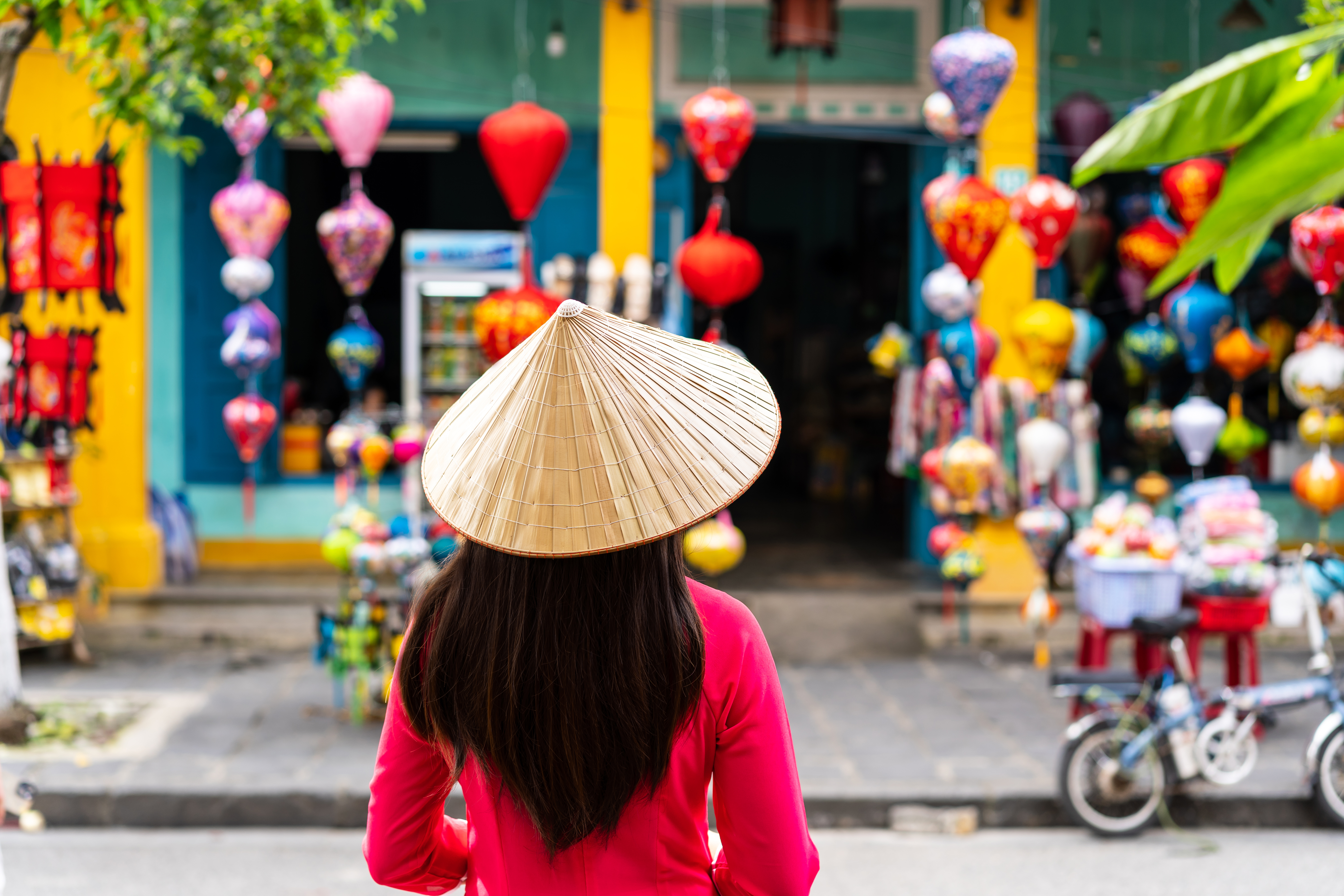
Hội An is Vietnam’s best-preserved trading port — a UNESCO World Heritage Site of yellow-walled merchant houses, Japanese bridges, Chinese temples and tailor shops. The old town is navigated on foot; motorbikes are banned in the core historic area.

Don’t miss: The Japanese Covered Bridge (Cầu Nhật Bản) — 18th century, built by the Japanese merchant community; the old town at night when lanterns are lit and the Thu Bồn River glows; An Bàng Beach and Cửa Đại Beach (5km from the old town); the monthly Full Moon Festival (14th day of the lunar month) when the old town is illuminated entirely by lanterns and electricity is switched off.
Food: Hội An has three dishes unique to the town — Cao Lầu (thick noodles made with ash-lye water from a specific well, served with char siu pork and herbs), Cơm Gà Hội An (Hội An chicken rice) and Bánh Mì Phượng (the most famous bánh mì in Vietnam — a queue forms outside Phượng’s store every morning).
Getting there: Fly to Đà Nẵng Airport (DAD), then 45 minutes by taxi or shuttle. Đà Nẵng has direct flights from Sydney and Melbourne (Vietnam Airlines).
Đà Nẵng — the beach city
Đà Nẵng is Vietnam’s third-largest city and its fastest-growing tourist destination — a modern coastal city that has emerged in the past decade as a major hub for both domestic Vietnamese tourism and international visitors. It sits on a long curve of beach, backed by the marble mountains and jungle-covered Bà Nà Hills, and is perfectly positioned as a base for day trips to both Hội An (30 minutes south) and Huế (2 hours north).

Mỹ Khê Beach: Stretching 30km along Đà Nẵng’s coastline, Mỹ Khê is consistently rated one of the best urban beaches in Asia — clean sand, warm water, manageable waves for swimming and surfing, and a rapidly developing strip of cafés and beach clubs. Uncrowded by Southeast Asian standards.
Bà Nà Hills and the Golden Bridge: A French hill station resort at 1,487m altitude — accessible by a record-breaking cable car (the longest non-stop single-track cable car in the world at time of construction). The Golden Bridge — a 150m pedestrian bridge held up by two giant stone hands emerging from the hillside — is Vietnam’s most Instagrammed image of the past five years. Expect crowds; go on a weekday morning.
Marble Mountains (Ngũ Hành Sơn): Five marble and limestone hills between Đà Nẵng and Hội An, riddled with Buddhist sanctuaries and caves. Thủy Sơn is the most accessible — climb to the top for views over the South China Sea and explore the cave temples inside the mountain. Entry approximately VND 40,000.
Han River Bridge and Dragon Bridge: Đà Nẵng’s most recognisable landmarks — the Dragon Bridge (Cầu Rồng) breathes fire and water every Saturday and Sunday night at 9pm. A free and genuinely spectacular event that draws crowds of locals and tourists.
Food: Đà Nẵng is the home of Mỳ Quảng — a regional noodle dish with wide turmeric-yellow noodles, minimal broth and a complex mix of toppings (shrimp, pork, peanuts, sesame crackers, herbs). Bánh Tráng Cuốn Thịt Heo (pork and rice paper rolls) and Bún Chả Cá (fish cake noodle soup) are also Đà Nẵng staples.
Getting there: Direct flights from Sydney, Melbourne and Auckland via Đà Nẵng International Airport (DAD). Vietnam Airlines, VietJet Air and Bamboo Airways all serve Đà Nẵng. 1 hour by air from Hanoi or Ho Chi Minh City.
Huế — the imperial city
Huế was Vietnam’s imperial capital from 1802 to 1945 — the seat of the Nguyễn dynasty, whose influence on Vietnamese culture, cuisine and architecture was transformative. The Imperial Citadel (Đại Nội) is a vast complex of palaces, temples and ceremonial gates modelled loosely on Beijing’s Forbidden City.

Don’t miss: The Imperial Citadel; the Royal Tombs on the Perfume River — particularly Tomb of Tự Đức (most elaborate) and Tomb of Minh Mạng (most symmetrical and serene); the Thiên Mụ Pagoda on the river; a boat journey on the Perfume River at dusk.
Huế cuisine: Considered by many to be Vietnam’s most sophisticated regional cuisine — complex, refined, imperial. Bún Bò Huế (a spicier beef noodle soup different from Hanoi’s phở), Bánh Khoái (crispy crepe), Cơm Hến (clam rice).
Ho Chi Minh City (Sài Gòn)
Ho Chi Minh City is Vietnam’s economic engine — a city of 10 million people, perpetual motion and extraordinary food. It is often the first city Australian and New Zealand travellers visit (most direct flights land here) and rewards several days of exploration.

Don’t miss: The Reunification Palace (Dinh Thống Nhất) — where North Vietnamese tanks burst through the gates on 30 April 1975, ending the war; the War Remnants Museum — confronting, essential and one of the most visited museums in Vietnam; the Notre-Dame Cathedral (currently under restoration) and the Central Post Office (still functioning, French colonial interior); the Ben Thành Market; the rooftop bars of Bùi Viện Street.
Day trip — Củ Chi Tunnels: An extensive network of tunnels used by Viet Cong guerrillas during the Vietnam War — 200km of tunnels underneath the Cu Chi district, approximately 75km from Ho Chi Minh City. Guided tours run daily and include the option to crawl through sections of the tunnels.
Phú Quốc — the island
Phú Quốc is Vietnam’s largest island — off the coast of Kiên Giang province in the Gulf of Thailand — and has been developed rapidly as a beach resort destination over the past decade. White sand beaches, clear water and an increasingly sophisticated resort and restaurant scene.

Best beaches: Ông Lang Beach (quieter, north of Dương Đông town), Bãi Sao Beach (southern end, often listed among Vietnam’s most beautiful), Rạch Vẹm Starfish Beach (protected starfish habitat — check that starfish are still being preserved ethically before visiting).
Getting there: Fly directly from Ho Chi Minh City (1 hour) or Hanoi (2 hours) to Phú Quốc International Airport (PQC). Direct international flights from some Asian hubs also available.
Getting around Vietnam
Domestic flights: Essential for a multi-city trip. Vietnam Airlines, VietJet Air and Bamboo Airways connect all major cities. Book in advance for the best prices (typically USD $20-60 one way). Ho Chi Minh City to Hanoi is 2 hours by air vs 30+ hours overland.
Train: The Reunification Express runs the length of the country from Hanoi to Ho Chi Minh City (roughly 32 hours total; most people do shorter segments). Comfortable sleeper cabins are available. The Hanoi-Huế-Đà Nẵng segment is particularly scenic.
Grab: Vietnam’s most reliable way to get around cities — the regional ride-hailing equivalent of Uber. Download before arrival.
Motorbike taxis (xe ôm): Ubiquitous, cheap and fast for short distances. Negotiate the price before getting on.
Local SIM: Buy a Viettel or Vietnamobile SIM at the airport. Data plans from approximately VND 60,000-120,000 (AUD $3-6) for 30 days of 4G data.
Money and costs
Currency: Vietnamese Dong (VND). As of mid-2026, approximately AUD $1 = VND 16,500; NZD $1 = VND 14,500.
Handling VND: The large denominations (50,000, 100,000, 200,000, 500,000 VND notes) take some getting used to. A VND 500,000 note is worth approximately AUD $30 — not AUD $500. Double-check before handing notes to market vendors.
Daily budgets:
| Budget level | Daily spend | What you get |
|---|---|---|
| Budget | AUD $25-50 | Hostels, street food, local transport |
| Mid-range | AUD $60-120 | Comfortable hotels, restaurants, day tours |
| Luxury | AUD $200+ | Boutique hotels, private drivers, Ha Long luxury cruise |
ATMs: Widely available in cities and tourist areas. Less reliable in remote areas. Most ATMs dispense a maximum of VND 3,000,000-5,000,000 (~AUD $180-300) per transaction, which means multiple withdrawals for larger amounts.
Food — Vietnam’s greatest asset
Vietnamese food is one of the world’s great culinary traditions — light, fresh, herb-heavy and deeply regional. The same dish varies dramatically between Hanoi and Ho Chi Minh City.
Essential dishes by city:
Hanoi: Phở bò (beef noodle soup); Bún chả (grilled pork, noodles, dipping sauce); Bún riêu cua (crab noodle soup); Bánh cuốn (steamed rice rolls with minced pork); Egg coffee (cà phê trứng — coffee with whipped egg yolk and condensed milk, served at Giảng Café).

Hội An: Cao Lầu; Cơm Gà Hội An; Bánh Mì Phượng; White Rose dumplings.
Huế: Bún Bò Huế; Bánh Khoái; Cơm Hến.
Ho Chi Minh City: Cơm tấm (broken rice with grilled pork and egg); Hủ tiếu (pork noodle soup); Bánh Mì; Bún mắm (fermented fish paste noodle soup — not for the faint of heart).
Street food is safe: Eat where the locals eat — a busy street stall with plastic chairs and a full crowd at 7am is a better food safety signal than an empty “tourist restaurant.” Avoid raw vegetables that haven’t been washed in filtered water until your stomach has adjusted.
Coffee culture — Vietnam’s other great obsession
Vietnam is the world’s second-largest coffee producer after Brazil — and it shows. Coffee here is not a morning habit but a way of life, a social ritual and a source of genuine national pride. Vietnamese coffee is darker, stronger and more intensely flavoured than most Western styles, traditionally brewed through a small metal drip filter (phin) directly over a glass of sweetened condensed milk.

The essential Vietnamese coffees:
Cà phê sữa đá — the classic. Strong drip coffee brewed through a phin filter, poured over a glass of condensed milk and ice. Sweet, strong, cold and deeply refreshing in the heat. The drink that defines Vietnamese café culture.
Cà phê đen — black drip coffee, no milk. Served hot (đen nóng) or iced (đen đá). Intensely bitter and aromatic — not for the faint-hearted.
Cà phê trứng (egg coffee) — Hanoi’s most famous contribution to the coffee world. Invented by Nguyễn Giang in 1946 when fresh milk was scarce, the recipe replaces milk with a whipped foam of egg yolk, condensed milk and sugar. Rich, creamy and warm — closer to a dessert than a beverage. Served at Giảng Café (39 Nguyễn Hữu Huân, Hanoi) and Đinh Café, both original institutions and mandatory stops for coffee lovers.
Cà phê muối (salt coffee) — from Huế. Strong coffee blended with salted cream — the salt balances the bitterness in a way that sounds wrong and tastes extraordinary.
Cà phê dừa (coconut coffee) — a Ho Chi Minh City innovation. Cold brew or espresso blended with coconut milk or fresh coconut cream and ice. Lighter and tropical — wildly popular with younger Vietnamese and travellers.
Bạc xỉu — a Ho Chi Minh City specialty. Essentially a reverse latte — more milk than coffee, sweetened with condensed milk and served hot or iced. Milder and sweeter than cà phê sữa đá; popular for those who find Vietnamese coffee too intense.
How Vietnamese coffee is served:
The traditional phin drip filter sits on top of the glass and takes 3-5 minutes to brew. This is intentional — cafés are places to sit, watch the street and pass time, not to grab and go. Sitting at a plastic stool on a Hanoi pavement watching the world drift by while your coffee drips is one of the most quintessentially Vietnamese experiences available to a traveller.
Where to drink coffee:
- Hanoi: Giảng Café for egg coffee; Cà Phê Lâm (60 Nguyễn Hữu Huân) — a legendary artists’ café dating to the 1950s; Cộng Cà Phê (multiple locations) — a chain with mid-century socialist aesthetic and excellent coconut coffee
- Ho Chi Minh City: The Café Apartments building (L’Usine, Công Tơ Mỉnh, Workshop and many others stacked in a French colonial apartment block at 42 Nguyễn Huệ); Phúc Long for Vietnamese milk tea and coffee
- Hội An: Reaching Out Tea House (no phones, no noise — a mindful café employing people with disabilities)
- Đà Lạt: Vietnam’s highland coffee-growing region — many local roasters and cafés serving single-origin Arabica; the city’s cool climate suits the café culture perfectly
Robusta vs Arabica: Most Vietnamese commercial coffee is Robusta — grown in the Central Highlands around Buôn Ma Thuột. Robusta is higher in caffeine and lower in acidity than Arabica; it is stronger and more bitter, which is why condensed milk works so well with it. Specialty coffee shops in Hanoi and Ho Chi Minh City increasingly serve single-origin Arabica from Đà Lạt and the Central Highlands.
What it means for your transfers
Vietnam is home to the third-largest diaspora community in Australia, after India and China. AUD to VND transfers from Australia are fee-free with OrbitRemit — delivered directly to Vietcombank, BIDV, Agribank, Techcombank and all major Vietnamese banks, as well as MoMo and VNPay mobile wallets.
Related guides
- Moving to Australia from Vietnam →
- The 5 best eSIMs for international travel from Australia →
- The 5 best eSIMs for international travel from New Zealand →
- The 5 best SIM cards for international travel from Australia →
- The 5 best travel money cards in Australia 2026 →
- The 5 best travel money cards in New Zealand 2026 →
FAQs (frequently asked questions)
Do Australians need a visa for Vietnam?
Yes. Australians are not on Vietnam’s visa-free list. Apply for the 90-day e-Visa at evisa.gov.vn — costs USD $25 (single or multiple entry), takes 3-5 working days.
Do New Zealanders need a visa for Vietnam?
Yes. Same as Australians — not on Vietnam’s visa-free list. Apply for the 90-day e-Visa at evisa.gov.vn.
How much does the Vietnam e-Visa cost?
USD $25 for both single-entry and multiple-entry 90-day e-Visas. Apply only at the official evisa.gov.vn portal — third-party sites charge up to USD $150 for the same service.
What is the best time to visit Vietnam?
November to March works well for most of the country. Hanoi and the north are best October-April. Ho Chi Minh City and the south are driest December-April. Central Vietnam (Hội An, Huế) is best February-May.
How long are direct flights from Australia to Vietnam?
Approximately 9-10 hours direct from Sydney or Melbourne to Ho Chi Minh City or Hanoi (Vietnam Airlines, VietJet Air).
Is Vietnam safe for Australian and New Zealand travellers?
The Australian Government’s Smartraveller advisory is “Exercise Normal Safety Precautions” — the baseline level. Vietnam consistently ranks among Southeast Asia’s safest tourist destinations. Main risks are traffic (motorbikes dominate), petty theft in tourist areas and food safety — standard precautions apply.
Visa requirements, fees and entry conditions are subject to change. Always verify at evisa.gov.vn and Smartraveller (smartraveller.gov.au) or Safetravel (safetravel.govt.nz) before travelling. Last updated August 2026.
Sources: vietnamvisa.com — Vietnam Visa for Australian Citizens 2026 (July 22, 2026) | entryvn.com — Vietnam e-Visa Australian Citizens 2026 (2 weeks ago) | evisasvietnam.com — Vietnam E-Visa for New Zealand Citizens 2026 (3 weeks ago) | vietnamtourism.com — Vietnam E-Visa 2026 Step-by-Step Guide (May 23, 2026) | myvietnamvisa.com — Vietnam Visa NZ 2026


