Updated 12 November 2026. Dates are as published by organisers and travel guides and can change, so confirm them before you book.
Summary
Most of Europe’s big Christmas markets open between 13 and 28 November 2026, and many close on 24 December – Vienna, Budapest and Copenhagen’s Tivoli open first on 13 November, Cologne on 16 November, Munich and Tallinn on 20 November, Dresden on 25 November, Nuremberg and Strasbourg on 27 November and Prague on 28 November; if you are travelling after Christmas, Prague, Tallinn, Copenhagen’s Tivoli and Vienna’s Schönbrunn market stay open into January. For those seeking a festive experience, the Christmas markets Europe 2026 present a unique charm.
Bring cash and expect a mug deposit – at German and Austrian markets, a mug of Glühwein typically costs a few euros plus a refundable deposit (called Pfand), usually between €1 and €5, and many smaller stalls prefer or only accept cash
Australians and New Zealanders can visit the Schengen area for up to 90 days in any 180-day period without a visa, but check the entry rules before you go – the EU’s Entry/Exit System has been operating since 10 April 2026, and ETIAS, a €20 travel authorisation, was not yet in operation at the end of October 2026, with no start date announced
2026 dates at a glance
| Market | Where | 2026 dates | Known for |
|---|---|---|---|
| Vienna | Rathausplatz | 13 Nov to 26 Dec | The city’s biggest market, Käsekrainer sausage and Punsch |
| Budapest | Vörösmarty tér and Advent Bazilika | 13 Nov to about 1 Jan | A square market and a basilica market |
| Copenhagen | Tivoli Gardens | 13 Nov to 3 Jan | An amusement park dressed for Christmas, with rides |
| Cologne | Cathedral market and others | 16 Nov to 23 Dec | A cluster of seven or more markets, and Rievkooche potato fritters |
| Munich | Marienplatz | 20 Nov to 24 Dec | A setting beneath the Neues Rathaus glockenspiel |
| Tallinn | Town Hall Square | 20 Nov to 6 Jan | A medieval old town setting |
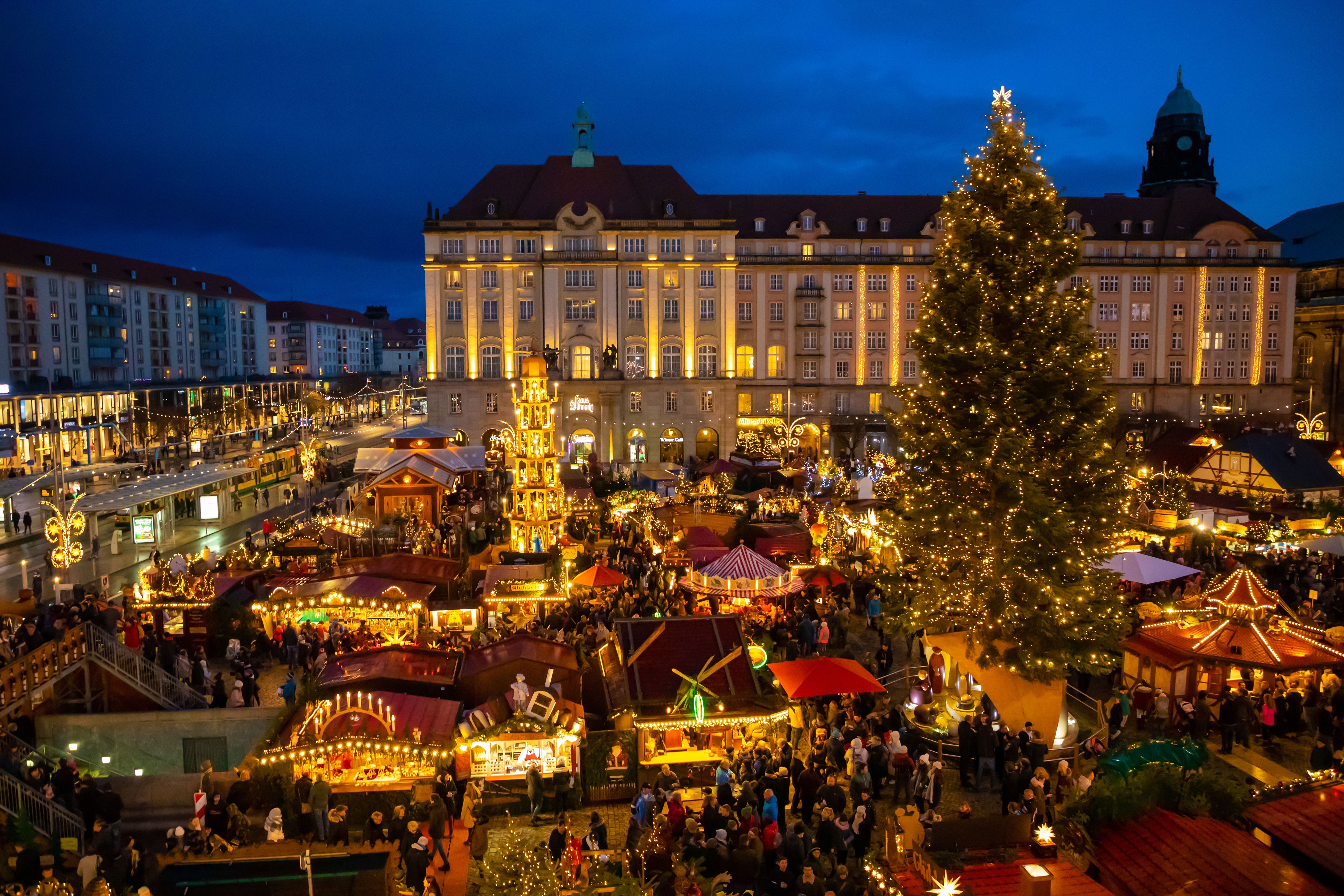
| Dresden | Striezelmarkt, Altmarkt | 25 Nov to 24 Dec | One of Germany’s oldest markets, recorded since 1434 |
| Nuremberg | Hauptmarkt | 27 Nov to 24 Dec | Roughly 170 to 180 stalls and the Christkind’s opening ceremony |
| Strasbourg | Place Broglie, Place de la Cathédrale and others | Opens 27 Nov; closing date to be confirmed (traditionally 24 Dec) | Several markets across the city centre |
| Prague | Old Town Square and Wenceslas Square | 28 Nov to 6 Jan | Two central squares and a long season |
Opening hours vary by market.
How firm are these dates? Nuremberg, Vienna (Rathausplatz), Munich and Dresden are confirmed by their organisers. The others are widely reported but worth rechecking: Budapest, Copenhagen, Cologne, Tallinn and Prague, and Strasbourg’s closing date.
The markets
Vienna

Vienna’s Rathausplatz market, in front of the City Hall, is the city’s biggest, and Vienna holds around two dozen markets in total. It opens on 13 November and runs to 26 December, and the ice rink stays open until 6 January. A separate market at Schönbrunn Palace opens earlier, on 6 November, and runs to 6 January.
Budapest

Budapest’s best-known market is on Vörösmarty tér, which opens on 13 November. The Advent Bazilika market in front of St Stephen’s Basilica opens the same day and runs to 1 January. Some sources describe the 2026 Budapest dates as provisional, so check before you book.
Copenhagen

Christmas in Tivoli turns Copenhagen’s amusement park into a Christmas market with rides, from 13 November 2026 to 3 January 2027. Entry to the park is paid, unlike most street markets, and the park is reported to be closed on 24 December.
Cologne

Cologne has a cluster of seven or more markets rather than one, and the Cathedral market, which runs from 16 November to 23 December, is the headliner. It is a good city for market-hopping.
Munich


The Marienplatz market sits beneath the Neues Rathaus and its glockenspiel, and runs from 20 November to 24 December. Munich also has dozens of smaller neighbourhood markets, and most traditional markets close on 24 December.
Tallinn


Tallinn’s market is on Town Hall Square in the medieval old town, from 20 November to 6 January. Dates are widely reported, with one source giving a later start, so confirm them. It is one of the longer-running markets, so it suits a trip after Christmas.
Dresden

The Striezelmarkt on the Altmarkt is one of the oldest Christmas markets in Germany, first recorded in 1434. It runs from 25 November to 24 December.
Nuremberg

The Christkindlesmarkt fills the Hauptmarkt with roughly 170 to 180 stalls under red and white roofs, from 27 November to 24 December. The city’s official notice lists opening hours of 10:00 to 21:00 daily, with closing at 14:00 on Christmas Eve. The market opens at a ceremony on Friday 27 November at 17:30, when the Christkind delivers an opening prologue.
Strasbourg

Strasbourg has several markets across the city centre, including Place Broglie and Place de la Cathédrale, and opens on 27 November according to the city’s website. The website hadn’t published a closing date in the sources I found, and some sites give 27 December, so treat 24 December, the traditional closing date, as unconfirmed and check before you book.
Prague

Prague’s markets are on the Old Town Square and Wenceslas Square, from 28 November to 6 January.
When to go
- Mid to late November: Vienna, Budapest, Copenhagen and Cologne are already open, and Munich and Tallinn follow within days.
- Late November to mid-December: The widest choice, with most major markets open. Crowds build as December goes on.
- After 24 December: Most German markets have closed. Prague, Tallinn, Copenhagen’s Tivoli, Vienna’s Schönbrunn and Budapest’s Advent Bazilika stay open into January.
- Check the calendar for closures: Some German markets close for a day on 22 November, a day of remembrance, and Cologne’s market is reported to be among them. Many markets also close early on 24 December, for example Nuremberg at 14:00.
- Time of day: Evenings are busiest as offices empty. Earlier in the afternoon is usually quieter, with shorter queues for food and drinks.
At the market: cash, mugs and prices


The mug deposit (Pfand). At most Glühwein stalls in Germany and Austria, you pay a deposit on the ceramic mug as well as the drink. It is usually between €1 and €5, depending on the market, and you get it back when you return the mug to a stall. Many people keep the mug as a souvenir, as each market has its own design.
Drink prices. A mug of Glühwein typically costs around €3 to €6 before the deposit, though prices at the biggest city markets have risen in recent years.
Cash. More vendors accept cards, but many smaller stalls still prefer cash, and some only take cash. Bring euros in small notes and coins, particularly for the mug deposits. Not every country on this list uses the euro: Czechia uses the koruna, Hungary the forint and Denmark the krone, so carry small amounts of local currency if you visit Prague, Budapest or Copenhagen.
Getting money out. Use a bank ATM, not an independent one, to avoid high fees, and decline any offer to convert the amount into Australian or New Zealand dollars so that you are charged in euros.
Dressing for it. You spend hours standing in the cold, so wear warm layers and comfortable, waterproof shoes.
Entry rules for Australians and New Zealanders
- No visa for short stays. Australian and New Zealand passport holders can stay in the Schengen area for up to 90 days in any rolling 180-day period without a visa. The 90 days apply to the Schengen area as a whole, not to each country.
- Entry/Exit System (EES). Since 10 April 2026, the EU’s EES has registered non-EU visitors with a photo and fingerprints at the border, in place of passport stamps. It is free. At least one source reported queue problems at major airports in summer 2026, so allow extra time.
- ETIAS. ETIAS is a €20 online travel authorisation for visa-exempt visitors, valid for three years. According to sources citing the European Commission, it was not yet in operation at the end of October 2026, and no start date had been announced. Check the official EU website before you book, because the rules may change.
Always check the latest requirements on the official EU website and on the Australian government’s Smartraveller or the New Zealand government’s SafeTravel sites before you travel.
Sending money while you travel
If you need to send money to family or pay a deposit to someone overseas while you are away, OrbitRemit sends money from Australia and New Zealand to over 50 countries. OrbitRemit is an international money transfer service for sending money to someone overseas. Compare the total your recipient would receive across providers, and check the rate and fees shown before you confirm.
OrbitRemit makes its margin on the exchange rate, which is shown before you confirm. OrbitRemit does not provide advice on exchange rate timing.
FAQs (frequently asked questions)
When do the Christmas markets in Europe open in 2026?
Vienna’s Rathausplatz, Budapest and Copenhagen’s Tivoli open first, on 13 November. Cologne opens on 16 November, Munich and Tallinn on 20 November, Dresden on 25 November, Nuremberg and Strasbourg on 27 November and Prague on 28 November.
Which Christmas markets stay open after Christmas?
Prague and Tallinn run to 6 January, Copenhagen’s Tivoli to 3 January and Vienna’s Schönbrunn to 6 January. Most German markets close on 24 December.
Do Christmas markets take cards?
Some do, but many smaller stalls prefer cash and some are cash-only, particularly in Germany, Austria and Czechia. Bring euros in small notes and coins.
What is the mug deposit (Pfand)?
A refundable deposit, usually €1 to €5, charged on the mug when you buy a hot drink at German and Austrian markets. You get it back when you return the mug, or you can keep the mug as a souvenir.
Do Australians and New Zealanders need a visa for Europe?
Not for stays of up to 90 days in any 180-day period in the Schengen area. Check the current rules on the official EU website, since ETIAS has not yet started.
What is ETIAS?
A €20 online travel authorisation for visa-exempt visitors to the Schengen area. At the end of October 2026 it was not yet in operation and no start date had been announced.
Important information
This article is general information, not travel, visa or financial advice. Dates, opening hours, prices and entry requirements change, and the figures here are drawn from organisers and travel guides at the time of writing, so confirm them with the official market websites and government sources before you book. OrbitRemit provides international money transfers and does not provide travel, visa or insurance advice. OrbitRemit does not provide advice on exchange rate timing, and its exchange rate includes a margin, with the rate and destination amount shown before you confirm each transfer.
Related guides
- France travel guide
- England travel guide 2026
- Ireland travel guide
- Christmas food in Australia
- Christmas food in New Zealand
Last updated 12 November 2026.
Sources: Radical Storage, Best Christmas markets in Europe 2026 | FlightGift, 26 best Christmas markets in Europe 2026 | European Tourism, Christmas markets in Europe 2026 and Schengen, ETIAS and visas | Route and Stay, Christmas market dates in Europe 2026 | The Second Angle, Best Christmas markets in Europe 2026 | Highlights.ai, Christmas markets in Europe 2026, dates for 19 cities | Etimes, Christmas markets 2026 with verified dates (citing the City of Nuremberg’s official notice) | WMAN, Europe’s Christmas markets 2026 | Travellemming, Simply Madeleine, Nomad and In Love and Idyllic Pursuit, German Christmas market tips | Munich Tourism and Festivian, Christmas market food and drink | Schengentraveler.com, ETIAS launch date and EES (checked 9 November 2026, citing the European Commission)


