Summary
Every major Australian city uses a different smartcard system — Opal (Sydney), Myki (Melbourne), go card (Brisbane), SmartRider (Perth), Metrocard (Adelaide) and MyWay+ (Canberra); none of these cards work in other cities
Sydney, Brisbane, Adelaide and Perth now accept contactless bank cards directly on readers — tap your debit or credit card without a transport card; Melbourne is in final testing and will introduce contactless in 2026; Canberra, Hobart and Darwin do not accept bank cards
Always tap on and tap off — forgetting to tap off results in the maximum fare being charged; every city has daily and weekly fare caps that limit your spending once you travel frequently enough
Australian public transport Australia is reliable in major cities and entirely card-based — almost no cash is accepted on buses, trains, trams or ferries. As a new migrant, getting your transport card set up on arrival is as important as getting a bank account and a SIM card.
This guide covers every major Australian city, how each system works, fare caps, ferry services, contactless bank card acceptance, and how to get the most out of it.
The golden rules — apply everywhere in Australia
1. Always tap on when you board. Touch your card to the reader at the gate, platform or bus entry. Wait for the beep and green light.
2. Always tap off when you exit. Touch your card to the reader as you leave. If you forget to tap off, the system charges you the maximum fare for that route.
3. Keep a positive balance. Most cards will not let you travel with a negative balance. Top up before your balance runs low.
4. Cards are not interchangeable between states. Your Sydney Opal card does not work in Melbourne. Keep separate cards for each city.
Do you need a transport card? Contactless bank card acceptance by city
Many migrants ask whether they need to buy a transport card at all. Here’s the current situation:
| City | Bank card accepted? | Notes |
|---|---|---|
| Sydney | ✅ Yes — trains, buses, ferries, light rail | No price difference vs Opal; no concession fares |
| Newcastle | ✅ Yes | Same Opal/contactless system as Sydney |
| Brisbane / SEQ | ✅ Yes | Accepted on Translink network |
| Gold Coast | ✅ Yes | Accepted on Translink network |
| Adelaide | ✅ Yes | Accepted on bus, train and tram |
| Perth | ❌ No | SmartRider or cash only; no contactless bank cards |
| Melbourne | 🔄 Trial — rolling out 2026 | In final testing; use Myki for all journeys until fully launched |
| Canberra | ❌ No | MyWay+ card required |
| Hobart | ❌ No | Greencard or cash |
| Darwin | ❌ No | Tap & Ride card or cash |
Important: Even where bank cards are accepted, you will not receive concession fares, weekly caps, transfer discounts or other smartcard benefits. For regular commuters, a registered transport card almost always works out cheaper.
Sydney — Opal card
Network: Trains, metro, buses, ferries and light rail across Greater Sydney, the Blue Mountains, Hunter, Central Coast and Illawarra regions.
Contactless bank cards: ✅ Accepted on all modes — no price difference vs Opal. Use your Visa or Mastercard debit/credit card or Apple/Google Pay directly.
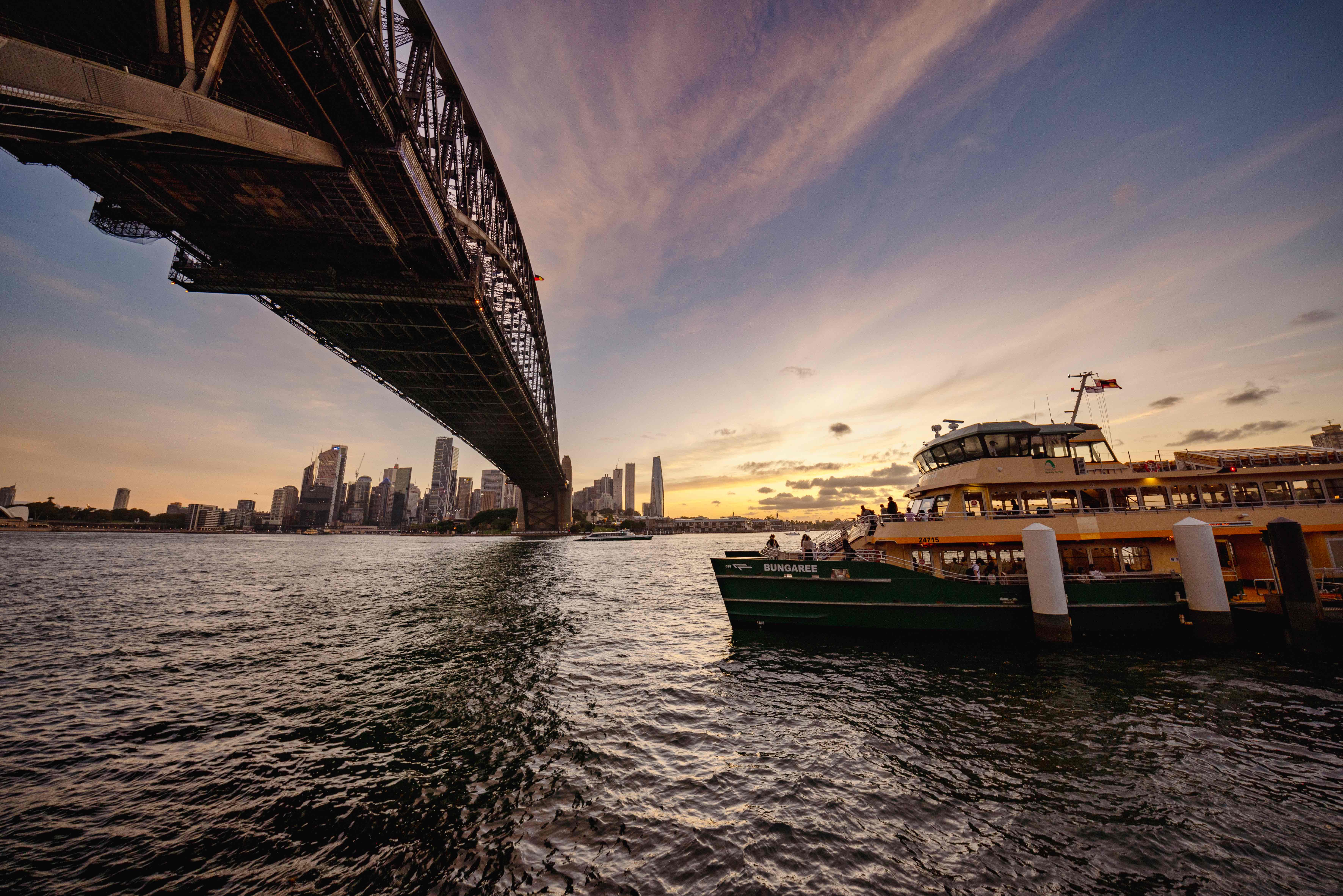
Ferries: Sydney Ferries are fully integrated on Opal — tap on and tap off at ferry wharves. Services include Circular Quay to Manly (one of the world’s great urban ferry routes, 30 minutes, views of the Opera House and Harbour Bridge), Circular Quay to Parramatta, Balmain, Watsons Bay and more.
Fare caps (from 14 July 2026):
- Adult daily cap: AUD $19.30 (Monday to Thursday)
- Adult daily cap: AUD $9.65 (Friday, Saturday, Sunday and public holidays)
- Weekly cap: AUD $50.00 — after 8 paid journeys in a week, remaining journeys are half price
- Senior/pensioner daily cap: AUD $2.50 (unchanged since 2012)
- Concession daily cap: AUD $9.65 (Mon-Thu), AUD $4.80 (Fri-Sun)
Off-peak discount: 30% off on journeys outside peak hours (Monday-Friday outside 6-10am and 3-7pm)
Transfer discount: AUD $2.00 off if you transfer between modes within 60 minutes of tapping off
Airport surcharge: An additional access fee applies at Sydney Domestic and International Airport train stations — approximately AUD $17.30 on top of the regular fare. To avoid this, take a bus to Mascot Station and board the train there.
Where to buy: Newsagents and convenience stores with the Opal logo, online at opal.com.au, or station machines.
Melbourne — Myki
Network: Trains, trams and buses across metropolitan Melbourne; also V/Line commuter trains and regional buses in Geelong, Ballarat, Bendigo and the Latrobe Valley.
Contactless bank cards: 🔄 Rolling out 2026 — Victoria is in final testing of a tap-and-go system where passengers can use bank cards or smartphones. Until fully launched, use a physical Myki or Mobile Myki (Android/Google Wallet).
Myki card cost: AUD $6 (adult); AUD $3 (child/concession)
Free Tram Zone: Melbourne’s entire CBD tram network is free — no tapping required within the Free Tram Zone. This is one of the best transport perks for migrants living in the inner city.
Under 18s: Free travel across all modes from 1 January 2026 — must use a Youth Myki to tap on and off.
Fare caps: Myki has a daily fare cap — once you reach the maximum for the day, all remaining travel is free. The exact daily cap varies by zones travelled; check ptv.vic.gov.au for current amounts.
Where to buy: 7-Eleven stores (800+ locations), station vending machines, online at ptv.vic.gov.au, PTV Hubs at major stations.
Top-up tip: Online top-ups can take up to 90 minutes to process — top up at a 7-Eleven or station machine for instant credit.
Ferries: Melbourne does not have a regular public ferry network integrated with Myki. The Williamstown Ferry (private operator) and Docklands ferries operate separately.
Brisbane and South East Queensland — go card
Network: All Translink bus, train, ferry and tram services across South East Queensland — Brisbane, Gold Coast, Sunshine Coast, Ipswich and Toowoomba.
Contactless bank cards: ✅ Accepted across the Translink network.
Ferries: Brisbane’s CityCat and CityHopper ferry services are fully integrated with the go card. The CityCat runs along the Brisbane River from University of Queensland to Apollo Road, Bulimba — one of the most scenic and practical commuter routes in the city. The free CityHopper runs between North Quay, South Bank, Mowbray Park, Thornton Street and Holman Street wharves.
Fare caps (2026):
- Flat 50-cent fares on most Translink journeys — introduced in early 2026 as a government initiative to encourage public transport use
- Daily and weekly caps apply — check translink.com.au for current amounts
Concession: Full-time international students can apply for a concession go card — requires online application linked to Student ID.
Where to buy: 7-Eleven stores, Translink customer service centres, online at translink.com.au.
Perth — SmartRider
Network: All Transperth bus, train and ferry services across the Perth metropolitan region.
Contactless bank cards: ❌ Not accepted. SmartRider or cash only — but cash fares are more expensive than SmartRider fares.
Ferries: Transperth operates the Captain Cook Cruises ferry between Elizabeth Quay and South Perth (Mends Street Jetty) — integrated with SmartRider, tap on and off at the jetty.
Fare caps (from January 2026):
- Single journey cap: AUD $3.50
- Daily cap: check transperth.wa.gov.au for current daily maximum
SmartRider discount: Registered SmartRider gives an automatic 5% discount on all fares vs unregistered card or cash.
Where to buy: Transperth InfoCentres at Perth Station and major bus ports, online at transperth.wa.gov.au.
Register your card: Register at transperth.wa.gov.au for the 5% discount and balance protection if lost or stolen.
Adelaide — Metrocard
Network: All Adelaide Metro bus, train and tram services across metropolitan Adelaide.
Contactless bank cards: ✅ Accepted on bus, train and tram — Visa, Mastercard and mobile wallets.
Fare caps: Check adelaidemetro.com.au for current daily and weekly caps. A two-hour travel window applies — a single fare covers unlimited travel within 2 hours of first tap on.
Two-hour travel window: One fare covers any number of trips within 2 hours of the first tap — ideal for migrants who need to transfer between bus and train to reach their destination.
Concession: International students are eligible for concession rates — buy a card at a newsagent and register it online with your student details.
Where to buy: Newsagents across Adelaide, Adelaide Railway Station, online at adelaidemetro.com.au.
Canberra — MyWay+
Network: All ACTION buses and Capital Metro light rail across the ACT.
Contactless bank cards: ❌ Not accepted. MyWay+ card required.
Where to buy: myway.act.gov.au or at selected outlets across Canberra.
Scenic public transport routes worth taking
One of the great surprises for migrants new to Australia is how beautiful some of the daily commutes are. These routes are not tourist extras — they use the same Opal, go card or Myki as a regular commute.
Sydney — the world’s most scenic ferry commute
F1 Manly Ferry — the must-do
The 30-minute crossing from Circular Quay to Manly Beach is widely considered one of the great public transport journeys in the world. The ferry departs from directly in front of the Opera House, passes under the Harbour Bridge, crosses open Sydney Harbour with views of the Heads, and arrives at Manly Beach. You pay the standard Opal fare — the same as any bus or train journey. Covered by the daily and Sunday caps. Takes the same Opal or contactless bank card as everywhere else. Runs approximately every 30 minutes, 7 days a week.
F1 Luna Park Ferry — Milsons Point Wharf
The ferry from Circular Quay to Milsons Point drops you at the base of Luna Park — Sydney’s heritage amusement park, with the iconic laughing face entrance and views back across the harbour to the Opera House. The crossing takes about 12 minutes. Combined with a walk across the Harbour Bridge (free), this makes one of Sydney’s best half-day outings using only public transport.
F2 Taronga Zoo — 12 minutes from Circular Quay
The ferry to Taronga Zoo Wharf takes just 12 minutes and runs every 30 minutes. Combine with a Zoo Express ticket (includes cable car/shuttle up to the zoo entrance) for the full experience.
F3 Parramatta River — the long scenic route
The F3 takes 90 minutes from Circular Quay to Parramatta, stopping at Cockatoo Island (a UNESCO World Heritage former convict prison and shipyard), Drummoyne, Olympic Park and the Inner West villages. Not the fastest way to Parramatta, but one of the most enjoyable Sunday afternoon journeys in Sydney — covered by the AUD $9.65 Sunday cap.
F8/F9 Watsons Bay — 25 minutes from Circular Quay
Past the Royal Botanic Garden, the eastern harbour cliffs and Vaucluse mansions to the village of Watsons Bay — excellent fish and chips at Doyles, walk up to Hornby Lighthouse for clifftop views.
Train — Blue Mountains via Central Station
The train from Central to Katoomba takes about 2 hours and passes through the dramatic Blue Mountains scenery. On Sundays, covered by the AUD $9.65 Sunday cap — making a Blue Mountains day trip one of Sydney’s best value outings.
Melbourne — tram rides worth taking
Tram 35 (City Circle) — free CBD loop
Melbourne’s famous City Circle tram runs a loop around the CBD, stopping at Flinders Street Station, Southern Cross, Docklands, Victoria Harbour and Fitzroy Gardens. Completely free — no tapping required. A genuine way to orientate yourself on arrival.
Tram 96 to St Kilda — Luna Park and the beach
Melbourne also has a Luna Park — at 18 Lower Esplanade, St Kilda, opened in 1912. Take tram 96 from the CBD to St Kilda, which runs along Fitzroy Street to the beach and Luna Park. About 35 minutes from the CBD. Covered by Myki.
Tram 109 — Box Hill via the eastern suburbs
One of Melbourne’s longest and most interesting tram routes — runs from Port Melbourne through the CBD and along Collins Street to Box Hill, passing through Richmond, Surrey Hills, Camberwell and Deepdene. A window into Melbourne’s diverse suburbs.
Brisbane — CityCat along the river
CityCat — University of Queensland to Bulimba
Brisbane’s CityCat ferry runs along the Brisbane River from UQ in the west to Apollo Road in Bulimba in the east, stopping at South Bank, Kangaroo Point, New Farm and Teneriffe. The trip provides excellent views of the Story Bridge, the CBD skyline and Brisbane’s riverside parks. Covered by the go card (50-cent flat fare in 2026).
Free CityHopper — cross the river for nothing
The free CityHopper ferry runs between North Quay, South Bank, Mowbray Park, Thornton Street and Holman Street — completely free, no tapping required. Excellent for crossing the river between South Bank and the CBD without taking a bus.
Perth — Elizabeth Quay to South Perth
Transperth Ferry — across the Swan River
The short ferry between Elizabeth Quay and Mends Street Jetty, South Perth takes about 10 minutes and provides views across the Swan River to the Perth CBD skyline. Use SmartRider — tap on and off. On the South Perth side, Perth Zoo is a short walk from the jetty.
Money-saving tips
Sydney — Sunday cap is AUD $9.65: Use Sunday for long explorations — the entire network is capped at AUD $9.65 regardless of how many trips you take. Ideal for day trips to the Blue Mountains or beach suburbs.
Melbourne — Free Tram Zone: The entire Melbourne CBD tram network is free. Live or work in the city centre and you may barely need to top up your Myki at all.
Brisbane — 50-cent fares: With flat 50-cent fares on most Translink journeys in 2026, Brisbane is the cheapest city in Australia to get around on public transport.
Perth — register your SmartRider: The 5% discount adds up over a year of daily commuting. Register online — it takes five minutes.
All cities — use off-peak where possible: Sydney (30% off-peak discount), Melbourne (daily cap) and Brisbane (zone-based pricing) all reward travel outside rush hours.
All cities — tap off every time: The single most common mistake migrants make. Forgetting to tap off costs you the maximum fare — often AUD $5-$10 more than the actual journey.
Apps to help you get around
| App | What it does |
|---|---|
| Google Maps | Best for planning routes across all Australian cities; real-time public transport directions |
| Moovit | Public transport trip planner with real-time updates |
| Opal Travel (NSW) | Check balance, view journey history, top up — Sydney only |
| PTV (VIC) | Melbourne public transport planner, Myki balance and top-up |
| Translink (QLD) | Brisbane and SEQ trip planner and go card management |
| Transperth (WA) | Perth network planner and SmartRider management |
| Adelaide Metro | Adelaide trip planner and Metrocard management |
Summary table
| City | Card | Bank card accepted? | Daily cap | Weekly cap | Ferries |
|---|---|---|---|---|---|
| Sydney | Opal | ✅ Yes | AUD $19.30 (weekday), $9.65 (weekend) | AUD $50 | ✅ Integrated |
| Melbourne | Myki | 🔄 2026 trial | Daily cap applies | — | ❌ Not integrated |
| Brisbane/SEQ | go card | ✅ Yes | Cap applies | Cap applies | ✅ CityCat/CityHopper |
| Perth | SmartRider | ❌ No | Cap applies | — | ✅ Integrated |
| Adelaide | Metrocard | ✅ Yes | 2-hour window | Cap applies | ❌ Not integrated |
| Canberra | MyWay+ | ❌ No | — | — | ❌ |
FAQs (frequently asked questions)
Can I use my bank card instead of a transport card in Australia?
In Sydney, Brisbane, Gold Coast and Adelaide — yes. Perth and Canberra require a transport card. Melbourne is rolling out contactless bank card acceptance in 2026 but still requires Myki until fully launched.
What happens if I forget to tap off?
You are charged the maximum fare for that route — often significantly more than the actual journey cost. Always tap off.
Are there ferry services in Australian cities?
Yes. Sydney Ferries are fully integrated with Opal and cover extensive harbour routes. Brisbane’s CityCat and free CityHopper run along the Brisbane River. Perth’s Transperth ferry runs between Elizabeth Quay and South Perth. Melbourne does not have an integrated public ferry network.
What is the daily fare cap in Sydney?
AUD $19.30 on weekdays (Monday-Thursday) and AUD $9.65 on Fridays, weekends and public holidays, from 14 July 2026. The weekly cap is AUD $50.
Is public transport free in Melbourne’s CBD?
Yes — the Free Tram Zone covers the entire Melbourne CBD tram network. No tapping required within this zone.
Is travel free for children in Australia?
In Victoria (Melbourne), all under-18s travel free from 1 January 2026 with a Youth Myki. Other states charge standard or concession fares for children.
Do I need cash for public transport in Australia?
Most Australian cities do not accept cash on buses. Use a transport card or contactless payment. Perth accepts cash on trains and buses but charges higher fares than SmartRider.
This guide is for general information only. Transport fares, card costs and policies change regularly — always verify current information at the relevant state transport authority website before travelling. Last updated July 2026.
Sources: Transport for NSW — Opal fare changes 14 July 2026 (transport.nsw.gov.au) | Sydney Metro — Tickets and Opal fares 2026 | Cities Insider — Sydney Ticketing & Opal 2026 | NammAustralia — Setting Up Your Public Transport Card in Australia 2026 | AUWith — Australia Public Transport Guide 2026 | NerdWallet AU — Tap on train with credit card | CardHolder.au — Tap-to-Pay Technology in Australia | RMIT — Victoria contactless payment on public transport (January 2026) | First Migration Service Centre — Public Transport Australia Guide 2026


