Summary of the India Travel Guide 2026
Australian and New Zealand passport holders must obtain an e-Visa before travelling to India — there is no visa-free or visa-on-arrival entry; the e-Tourist Visa is applied for entirely online at indianvisaonline.gov.in and comes in 30-day, 1-year and 5-year options; apply at least 4 days before travel and carry the approval email
In 2026, most travellers need three documents, not one — the e-Visa, the eArrival Card (completed within 72 hours of arrival) and the Air Suvidha 2.0 health declaration (completed within 24 hours of arrival); missing any one of these can cause delays at immigration
India is one of the most extraordinary travel destinations on earth — from the Mughal architecture of Rajasthan and the backwaters of Kerala to the Himalayan foothills of Darjeeling and the beaches of Goa; more than 100,000 New Zealanders visited in 2024 alone, and the number of Australian visitors continues to grow
India is not a country you visit — it is a country you experience, survive, fall in love with, and spend the rest of your life trying to return to. It is chaotic and transcendent, overwhelming and deeply beautiful. No destination in the world offers the same density of history, landscape, culture, food and human encounter in the same space.
For Australian and New Zealand travellers, particularly those with Indian heritage returning to see family, India is one of the most emotionally significant journeys possible. This guide makes the practical side straightforward so you can focus on the experience.
Visa and entry requirements
e-Visa — required for all Australians and New Zealanders
Unlike the Philippines, India does not offer visa-free entry to Australian or New Zealand passport holders. A valid visa is required for all travel purposes — tourism, visiting family, business or transit.
The e-Tourist Visa is the standard option for short-term tourism and family visits:
| e-Visa type | Duration | Fee (AU + NZ passports) | Multiple entry |
|---|---|---|---|
| 30-day e-Tourist Visa | 30 days from first entry | USD $25 | Double entry |
| 1-year e-Tourist Visa | 1 year from issue | USD $40 | Multiple entry — max 90 days per visit, 180 days per year |
| 5-year e-Tourist Visa | 5 years from issue | USD $80 | Multiple entry — max 90 days per visit, 180 days per year |
How to apply:
- Go to indianvisaonline.gov.in/evisa — the official Government of India portal
- Select “Tourism” as your visa type
- Complete the application form — have a scanned passport photo and passport biographical page ready
- Pay the fee online — USD $25 for 30-day, USD $40 for 1-year, USD $80 for 5-year
- Wait for approval — typically 1-3 business days; allow up to 5 days during busy periods
- Print the approval email and carry it with your passport
Important: Apply at least 4 days before your departure — the government specifies a minimum processing window.
Entry points: e-Visa holders must enter India via one of the designated e-Visa airports (including all major international airports: Delhi, Mumbai, Chennai, Bengaluru, Kolkata, Hyderabad, Kochi, Pune and more) or designated seaports. Most international routes from Australia and New Zealand arrive at designated airports.
e-Visa limit: An Indian e-Tourist Visa can only be obtained twice per calendar year.
The three documents you need in 2026
Most Australian and New Zealand travellers only know about the e-Visa. In 2026, there are two additional mandatory registrations:
1. e-Visa — your permission to enter India; apply at indianvisaonline.gov.in; carry the printed approval
2. eArrival Card — replaces the paper disembarkation card; complete online within 72 hours before arrival; generates a QR code checked at immigration
3. Air Suvidha 2.0 — India’s current health declaration; complete within 24 hours of arrival
Missing any of these three can cause delays at immigration. Set a reminder to complete all three in the 3 days before your flight.
OCI (Overseas Citizen of India) cardholders
If you or a family member holds an OCI (Overseas Citizen of India) card — formerly known as PIO (Person of Indian Origin) — entry to India is visa-free for life. OCI cardholders still need to register the eArrival Card but do not require an e-Visa.
New from May 2026: e-OCI applications can now be lodged entirely online. In-person lodgement remains available from April 2026. The fee is approximately AUD $150-220 for Australian applicants.
Best time to visit
Best overall: October to March
India is a vast country with dramatically different regional climates. However, October to March is broadly the best time for most destinations:
- North India (Delhi, Rajasthan, Agra): October to March is ideal — comfortable temperatures of 15-25°C. Avoid April to June (extreme heat up to 45°C+) and July-September (monsoon).
- South India (Kerala, Goa, Tamil Nadu): November to February is peak season — dry, warm and pleasant. Kerala’s backwaters are stunning in post-monsoon October.
- Himalayan foothills (Darjeeling, Shimla, Manali): March to June and September to November — avoid the peak monsoon.
- Goa: November to February — peak beach season, warm and dry.
For Australians and New Zealanders: India’s prime travel season (October-March) aligns with the Southern Hemisphere’s spring-summer. Christmas and New Year in Goa is a well-worn Australian tradition.
Getting there
From Australia
Direct flights: Air India operates direct flights from Melbourne and Sydney to Delhi and Mumbai. Qantas, Singapore Airlines, Emirates, Etihad and others connect via their respective hubs.
Flight time: Sydney to Delhi is approximately 14-15 hours direct; via Singapore or Dubai adds 2-4 hours.
Costs: Return flights from Australia to India range from approximately AUD $900-1,500 return booked 2-3 months ahead, to AUD $1,500-2,500 for peak holiday periods.
From New Zealand
No direct flights operate between New Zealand and India. All routes connect via Singapore, Dubai, Doha, Hong Kong or other Asian hubs.
Flight time: Auckland to Delhi approximately 20 hours including connection. Common routes: Air New Zealand code-share via Singapore (Singapore Airlines), Emirates via Dubai, Qatar Airways via Doha.
Costs: NZD $1,500-2,500 return for standard booking; higher during peak periods.
Top destinations
Delhi — the capital
Delhi is India’s capital and a city of extraordinary contrasts — the ancient Mughal architecture of Old Delhi alongside the colonial grandeur of New Delhi designed by Edwin Lutyens.

Old Delhi: Jama Masjid (India’s largest mosque), the Red Fort, Chandni Chowk’s chaotic bazaar, Karim’s restaurant (established 1913, legendary Mughal cuisine), and the lanes of Paharganj. India at its most concentrated and overwhelming.
New Delhi: India Gate, Rashtrapati Bhavan, Humayun’s Tomb (the architectural precursor to the Taj Mahal), Qutub Minar (a 13th-century minaret — UNESCO World Heritage), Lodhi Garden and the National Museum.
Practical: Use the Delhi Metro — it is safe, air-conditioned and connects most major attractions. Book Ola or Uber rather than negotiating with auto-rickshaws (though auto-rickshaws are the more atmospheric option for shorter hops).
Rajasthan — the desert kingdom
Rajasthan is the India that most travellers imagine before they arrive — sand dunes, palace hotels, camels, forts that rise from the desert horizon and cities that are literally painted blue (Jodhpur) or pink (Jaipur).

The golden triangle: Delhi → Agra (Taj Mahal) → Jaipur → Delhi is the classic introduction — manageable by train in 5-7 days and genuinely spectacular.
Jaipur: City Palace, Amber Fort, Jantar Mantar (the 18th-century astronomical observatory — UNESCO World Heritage), Hawa Mahal (Palace of Winds). The pink city is the most tourist-ready of Rajasthan’s major cities.
Jodhpur: The Blue City — Mehrangarh Fort looming above cobalt-blue houses. The fort is one of India’s most impressive — allow 3 hours minimum.
Udaipur: The City of Lakes — Lake Pichola, the City Palace (partially converted to a hotel), Gangaur Ghat. Romantic and slower than Jaipur. Often described as the most beautiful city in India.
Jaisalmer: The Golden City — built entirely of yellow sandstone in the middle of the Thar Desert. The fort is a living, inhabited medieval fortress. Overnight camel safari in the Sam Sand Dunes.
Agra — the Taj Mahal
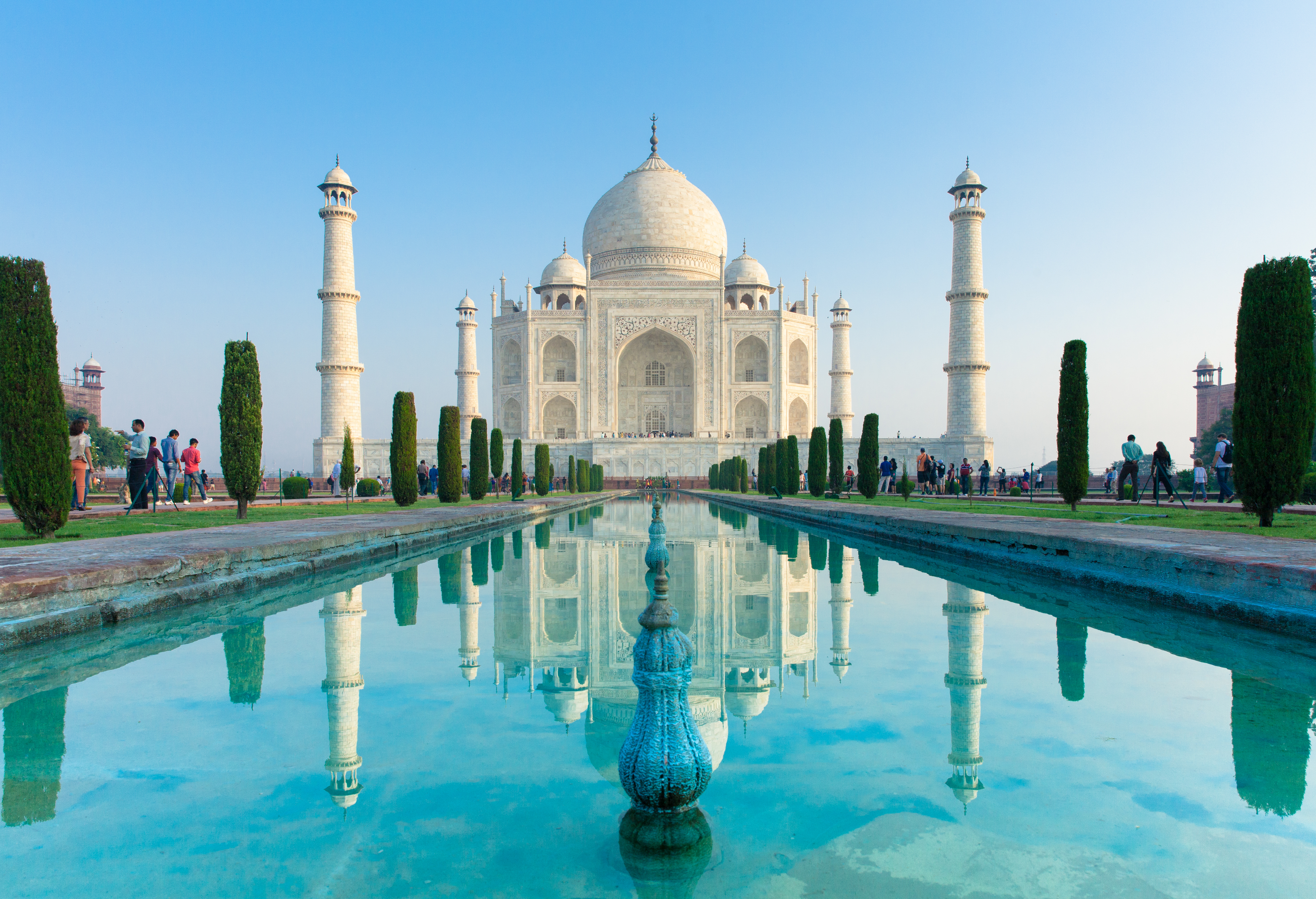
The Taj Mahal needs no introduction — the 17th-century ivory marble mausoleum built by Mughal Emperor Shah Jahan for his wife Mumtaz Mahal is one of the world’s most recognisable buildings and a UNESCO World Heritage Site.

Practical tips:
- Visit at sunrise — the light is extraordinary and the crowds thinner than midday
- Book tickets online at the Archaeological Survey of India website in advance
- The Taj is closed on Fridays
- Also visit Agra Fort (a 30-minute walk from the Taj) — a red sandstone fortress equally impressive in its own right
- Stay in Agra one night minimum — a same-day Delhi to Agra trip by train is possible (2 hours on the Gatimaan Express) but does not do justice to the city
Kerala — God’s own country
Kerala is India’s most southern state — a narrow strip between the Western Ghats mountain range and the Arabian Sea, covered in tea and spice plantations, coconut palms and the famous backwater lagoons.

The backwaters: A network of lakes, canals and rivers stretching over 900km. Houseboats (kettuvallam) are hired for overnight stays — drifting through the backwaters past rice paddies, fishing nets and village life is one of India’s most memorable travel experiences. Alleppey (Alappuzha) is the houseboat capital.
Munnar: Tea estates climbing into the Western Ghats at 1,600m — cool temperatures, rolling green hills and silence. The contrast with Mumbai or Delhi is almost surreal.
Kochi (Cochin): Fort Kochi has extraordinary colonial history — Portuguese, Dutch and British occupation layered over ancient Kerala spice trade heritage. The Chinese fishing nets along the harbour at sunset are iconic.
Kerala Ayurveda: Kerala is the home of classical Ayurvedic medicine. Retreats offering authentic Ayurvedic treatments (not the commercial spa version found elsewhere) are genuine, medically recognised and a significant reason many travellers come.
Goa — beaches and colonial history
Goa is India’s smallest state and its most famous beach destination — 105km of coastline, Portuguese colonial architecture, excellent seafood and a nightlife scene that has been drawing international travellers for 60 years.

North Goa: The party beaches — Baga, Calangute, Anjuna. Loud, crowded and full of beach bars, markets and late-night clubs. Also the site of Vagator and Ashwem — quieter alternatives with a more bohemian character.
South Goa: Palolem, Agonda, Benaulim — slower, more beautiful, better suited to relaxation than nightlife. Palolem’s curved bay is one of India’s most photogenic.
Old Goa: The historical capital — the Basilica of Bom Jesus (containing the remains of St Francis Xavier) and the Se Cathedral are UNESCO World Heritage Sites and among the finest examples of Portuguese colonial religious architecture in Asia.
Mumbai — the maximum city
Mumbai is India’s financial capital, its film industry (Bollywood) and its most visceral urban experience. It is a city of extraordinary contradictions — the most expensive real estate in Asia adjacent to Dharavi (one of Asia’s largest informal settlements), colonial Gothic architecture alongside glass towers, and a street food culture that is among the best in the world.

Don’t miss: Gateway of India, the Taj Mahal Palace Hotel (a tea in the Sea Lounge is worth the cost), Chhatrapati Shivaji Maharaj Terminus (Victoria Terminus — a Gothic railway station and UNESCO World Heritage Site), Dharavi (guided tour only — context is essential), Colaba Causeway market, and dinner at a traditional Irani café.
Varanasi — the spiritual heart
Varanasi is one of the world’s oldest continuously inhabited cities and the holiest city in Hinduism. On the banks of the Ganges, cremation ghats operate 24 hours a day. The river at dawn — with pilgrims performing puja (rituals), boatmen rowing through the mist and the sound of temple bells — is one of the most profoundly moving scenes in the world.
Varanasi is not for everyone. It is confronting, deeply spiritual and utterly unlike anywhere else on earth. For many travellers, it is the most memorable experience of their entire trip.

Getting around India
Trains: The Indian railway network is one of the world’s largest and most extensive — and the best way to travel between major cities. Book through irctc.co.in (official) or 12go.asia (tourist-friendly interface) well in advance. Sleeper trains between Delhi and Jaipur (5 hours), Delhi and Agra (2 hours on the Gatimaan Express) and Delhi to Varanasi (overnight) are safe, comfortable and memorable.
Domestic flights: IndiGo, Air India Express and SpiceJet connect major cities for USD $20-50 one-way booked in advance. Essential for longer distances (Mumbai to Kochi, Delhi to Goa).
Ola and Uber: Both work across major Indian cities. Essential for safe, metered transport and avoiding negotiation fatigue. Download both before you arrive.
Auto-rickshaws: Three-wheeled tuk-tuks — the definitive Indian city transport. Always agree on the price first or insist on the meter where available. Good for short distances.
Money and costs
Currency: Indian rupee (INR). As of mid-2026, approximately AUD $1 = INR 55; NZD $1 = INR 47.
Daily budgets:
| Budget level | Daily spend | What you get |
|---|---|---|
| Budget | AUD $30-60 | Guesthouses, local food, train travel |
| Mid-range | AUD $80-150 | Comfortable hotels, restaurants, domestic flights |
| Luxury | AUD $250+ | Heritage hotels, private cars, fine dining |
ATMs: Widely available in all cities and most tourist towns. Withdrawal limit is often INR 10,000-15,000 per transaction — allow for multiple withdrawals for larger amounts.
UPI payments: India’s UPI digital payment system is ubiquitous — from street food stalls to luxury hotels. If visiting family, they can receive money from Australia directly to their UPI ID. See our guide: What is UPI? →
Food
Indian food in India is not like Indian food in Australia or New Zealand. The diversity is staggering — cuisine changes dramatically by region, state, religion and caste. Here are the essential categories:
North Indian: Roti, dal, paneer dishes, butter chicken, biryani, tandoori. The cuisine most familiar to Australians through Indian restaurants at home — but vastly better in situ.
South Indian: Dosa (fermented rice crepe with sambar and chutney), idli, vada, coconut curries, fish molee. Lighter, rice-based and extraordinary.
Street food: Pani puri, chaat, vada pav (Mumbai’s iconic potato fritter in a bread roll), kati rolls (Kolkata), pav bhaji, jalebis, lassi. Essential and mostly safe if chosen carefully — go where the locals are eating.
Vegetarian India: India has the world’s most developed vegetarian cuisine — a significant proportion of the population is vegetarian and the cooking reflects centuries of refinement. Do not miss the pure veg thalis.
Practical tips
Water: Drink bottled water only. Avoid ice in drinks outside high-end restaurants. Carry electrolyte sachets for long travel days in the heat.
Health: Consult a travel health clinic before departure for vaccinations and antimalarial advice specific to your itinerary. Hepatitis A and B, typhoid and tetanus are commonly recommended.
Stomach: Many travellers experience some digestive adjustment in the first few days — this is normal. Start with cooked foods, be cautious about street food in the first week, and carry oral rehydration salts.
Dress: Dress modestly at religious sites — cover shoulders and knees. Women should carry a scarf or shawl. Remove shoes before entering temples, mosques and gurudwaras.
SIM: Buy a Jio or Airtel SIM at the airport — available at all major international airports. Requires your passport for registration and activates within 24 hours. Data plans from INR 179 (approximately AUD $3.20) for 28 days unlimited data. Essential for navigation and Ola/Uber.
Indian culture — dos and don’ts
India is extraordinarily diverse — customs, language and religious practice change dramatically from state to state and region to region. However, certain values are universal across the country: respect for elders, modesty, religious reverence and genuine hospitality toward guests. Indians are famously forgiving of foreigners who make honest cultural mistakes, but a little awareness goes a long way.
Things to do
Greet with Namaste Joining your palms together (like a prayer gesture) and saying “Namaste” is the universal Indian greeting — respectful, warm and immediately appreciated. It is particularly preferred between men and women, avoiding the physical contact of a handshake. Between people of different ages, always greet elders first.
Remove your shoes before entering religious sites and homes This is the most universal rule across India. Before entering any temple, mosque, gurudwara or private home, remove your shoes. Look for the pile of footwear at the entrance — that is your cue. Temple floors can be hot, so carry socks. Many temples have a cloakroom for shoes.
Use your right hand The right hand is used for eating, greeting, giving and receiving in Indian culture. The left hand is associated with unclean tasks. When handing over money, accepting food, or passing something to someone, always use the right hand — or both hands for particularly respectful situations.
Dress modestly at religious sites Cover shoulders and knees when visiting temples, mosques, gurudwaras and churches. Women should carry a lightweight scarf or dupatta for covering the head inside certain temples and mosques. Men may need to remove shirts at some shrines — follow the signs and the example of those around you.
Cover your head at Sikh gurudwaras All visitors to a Sikh gurudwara must cover their head — scarves are usually provided at the entrance. Also remove shoes and wash hands before entering. Gurudwaras welcome visitors of all faiths and typically offer langar (free communal vegetarian meal) — accept it with gratitude.
Accept food when offered by hosts Indian hospitality is legendary and centres on feeding guests. Declining food offered by a host family is considered impolite. Accept at least a small amount — then feel free to eat as much as you like.
Ask before photographing people or religious sites Always ask permission before photographing individuals, particularly in rural areas, at religious ceremonies or in poorer communities. Many temples and inner sanctums prohibit photography — look for signs or ask before raising your camera.
Bargain at markets — with a smile Haggling is expected and enjoyed at street markets, bazaars and with rickshaw drivers where there is no meter. Start lower than you want to pay, smile throughout and remain friendly. Aggressive bargaining is bad form; walking away with a smile when the price is too high often produces a better offer.
Learn a few Hindi phrases Hindi is not spoken everywhere in India (Tamil Nadu, Kerala and much of the south have their own dominant languages), but a few words earn enormous goodwill across the country:
- Namaste — Hello / Goodbye
- Dhanyavaad / Shukriya — Thank you (Hindi / Urdu)
- Haan / Nahin — Yes / No
- Kitna? — How much?
- Bahut achha — Very good
Things not to do
Don’t touch anyone’s feet accidentally — and apologise if you do Feet are considered the lowest and most impure part of the body in Indian culture. If you accidentally touch someone’s feet or nudge a book or object with your foot, apologise immediately — Indians will instinctively touch their own chest or eyes as an act of self-purification.
Don’t enter temple inner sanctums if non-Hindus are not permitted Some Hindu temples restrict entry to non-Hindus — particularly in the innermost shrine. Signage is usually posted in English. If you are unsure, ask temple staff rather than assuming. Jain temples are generally open to all; some South Indian temples have restrictions.
Don’t publicly display affection Kissing, cuddling or strong physical affection between couples in public is socially conservative in most of India — particularly in rural areas, religious sites and smaller cities. Holding hands is generally fine. Be guided by what you see around you.
Don’t eat beef in Hindu areas or pork in Muslim areas Cows are sacred in Hinduism — beef is not available in many parts of India and offering it to a Hindu host would cause serious offence. In predominantly Muslim areas (particularly in Kashmir, parts of Hyderabad and the Muslim quarters of old cities), pork is similarly avoided. Vegetarian options are available everywhere and are excellent.
Don’t drink tap water Drink only bottled water with an intact seal. Avoid ice in drinks at street stalls and smaller restaurants. Brush teeth with bottled water in your first week. Carry electrolyte sachets for long travel days.
Don’t dismiss personal questions Indians will often ask within minutes of meeting you: Are you married? What is your job? What does your father do? How much do you earn? These are not intrusive — they are genuinely friendly expressions of interest and the normal shape of a getting-to-know-you conversation in India. Answer warmly or deflect with a smile.
Don’t photograph military installations, bridges or government buildings This is a legal restriction in India — photographing military sites, strategic infrastructure and some government buildings is prohibited. Outside of these categories, be respectful rather than intrusive.
Don’t assume vegetarian means vegan Indian vegetarian food is extraordinary and widely available — but vegetarian in India typically includes dairy (paneer, ghee, curd). If you are vegan, specify “no dairy” (no doodh, no ghee, no paneer) when ordering.
Cultural experiences worth seeking out
Attend a morning aarti: The daily aarti (fire offering ceremony) at the river ghats in Varanasi, Haridwar or Rishikesh is one of the most moving spiritual experiences available to a traveller anywhere in the world. Arrive before dawn, take a seat, and watch the city wake up with prayer.
Eat at a dhaba: A dhaba is a roadside food stall — usually a simple room with plastic chairs, serving fresh dal, sabzi (vegetable curry) and roti cooked in a tandoor. They are where truck drivers eat, which means they are where the food is freshest and most real. Seek them out over tourist restaurants for most meals.
Visit a market at dawn: Whether it is a flower market in Kolkata, a fish market in Mumbai’s Crawford Market, or a vegetable mandi in Jaipur, Indian markets at 5-6am are a world apart from anything at midday — extraordinary colour, noise, energy and humanity.
Experience a festival if your timing allows: Holi (March), Diwali (October/November), Navratri, Ganesh Chaturthi, Onam, Eid, Pongal — India’s festival calendar is year-round and regional. If your travel dates coincide with a major local festival, rearrange your schedule to be present. The experience will define your trip.
Stay in a heritage hotel: Rajasthan has converted dozens of maharajas’ palaces and havelis (merchant mansions) into extraordinary heritage hotels — from grand converted palaces (the Umaid Bhawan in Jodhpur, the Taj Lake Palace in Udaipur) to affordable converted havelis in Jaisalmer. Staying in one changes how India feels.
India is a country where financial ties across borders matter deeply. Whether you are sending money to family while you travel, covering a family member’s medical costs, or contributing to a celebration from abroad, AUD and NZD to INR transfers with OrbitRemit are fee-free from Australia.
UPI delivery means the money arrives directly in your family’s digital wallet — often within minutes.
FAQs (frequently asked questions)
Do Australians need a visa for India?
Yes. Australian passport holders must obtain an e-Visa before travelling to India. Apply at indianvisaonline.gov.in. The e-Tourist Visa comes in 30-day, 1-year and 5-year options. Apply at least 4 days before departure.
Do New Zealanders need a visa for India?
Yes. Same requirements as Australians — an e-Visa is required for all travel purposes. Apply at indianvisaonline.gov.in at least 4 days before departure.
What is the eArrival Card for India?
A mandatory digital registration replacing the paper disembarkation card. Complete it within 72 hours before arrival at the official Government of India portal. Generates a QR code checked at immigration.
What is Air Suvidha 2.0?
India’s mandatory health declaration — complete within 24 hours before arrival. Required in addition to the e-Visa and eArrival Card for most travellers in 2026.
What is the best time to visit India?
October to March for most of India. Rajasthan, Delhi and Agra are best in November-February. Kerala and Goa peak from November to February. Avoid April-June in the north (extreme heat) and July-September (monsoon, though this is when the countryside is lushest).
How much does a trip to India cost?
Budget travellers can travel comfortably on AUD $30-60 per day. Mid-range is AUD $80-150. Heritage hotel experiences can push costs higher. Domestic flights and train travel are very affordable.
Related guides
- What is UPI? India’s payment system explained →
- Moving to Australia from India →
- Moving to New Zealand from India →
- The 5 best eSIMs for international travel from Australia →
- The 5 best eSIMs for international travel from New Zealand →
- The 5 best SIM cards for international travel from Australia →
- The 5 best travel money cards in Australia 2026 →
- The 5 best travel money cards in New Zealand 2026 →
This guide is for general information only. Visa rules and entry requirements change — always verify at indianvisaonline.gov.in and Australia’s Smartraveller (smartraveller.gov.au) or NZ Safetravel (safetravel.govt.nz) before travelling. Last updated August 2026.
Sources: manntravel.com.au — India e-Visa for Australian Travellers 2026 (1 week ago) | manntravel.co.nz — India e-Visa for NZ Travellers 2026 (July 2026) | Wise NZ — Complete Guide to Traveling to India from NZ 2026 (January 2026) | india-immi.org — Updated India Visa Guide for Australia Citizens 2026


